
After reading Critical Theory chapter 5 “New Criticism” and T.S. Eliot’s “Traditional and the Individual Talent” I considered the complicated relationship between art and the individual, specifically whether or not they can be separated. I think that it is impossible to completely depersonalize a piece of creative art. Therefore, I struggle to completely accept the New Criticism theory. I think that the new critic’s fascination with paradox, irony, ambiguity, and tension results in compelling and complex arguments. However, I prefer to contextualize these abstract contradictions using more concrete methods. As an English major, I have struggled to imagine the real-life effects that literature has on the world, often leading me to wonder whether all of literature’s great questioning is done in vain. And while the new critics would argue that close reading stylistic and imagistic choices help us gain a better understanding of the representative truth or greater theme, I think one must balance both an affective fallacy and intentional fallacy to create a meaningful, and well-judged interpretation. Because as much as new critics want to believe that art can stand on its own, there will always be the authors’ and readers’ intrinsic biases. Therefore, I struggle to agree on the new critic’s idea of organic unity, because the new critic also believes that the art is unchanging and that each interpretation should have closure. Despite using organic unity to show harmony within a piece, the new critic still adheres to strict structures, such as analyzing form, language, and objects, instead of focusing on the natural movement or ever-changing essence of a piece. The new critic idealistically categorizes everything as a meaningful paradox that points towards greater meaning, but this alienates the reader and makes art less personal, and therefore (in my opinion) less meaningful. Art and literature are like a mirror, and in the end, everyone yearns to learn something about themselves. This is often accomplished when great art causes the audience to experience a metaphysical or artistic self-projection. I would like to further investigate the particular idea of organic unity and how the connotation of “organic” pushes against the new criticism theory.
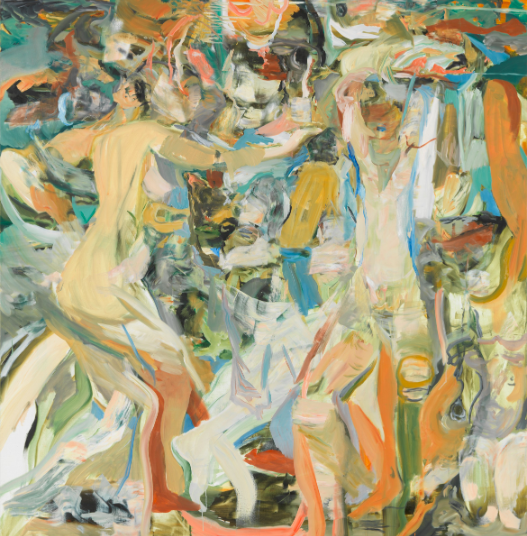
I analyzed Cecily Brown’s abstract painting “The River’s Tent Is Broken” using the new criticism lens, but then I also approached the painting in a more organic way. In order to show how new criticism could be improved upon by considering the natural connotation of the word “organic,” such as how organic matter often decomposes or grows as time progresses, I will address the interpretative possibilities of this painting when freed from the constraints of being a new critic.
- New critic analysis: The painter chose the symbolic colors blue and beige to allude to the unattainable and surreal connection between heaven and humans. The heavens being the blue, sky-like color and the humans being the abstract, beige shapes. The warm and cool tones of the painting juxtapose the tangible and intangible creations in our world. This painting uses the malleable medium of oil paints in order to tie all these themes together and illustrate the interconnectedness of man, nature, and the uncontrollable.
- Alternative, “organic” analysis: The painter, Brown, has created an oil painting in which the observer is bound to see a reflection of herself in the painting. Even though the shapes are abstract and ambiguous, our brains recognize the human shapes in the painting and immediately make personal, bodily connections. Therefore, the reader is automatically placed into the painting—going against the new critic theory of objectification. In addition, the painting is always changing because it embodies different stories depending on how you piece each part together. Abstract art is meant to change based on someone’s personal perspectives. Brown describes her work as taking from the classical expressionism but creating a “new aesthetic reality.” In this way, she conforms to T.S. Elliot’s idea that there is perhaps no individuality, but there are moments of reinventing the past in fresh, and timeless ways. Both artists embrace history and use it as a springboard to create new ideas that mesh with the past in order to create a dynamic present.
https://gagosian.com/artists/cecily-brown/
“The River’s Tent Is Broken”
Works Cited
Eliot, T. S. “Tradition and the Individual Talent by T. S. Eliot.” Poetry Foundation, Poetry Foundation, 13 Oct. 2009
Tyson, Lois. Critical Theory Today. 3rd ed., Routledge, 2015
 Creative Reading