
From our in-class discussions and supplemental readings, one concept that has interested me is the idea of intentional fallacy and the isolation of “the text itself” (Tyson 130). In Critical Theory Today, Lois Tyson provides the definition of intentional fallacy as the “mistaken belief that the author’s intention is the same as the text’s meaning” (130). New Criticism does not find value in authorial intention but looks at the text alone to determine and identify meaning. While there is value in isolating the text and looking at sentence structure, diction, etc., when determining a piece’s true meaning in the grand scheme, there is certainly some importance in knowing background about authorial intention or the author’s backstory.
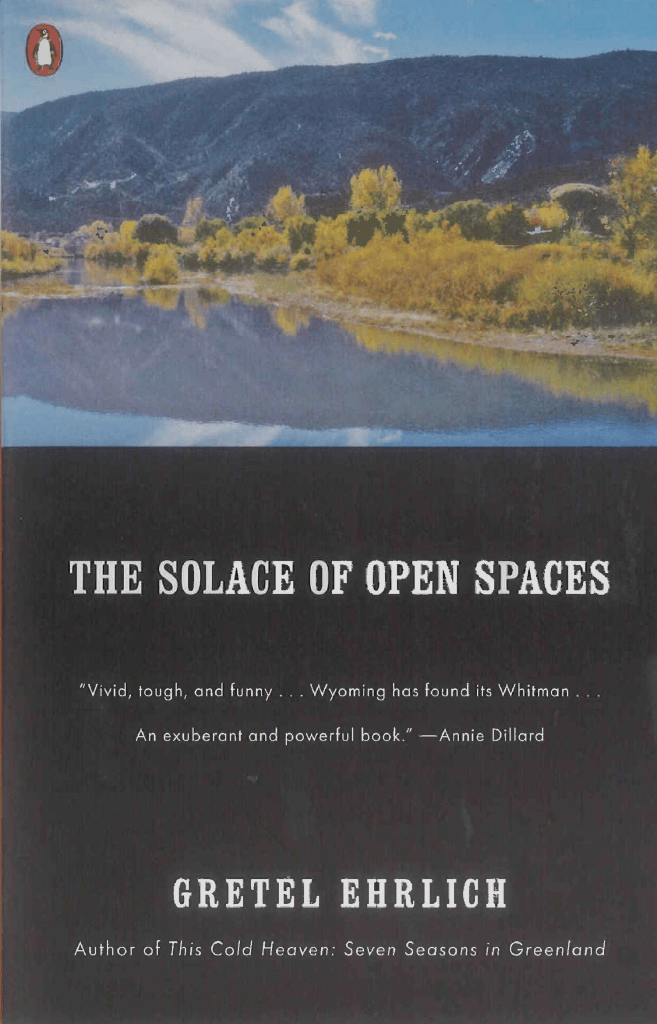
Thus, this sparked my interest to apply the concept of isolation and omission of author intention in New Criticism and see how an interpretation of Gretel Ehrlich’s The Solace of Open Spaces would differ depending on the lens it is seen through. Starting with the genre, the memoir has information about the author’s life included within the text, so New Criticism lends itself well for analysis as the outside information and authorial perspective is. However, The Solace of Open Spacesconflicts with New Criticism because of its lack of separation between the author and the author’s work. In a memoir, the two cannot be separated like poem and poet can be, as the reader is already aware that they are reading about some part of the author’s life. As readers, we are forced to engage with Gretel Ehrlich in relation to her work because the memoir is told directly from her perspective. Following the guidelines of New Criticism, we can look at The Solace of Open Spaceswith more of a focus on form, language, and the text itself, but the first person point of view introduces inherent authorial intention and rules out the isolation of author and text to some extent.
Specifically with applying New Criticism’s focus on isolation of the text and the text alone, The Solace of Open Spacesexists within its own space and the author’s world, but fails to reach outside of that and have a broader meaning. The entire purpose of the memoir cannot be assessed under New Criticism because it deals with author intention. We cannot interpret what Gretel might mean or want to convey by only talking about certain moments in her life—or including chapter titles such as “To Live in Two Worlds” or “Other Lives”—for that would be intentional fallacy. She focuses on her time as a ranch hand and on the landscape of Wyoming, but we cannot assess why that is important to others reading her memoir. We can only take Ehrlich’s life story at surface level with New Criticism, because any further analysis would have to include why she is telling her story in global context and why the world is listening, which is then affective fallacy.
Rhetorically, New Criticism allows the reader to see what devices Ehrlich puts into play, and the reader can appreciate her use of metaphor and simile as well as acknowledge her sentence structure and literary devices. Ehrlich’s use of metaphor paints a beautiful picture, where “dust rises like an evening gown behind his truck. It flies free for a moment, then returns, leisurely, to the habitual road—that bruised string which leads to and from my heart” (61), but the picture is all the reader can see with New Criticism, not the meaning behind it. I think applying New Criticism to a memoir is almost ironic: using a theory that does not look at the author or outside the text being used to analyze a piece that focuses specifically on authorial intentional and its implication with the outside world. Ultimately, I do not think using New Criticism to analyze a memoir is really fruitful because it dead-ends the reader into just looking at the text and not the surrounding environment, which is what truly gives purpose to the memoir as a genre.
Ehrlich, Gretel. The Solace of Open Spaces. New York, Penguin, 1985.
Tyson, Lois. Critical Theory Today. 3rded., Routledge, 2015.
 Creative Reading