
When considering the deconstructive method of literary criticism, I immediately imagine a never-ending food chain in which a string of organisms (both micro and macro-sized) evolve as life goes on. I think that deconstructive theory relates to an ever-growing ecosystem in the sense that language, meaning, and semantic codes are always tumbling forward, building off one another, and leading to new life or interpretation. In Tyson’s chapter on deconstruction, she uses terms such as undecidability, dissemination, and plurality to describe how language is always changing. I find it helpful how Tyson defines undecidability as meaning “that reader and text alike are inextricably bound within the language’s dissemination of meanings” (Tyson, 245). Dissemination is defined as the action of spreading, diffusing, or distributing, and I believe that a deconstructive outlook on language would view the text as constantly diffusing and expanding across the page and the world. In analyzing a text with a deconstructive lens, one must accept that “the ‘meaning’ of the text is really an indefinite, undecidable, plural, conflicting array of possible meanings and that the text, therefore, has no meaning” (Tyson, 245). Once we can accept that language is a messy, slippery form of expression, we can allow the text to unfold in an unforced and organic way. This natural progression of a text, or dissemination, can also be applied to one’s mental and spiritual state. For example, Tyson writes that “our mental life consists not of concepts — not of solid, stable meanings — but a fleeting, continually changing play of signifiers” (Tyson, 238). Moreover, I am interested in how a deconstructive lens can be applied to both literature and a state of mind, and how this affects the structural unfolding of a text. Also, I want to explore texts that use deconstruction, rather than a formal and “meaningful” structure, to celebrate words and breath life into the beautiful, ambiguous mess of linguistics.
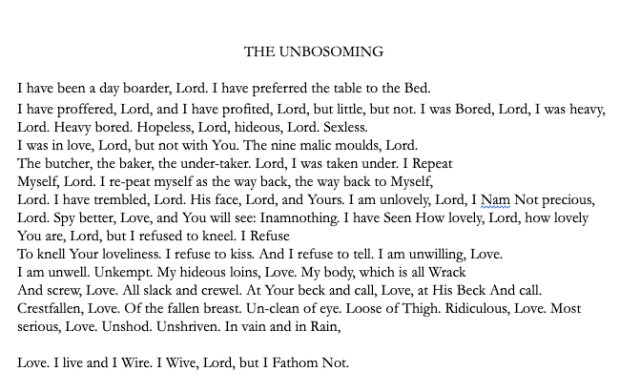
Roland Barthes writes in her essay “From Work to Text” that “the work is a fragment of a substance” (Barthes, 156). This ambiguous and abstract concept works so well to describe the deconstructive theory. Each word is a fragment of an essence, and this essence is neither absolute or tangible. Therefore, language is simply an organism that has feasted on the previous organism to gain depth and movement (going back to my food chain analogy). A work of art does not have to have a concrete meaning. This is especially present in Olena Kalytiak Davis’ poem “The Unbosoming.” Davis creates a long, associative string of nonsensical words that all recall auditory connections with previous words. Her poem is highly musical and contains so much consonance and assonance that the language simple takes over any possible meaning. I would argue that her poem completely deconstructs language. Her use of sonic wordplay propels the poem forward. Her reliance on language’s instability also highlights the tension between language and expected meaning. Deconstruction aims to sustain tension by leaving the text unresolved, and Davis defers inherent meaning by stringing together impressionistic and musical words. The poem unfolds like a stream-of-consciousness that is free from any critical or structural judgment. The words and images work as associative sequences that debunk the poet’s illusion of control over the poem. She truly embraces the messy and decentralizing nature of deconstructionism by creating “nonsense” words.
Overall, her poem would be celebrated by deconstruction critics because they would argue that her nonsensical diction and lack of narrative control is a testament to literature’s continuous journey towards nothingness. Davis writes: “Lord, I was taken under. I Repeat /Myself, Lord. I re-peat myself as the way back, the way back to Myself” (5-6). She is taken under by the power of language. The limits of language and self-expression are materialized by her poem. The narrator swallows sounds and images as if they have agency over us as if they will keep moving regardless of whether humans find meaning in them. After applying deconstructionism to “The Unbosoming” I understand how existentialists are constantly questioning whether there is a fixed existence. In reading Davis’ poem, which is a great manifestation of deconstructionist thinking, I was able to forget about authorial intention, structural form, and thematic meaning to simply follow the words and they grow and change.
Works Cited
Barthes, Roland. “From Work to Text.” Image Music Text. Translated by Stephan Heath. Fontana Press, 1977.
Davis, Olena Kalytiak “The Unbosoming”
Tyson, Lois. Critical Theory Today. 3rd ed., Routledge, 2015
 Creative Reading