
 Finally, the reader. After working our way through New Criticism, structuralism, and the poststructuralist critical theory of deconstruction, we finally take up a key subject in the literary experience heretofore forgotten by analysis of “the text itself”: the reader. As we saw, in a variety of ways, all three previous theories and methods of literary interpretation–from Brooks to Barthes to Derrida–focus so thoroughly on the text as object and linguistic construct that the reader (and also the author, another kind of reader, an embodied subject) seemed to matter not in the least. Even to the point of the critic’s own unimportance in the end: the text, after all, deconstructs itself. If there is no outside the text, there’s also no reader separate from the text, waiting to take it up.
We have thus far considered the apparent loss of the reader and the author for its limitations and constraints. With reader response theory, we perhaps have a way to solve the problem of too much text. Here we still have a text, but the reader’s role in reading, in relating to, and perhaps even creating, the text is given prominence. The reader returns.
Tyson does good work in the chapter summarizing 5 different kinds or categories of reader response theory that are out there, or were out there at an earlier point in the study of English (roughly from the 1970s forward), and might be of use to you as you develop your ideas for a project and the most effective methods of interpretation you would bring to it.
- Transactional theory: Rosenblatt; the reader creates the “poem” out of the text.
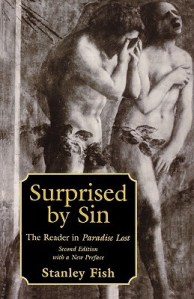
- Affective Stylistics: a good example, Stanley Fish’s Surprised by Sin, his argument for “the reader in Paradise Lost.”
- Subjective reader response theory: the readers response are the text–about as far from New Criticism as one could get.
- Psychological reader response: the readers interpretations are based in their psychology (defenses, fantasies, etc.)
- Social reader response theory: Fish returns, focused here on the idea of an “interpretive community,” the ways that we all read based on assumptions given or expected by the institutions within which we work, read, think.
I’d like to give some further thought to Stanley Fish. We can apply and combine the two approaches he is known for to a broader discussion of how we can read and write the sort of critical thinking and rhetorical knowing we do in English, and will be developing throughout the seminar. In other words: argumentation, the work we do (read, research, write, revise) to put forth a “thesis.”
What is a thesis? It is a name for a dynamic structuring of an argument that has a very basic core, whether that argument is 2 pages or 200 pages. Discovering a good argument (the word I tend to use instead of “thesis”) is as simple (and as complex) as asking the question: what’s the difference if we understand things this way instead of that way, if we rethink the topic, or reread the text in a different way? In other words, an argument is a re-sponse, re-lating and re-vising what is known with what is new, thus developing new ideas by re-thinking existing ones. This is what Kenneth Burke has in mind with the parable of the parlor, and why Burke argues that all thinking, by which he means therefore all rhetoric, is by nature dramatic–or what he called dramatism. Here is a basic dramatic structure for argumentation we will be using and practicing throughout the semester gets at the dynamics of response:
1. Context/Topic/Given/Premise—what’s already known: the conventional view
2. Problem or Question or Challenge to conventional view
3. Response—how the author will resolve the issue or answer the question
or in a variation of this structure (The Craft of Research refers to this as the “elevator speech” for any research project):
I am working on X [Topic, Author, Context]
To learn more about Y [a particular Problem, Question, Issue raised with regard to the topic]
So that my readers can better understand Z [What’s at stake, what’s the difference when we resolve the issue or question, and thus rethink X and understand it differently]
I would call this very basic structure and its variations a kind of Affective Stylistics that our interpretive community (in this department, English majors and English professors) expects to see and hear in an argument. The structure signals what’s at stake in an argument or critical reading. Why do we expect this “stake”? Because we know that this is an effective way to move our readers into and through our argument toward a level of persuasion and understanding we, as writers, want them to reach. It helps the reader understand why our thinking (and by hopeful extension, their thinking) matters, why they should care.
We can think of this combination of rhetorical knowledge and critical reading we bring to our writing in English as “effective stylistics.” We pay attention to the rhetorical matters of our style and syntax and organization not just because our interpretative community (faculty, editors, other readers in the field) expects this from us, but because we can also use this knowledge to move our readers.
Like Milton with Satan in Paradise Lost. To speak metonymically: We can surprise our readers out of the syntax of their conventional views and suggest ways to rewrite and rethink our sentences.
Reader, what would you do with reader response theory in your critical reading and writing? We will continue to think about various projects and the critical theories that best illuminate their problems and issues and the questions we want to pursue. Reader response theory is yet another. But I am also suggesting that whenever we think about and work on our own critical writing, reflect on its effects and think about our audience of readers, we are inevitably engaging in some version of reader response.
 Creative Reading