My further reading this week focused on Marxism, specifically the concept of commodification and how this relates to literature and media. Lois Tyson writes in her book Critical Theory Today that “For Marxism, a commodity’s value lies not in what it can do (use value) but in the money or other commodities for which it can be traded (exchange value) or for the social status it confers on its owner (sign-exchange value)” (59). Tyson defines commodification as “the act of relating to objects or persons in terms of their exchange value or sign-exchange value” (60). Literature is commodified when it is reprinted numerous times and sold. Stories are commodified when they are turned into easy-to-sell forms of media, such as the multi-billion-dollar movies made by the Disney company. Disney is one of the largest media companies in the world, worth (at the time of my writing) 132.75 billion US dollars. They have bought so many media franchises that they are in competition with themselves and have essentially created their own superstructure. A superstructure is the dominant cultural and societal institutions that result from a society’s economy. The dominant narrative in children’s media, both in movies, TV shows, and games, is largely controlled by Disney. Disney capitalizes off these stories through their amusement parks, through toys, clothes, music, and even healthcare products. But what they really sell is, essentially, stories.
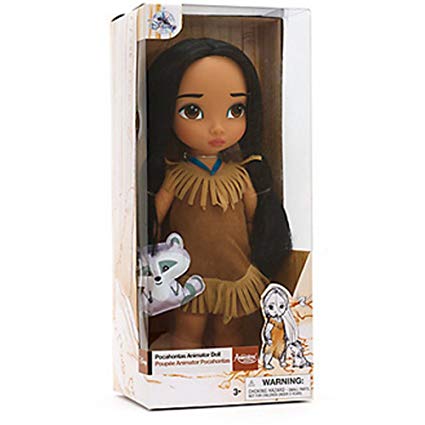
Most of the popular stories that have become their most famous and best-earning movies are those taken from popular literature and commodified, that is, turned into a product which has the purpose of making money and furthering Disney’s reputation. Sleeping Beauty, Snow White, and even the more recent The Princess and the Frog are based on fictional retellings of fairytales. However, not all Disney movies come from fairytales. The plot of The Lion King is largely based on Shakespeare’s Hamlet. Their animated film Pocahontas, however, is a retelling of a historical event—one that makes drastic mistakes in their narrative and commodifies a story of oppression into a family-friendly movie designed for capital gain. When companies like Disney and Universal own stories, they own control over dominant narratives. They hold the power to write history out of existence in popular knowledge.
According to Smithsonian, an institution which tells more accurately researched stories of history, Pocahontas was born Matoaka. Unlike in Disney’s film, she was not an eighteen-year-old who fell in love with the dashing John Smith after saving him from death by her father and lived happily ever after. She was the Great Powhatan’s daughter, who was captured by settlers, married John Rolfe and was paraded around Europe as an example of a “good” Native American until her untimely death at 21. Her story is a sad one, of a talented young translator’s death at the hands of a colonizing society. Disney’s retelling romanticizes her story for capital gain in an inauthentic and disrespectful fashion.
When the authenticity of Pocahontas’s story is damaged, the historical aspect of the story is lost in its reproduction. Walter Benjamin says in The Work of Art in the Age of Mechanical Reproduction that “The authenticity of a thing is the essence of all that is transmissible from its beginning, ranging from its substantive duration to its testimony to the history which it has experienced. Since the historical testimony rests on the authenticity, the former, too, is jeopardized by reproduction when substantive duration ceases to matter. And what is really jeopardized when the historical testimony is affected is the authority of the object” (Walter Benjamin 2).
The prominent idea of Pocahontas in mainstream media, because of Disney’s commodification of her story, is historically inaccurate. The reason this idea still persists despite its inaccuracy is because of Disney’s status as a superstructure. A Marxist critic believes that companies who hold financial power control the knowledge that we learn through media, and this explains why Pocahontas herself—the real woman, not the Disney Princess—is so misunderstood today.
source: Google Images
Works Cited
Tyson, Lois. Critical Theory Today: a User-Friendly Guide. Routledge, Taylor & Francis Group, 2015.
Mansky, Jackie. The True Story of Pocahontas. Smithsonian.com, March 23, 2017.
Benjamin, Walter. The Work of Art in the Age of Mechanical Reproduction. Schocken/Random House, 1998.
 Creative Reading