The Proposal: moving from particle to wave to field

Proposal: Guidelines

The real-world, academic model for the SCE you will complete (in your senior year) is a 25-30 page essay that we scholars publish in journals, books, and other venues, based on extensive research (an Annotated Bibliography due in the fall of your senior year) and substantial drafting and revision (the essay composed in the spring of your senior year). You have likely encountered and started to work on initial ideas in other English courses that could serve as the foundation for the SCE. But you probably don’t know it yet.

So, how do we work toward that substantial project, explore a direction before we know where we are going? There are various models scholars use to explore and develop their initial thinking/reading/writing on the way to more substantial, publishable scholarship: sometimes they’ll take the form of a conference presentation, other times a proposal for a grant or fellowship.

For this assignment, you’ll be writing a substantial proposal for future research. At 1750 words or so (inclusive of abstract), it will be on the longer end for SCE proposals in the English department, but this length is common to professional research proposals and as such will give you the space to fully articulate your research findings and your claims in relation to them.

Guidelines:
1500 words + 250 word abstract. Your project proposal should begin with a re-revised abstract summarizing your proposed project. Remember, that proposed project is essentially an academic article, examples of which you’ve been reading all semester. The body of your proposal should:

  • describe the project, explaining the topic and the significance of the argument;
  • place the work in the context of your field (methodological, geographical, and period-based as applicable);
  • indicate how the project would contribute to that field;
  • be clear about the critical theory and methodology informing your argument; and
  • make sure to situate your work in relation to others. You may use *revised* portions of your literature review to do this.

For some further guidance on an Academic Proposal, consult this resource from the University of Toronto.

Proposal: Brainstorming–Particle/Wave/Field

For further development and complication of your project’s argument as it stands now, use this heuristic (in classical rhetoric: a model or structure to generate or organize thinking for an essay, argument, project, a device for invention) known as the particle/wave/field heuristic. I summarize it below by way of the rhetoric book Form and Surprise in Composition:   Writing and Thinking Across the Curriculum by John Bean and John Ramage [they take the heuristic from the Young, Becker and Pike’s Rhetoric: Discovery and Change]. They suggest it as a method that helps develop an argument on a given topic by enabling the writer to switch perspective systematically. 

First, take your topic X  and view it as a static, unchanging entity (particle): note its distinguishing features, characteristics; consider how this entity differs from other similar things. You will know some of these details and characteristics from your research–how other critics and scholars have defined your topic in the past.

Second, view the same topic as a dynamic changing process (wave): note how it acts and changes through time, grows, develops, decays. Think of this as where your Y enters the topic: issues, questions, problems that you might pose, wanting to learn more about the topic, recognizing (from your research and review) that there are some gaps, there is more to know or do with this topic.

Third, view the topic as a Field, as related to things around it and part of a system, network or ecological environment. What depends on X? What does X depend on? What would happen if X doesn’t exist? Who loves (hates) X? What communities (categories) does X belong to? What is X’s function in a larger system? This is a way to identify critical and theoretical implications for your argument–the larger field and conversation that your study participates in, relates to (and lots of other “reverbs”), potentially revises, but also (this is what is complicated about “field”) is potentially revised by.  This is your stake, your “So What.”

Critical Practice: Literature Review

The Literature Review

A “literature review” is an extended analysis of the extant critical discussion surrounding a topic in which you are interested. Often, this topic takes the form “subject in author’s text”: “Parentheses in Walt Whitman’s Leaves of Grass,” “Cannibalism in David Mitchell’s Cloud Atlas,” “Queer desire in Toni Morrison’s Sula.” Any critical analysis of a text—or as Kenneth Burke suggests, any critical thinking about anything—relates new ideas to what’s known, responds to questions or problems, which are themselves in response to what is given. The literature review provides context for the new and the known. It is you listening attentively in Burke’s parlor before you put in your oar.

In our studies this semester, we have seen literature reviews sometimes in the introduction, used to set up the argument before the author presents evidence in the body; we have also seen reviews emerge in the body of an article, used to advance evidence and borrow (and/or distinguish) previous critical readings or theoretical insights. Versions of this component of scholarly composition can thus be found in most of the articles you have read for this class this semester. Going back through the readings and studying these moments, normally towards the beginning of a given article, will be very helpful.

Assignment Guidelines: In approximately 2000 words, review 8-10 critical sources on/around/adjacent to your topic. This might sound like a ton, but do not despair! You do not have to (and indeed, shouldn’t) write an equal amount on all sources. Instead, you should focus on outlining the conversation surrounding your topic in broad strokes: which sources seem to be in agreement? Where is there disagreement? Where are there gaps (or “lacunae,” an academic commonplace) or limitations in the research, and why do you think this is the case? (This is where the review sets the stage for your argument in progress: how you will fill those gaps and respond to those limitations). Which sources deserve lengthier explanation and response, and which can attach to these more major ones as footnotes or asides? Most importantly, what kind of narrative do your sources build: what kind of story do they tell about how this author/text/topic/etc. has been treated?

At the top of your review, provide the latest and most refined version of your abstract (this will take the place of your introduction and provide context for what is motivating this critical review of the literature). At the bottom of the review, provide a works cited list of the secondary sources you are reviewing.

For further guidance on the Literature Review, consult this resource from the University of Toronto. Also, revisit the various critical articles we read this semester and observe how those critics engaged in the rhetoric and poetics of the literature review.

Class Workshop:

Each member of the group will do the following to practice and probe the research you are conducting and reviewing.

  1. Critic: Update your research and literature review
    1. Present the latest version of your elevator pitch.
    2. Select one of your sources and present an oral summary of its argument (think abstract).
    3. Identify the uses and/or limitations of this source: Will it deserve lengthier explanation in your review or briefer discussion, perhaps part of a footnote? Are there gaps in the source you could/should fill in?
    4. Compare this source to a few other sources you have found: what are the points of agreement or disagreement you will discuss in your review of the critical conversation?
  2. Group: Provide feedback on the quality of the source + suggestions for further research.
    1. Does it seem credible and substantial for the project? What else might the critic do in reviewing this source?
    2. What else might the critic explore as they continue to research and finalize the literature review? What do you need to understand better that the critic’s research could address?
    3. Research tips: where might the critic find additional sources?

Getting Concrete with your Abstract: messy metonymy

My messy but productive path toward an abstract that became A Liberal Education in Late Emerson: Readings in the Rhetoric of Mind (2019)

X Y Z
Emerson/James/Whitman Emerson’s rhetoric (late work) Emerson/liberal education
Emerson’s rhetoric Emerson/liberal edu


Emerson/James
Emerson/liberal edu Emerson’s rhetoric Emerson/James
Emerson/liberal (and transformation) Emerson/James Emerson’s rhetoric
Emerson/James Emerson (and James)/liberal edu Emerson’s rhetoric
Emerson’s rhetoric [5/21/17] Emerson/James/Whitman/ Emerson/liberal

[5/17]I am working on Emerson’s rhetoric of metonymy [the late rhetorical emerson] to learn more about Emerson’s rhetorical relation to Whitman/James/Eliot so that my readers can better understand/care about Emerson’s engagement with liberal education.

Abstract (from publishers website):

Recent scholarship has inspired growing interest in the later work of Ralph Waldo Emerson (1803-1882) and a recognition that the conventional view of an aging Emerson, distant from public matters and limited by declining mental powers, needs rethinking. Sean Meehan’s book reclaims three important but critically neglected aspects of the late Emerson’s “mind”: first, his engagement with rhetoric, conceived as the organizing power of mind and, unconventionally, characterized by the trope “metonymy”; second, his public engagement with the ideals of liberal education and debates in higher education reform early in the period (1860-1910) that saw the emergence of the modern university; and third, his intellectual relation to significant figures from this age of educational transformation: Walt Whitman, William James, Harvard president Charles W. Eliot, and W. E. B. Du Bois, Harvard’s first African American PhD. Meehan argues that the late Emerson educates through the “rhetorical liberal arts,” and he thereby rethinks Emerson’s influence as rhetorical lessons in the traditional pedagogy and classical curriculum of the liberal arts college. Emerson’s rhetoric of mind informs and complicates these lessons since the classical ideal of a general education in the common bonds of knowledge counters the emerging American university and its specialization of thought within isolated departments.


Marxist Criticism: more matter, less art

Atget_-_Avenue_des_Gobelins
Atget (1927)

Marxist criticism is arguably the most politically and socially engaged of the various critical theories we have explored. As Tyson describes it, Marxist criticism has an agenda: “If  a work criticizes or invites us to criticize oppressive socioeconomic forces, then it may be said to have a Marxist agenda.” But the name “Marx,” and certainly the political legacy of Marxism, evoke various abstracted images that will strike many as problematic and at best irrelevant for English majors. What do we do?

Forget the abstractions and think about the materials. And in the process, we can think more about the ideologies (another keyword in Marxist theory) that are at work in the texts we interpret, and also at work in our interpretations.

In focusing on class and the socioeconomic forces that inform our beliefs, politics, culture, and society, Marxism extends the discussion of identity we began with African American criticism and continued with critical theories of gender and sexuality. Class and economics are another marker and shaper of identity. And as Marxists would argue, class is often the least recognized determinant of identity due to the often hidden (occluded) powers of capitalist ideology.

I have borrowed elements of Marxist literary and cultural criticism second hand, from the German critic Walter Benjamin. We will be reading his famous essay “The Work of Art in the Age of Mechanical Reproduction” from 1936. I studied and applied Benjamin to my doctoral dissertation, since he provides insights on rethinking art from the perspective of photography. That’s what I was interested in doing with 19th c American autobiography, a study that eventually became my first book: Mediating American Autobiography: Photography in Emerson, Thoreau, Douglass, and Whitman.

The key insight from Benjamin, and in my admittedly otherwise limited view, a key to understanding the uses of Marxist criticism, is the focus on materiality. We have cultural works and texts–all the things you are thinking about for your projects, or that you have been studying and reading. Those works and texts, though they come to us (usually) as finished products, in fact those products are abstracted from the concrete social and economic contexts in which they were produced. Marxism literary criticism trains its eye on rethinking cultural works by way of their material conditions. If we want to think more about the material conditions of the works we are studying, reading, writing, then Marxist theory might be of use. And if we want to think about what Benjamin calls the “politics of art,” this critical theory is very relevant.

One useful distinction he makes, thinking about photography as a technology of reproduction that undermines (and thus politicizes) traditional art and its aura: exhibition value displaces cult value. Consider this image from the photographer Atget that Benjamin has in mind, and contrast with something like a Van Gogh. What’s the difference, and how might that difference be viewed in terms of politics?

Applications.

As an application, in addition to the Benjamin essay, I think of the Robert Pinsky poem “Shirt.”  [Here is Pinsky reading it in a video from the New Yorker.] We can read this text from any and all of the critical perspectives studied thus far: New Criticism/Formalism, Structuralism, Deconstruction, Reader Response, Psychoanalytic, New Historicism, Critical Race, Postcolonial, Gender/Sexuality.

What does Marxist critical theory help us to see and do with this poem? Would you say that this poem is particularly relevant for a Marxist reading? And if so, are there texts that are less relevant? How might concepts and questions from Marxist criticism be of use to you in the development of your seminar project?

For another example that foregrounds, or perhaps re-envisions, the materiality of reading and literacy, consider this scene from the recent movie The Post. We are reminded of the labor that goes into writing, the production and the process of getting words into print.

Rhetorical Materials.

If we focus more materially and deliberately on our own ideologies (call them also “theories” and “critical perspectives” and “interpretations”), we will strengthen our argumentation. Marxist criticism, in its concern with “false consciousness” and the belief that every idea potentially masks or hides its social and political conditions, can help us think more about our rhetoric: credibility, validity, counterargument.

With our seminar projects, we should address the credibility of our critical sources. What makes a source credible? [In the older rhetorical terms used by Aristotle, this is the appeal to ethos]

We need to think about the validity of our reasoning, specifically the warrants linking our reasons to our claim [This is a matter of logos, the presentation of our evidence and logic. For further discussion, see chapter 11 in The Craft of Research]

We must also consider the potential weaknesses in our own argument and the potential strengths in perspectives other than our own. In other words, take up a counterargument. [Related to logos, this is also an appeal to pathos]


Feminism, Gender, and Sexuality: bodies that matter

Where, when, how, why, and in what forms do we experience gender and sexuality in life? In literature and culture–in other words, as readers/writers/scholars in English? Much as we discussed recently with postcolonial criticism and its overlapping interest in issues of race, I propose that we interrogate how various concepts and keywords from feminist criticism, gender and sexuality studies, and queer theory speak to our experiences with literature and culture.

For a possible application this week, I turn our attention to the writer Shelley Jackson. Her work brings to mind several concepts and issues that intersect with the reading this week, perhaps most prominently the idea of “ecriture feminine” from Cixous and French feminism: a writing that is “fluidly organized and freely associative” and and “resists partriarchal modes of thinking and writing” (Tyson 96).

Jackson engages with this and other critical theories while also performing it in her hypertext novel Patchwork Girl, her imaginative rewriting and extension of Mary Shelley’s Frankenstein. Unfortunately, you need special software to “run” this computer-based novel (and my copy is out of date). To get a sense of how hypertext reads, take a look at Jackson’s essay/memoir “My Body”–this one you can read since it is on the web. And here is Jackson writing about hypertext and Patchwork Girl, in a critical essay “Stitch Bitch.” Notice how she describes hypertext as a “feminine” writing:

Bad writing is all flesh, and dirty flesh at that: clogged with a build-up of clutter and crud, knick-knacks and fripperies encrusted on every surface, a kind of gluey scum gathering in the chinks. Hypertext is everything that for centuries has been damned by its association with the feminine (which has also, by the way, been damned by its association with it, in a bizarre mutual proof without any fixed term). It’s dispersed, languorous, flaunting its charms all over the courtyard. Like flaccid beauties in a harem, you might say, if you wanted to inspire a rigorous distaste for it. Hypertext then, is what literature has edited out: the feminine. (That is not to say that only women can produce it. Women have no more natural gift for the feminine than men do.)

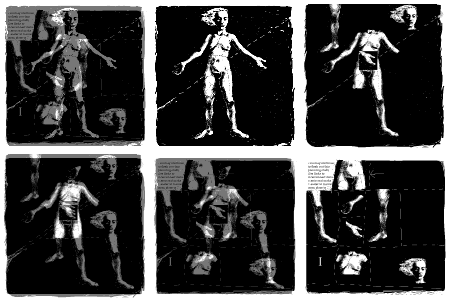
Another text by Shelley Jackson extends her interest in the intersectionality of writing and gender and the body in some remarkably vivid ways. Check out “Skin: A Mortal Work of Art,” a text published on the bodies of 2095 volunteers.

Jackson’s work as a contemporary writer and performance artist might be something to pursue for further research, perhaps an SCE project. But even if we don’t want to study a contemporary writer thoroughly engaged in the issues and actual texts of feminist and gender theory (she quotes Derrida, Cixous, and others in Patchwork Girl), how might concepts from those theories apply to other texts and authors elsewhere in our study of English, even works that might not seem to be particularly relevant for thinking about gender and sexuality.  As we discussed last week, at the very least, we can seek out our necessary “counter-discourse.” And in the process, we might discover that a work in question is more gendered or queer than we first assumed.

For example, we could return to Emerson’s “American Scholar” and give more thought to his gendering of the scholar, ‘Man Thinking.” What are the implications? What questions and problems regarding this passage do the critical theories of gender and sexuality help us identify? Are there gendered or queer or, as Halberstam puts it, “trans*” readings of the passage we could or should consider?

It is one of those fables, which, out of an unknown antiquity, convey an unlooked-for wisdom, that the gods, in the beginning, divided Man into men, that he might be more helpful to himself; just as the hand was divided into fingers, the better to answer its end.

The old fable covers a doctrine ever new and sublime; that there is One Man, — present to all particular men only partially, or through one faculty; and that you must take the whole society to find the whole man. Man is not a farmer, or a professor, or an engineer, but he is all. Man is priest, and scholar, and statesman, and producer, and soldier. In the divided or social state, these functions are parcelled out to individuals, each of whom aims to do his stint of the joint work, whilst each other performs his. The fable implies, that the individual, to possess himself, must sometimes return from his own labor to embrace all the other laborers. But unfortunately, this original unit, this fountain of power, has been so distributed to multitudes, has been so minutely subdivided and peddled out, that it is spilled into drops, and cannot be gathered. The state of society is one in which the members have suffered amputation from the trunk, and strut about so many walking monsters, — a good finger, a neck, a stomach, an elbow, but never a man.

Man is thus metamorphosed into a thing, into many things. The planter, who is Man sent out into the field to gather food, is seldom cheered by any idea of the true dignity of his ministry. He sees his bushel and his cart, and nothing beyond, and sinks into the farmer, instead of Man on the farm. The tradesman scarcely ever gives an ideal worth to his work, but is ridden by the routine of his craft, and the soul is subject to dollars. The priest becomes a form; the attorney, a statute-book; the mechanic, a machine; the sailor, a rope of a ship.

In this distribution of functions, the scholar is the delegated intellect. In the right state, he is, Man Thinking. In the degenerate state, when the victim of society, he tends to become a mere thinker, or, still worse, the parrot of other men’s thinking.

In this view of him, as Man Thinking, the theory of his office is contained. Him nature solicits with all her placid, all her monitory pictures; him the past instructs; him the future invites. Is not, indeed, every man a student, and do not all things exist for the student’s behoof? And, finally, is not the true scholar the only true master? But the old oracle said, `All things have two handles: beware of the wrong one.’ In life, too often, the scholar errs with mankind and forfeits his privilege. Let us see him in his school, and consider him in reference to the main influences he receives.


My subtitle echoes the title of an important theoretical work in gender and sexuality studies by the philosopher Judith Butler, Bodies that Matter: On the Discursive Limits of “Sex.” 

Tyson refers to some cultures that do not have a male/female gender binary. Here is discussion of a photographer exploring that with regard to Tahitian culture.


Postcolonial Criticism: double consciousness and slow violence

We observed “double consciousness,” one of the keywords of African American criticism and theory, at work in Frederick Douglass’s Narrative. It’s a phrase that takes us back to our first reading and Spivak’s notion of the double bind. You might recall at that time that I heard echoes there of the phrase “double consciousness” coined by Emerson (thinking of Plato), but also the version made more famous later by the African American essayist W. E. B. Du Bois (in Souls of Black Folk, 1903).

There are lots of new keywords and concepts we encounter in postcolonial criticism, but also much that relates to issues and ideas from African American and critical race theory. One way to explore them further would be to continue to listen and look for issues of “double consciousness” in postcolonial concepts such as the following:

  • mimicry
  • unhomeliness/unhomed
  • diaspora
  • othering
  • hybridity
  • intersectionality
  • margin/center
  • canonical counter-discourse

Indeed, the very disputes that are ongoing within postcolonial critical discourse, recounted by Tyson (is it still relevant? has globalization put an end to postcolonialism?) speak to another kind of double consciousness. On the one hand it seems to be a thing of the past, no longer relevant; on the other hand, as Rob Nixon argues (discussed by Tyson), postcolonial criticism can be very relevant to current matters such as environmentalism. And as we learn from Toni Morrison and her conception of “whiteness” and the “Africanist presence” in American literature, these implications of double consciousness are in the texts we read, even when we don’t (initially) see them.

I would take it a step further, remembering the rhetorical principle from Kenneth Burke: every way of seeing is a way of not seeing. In order to make a persuasive and informative argument, regardless of our texts, we need to consider and explore the double consciousness of our argument. We need to engage in counter-discourse with our own position, and risk the unhomeliness of our ideas. What other perspectives might I consider, even if I don’t think (initially) they are relevant? What changes in my perspective when I do so? A more persuasive argument, in the language of postcolonial theory, is rhetorically hybrid and intersectional.

For those interested in Rob Nixon’s scholarship, combining environmental literary theory and criticism with postcolonial theory, check out his 2011 book Slow Violence and the Environmentalism of the Poor. Our library has a copy. It’s quite stunning.

And for a recent application of perspectives raised by both critical race and postcolonial theory, consider this NY Times discussion by Jenna Wortham, “White Filmmakers Addressing (Or Avoiding) Whiteness Onscreen.


African American Criticism: Within the Circle

African American literature has been around a long time. The critical study of African American literature, or African American criticism, emerged more recently, shaped in part by social and political changes, and guided in part by critical theories such as deconstruction and new historicism. If African American literature was largely excluded from American literary history until the twentieth century, we can now say (as budding new historicists) that the exclusion was a discursive formation. It was not a matter of objective history, but the inherent subjectivity of history as discourse. Knowledge is power, and the powers that be determine what counts as knowledge.

Frederick Douglass knew a thing or two about this overlap of power and knowledge. Here is the beginnings of an important text in the African American literary tradition, Frederick Douglass’ first autobiography, the Narrative of the Life of Frederick Douglass, an American Slave: Written by Himself (1845). The frontispiece and the title page.

First, review: How might we read this text, or begin to read its beginnings, informed by new historicism and cultural criticism? [What would Foucault say?] Or further back: Structuralism and Deconstruction? Reader Response? Psychoanalytic? New Criticism?

Next, interrogation: How can we read this text through the lenses of African American criticism and theory? What do we see that we might not have seen or considered previously? [What would Toni Morrison or Henry Louis Gates, Jr., say?] What are the complications that this text presents us with, and that these critical theories help us to address? As always, what are the uses and limits? To take up a complicated passage, there is this moment from the end of Doulgass’ second chapter.

 I did not, when a slave, understand the deep meaning of those rude and apparently incoherent songs. I was myself within the circle; so that I neither saw nor heard as those without might see and hear. They told a tale of woe which was then altogether beyond my feeble comprehension; they were tones loud, long, and deep; they breathed the prayer and complaint of souls boiling over with the bitterest anguish. Every tone was a testimony against slavery, and a prayer to God for deliverance from chains. The hearing of those wild notes always depressed my spirit, and filled me with ineffable sadness. I have frequently found myself in tears while hearing them. The mere recurrence to those songs, even now, afflicts me; and while I am writing these lines, an expression of feeling has already found its way down my cheek. To those songs I trace my first glimmering conception of the dehumanizing character of slavery. I can never get rid of that conception. Those songs still follow me, to deepen my hatred of slavery, and quicken my sympathies for my brethren in bonds. If any one wishes to be impressed with the soul-killing effects of slavery, let him go to Colonel Lloyd’s plantation, and, on allowance-day, place himself in the deep pine woods, and there let him, in silence, analyze the sounds that shall pass through the chambers of his soul,–and if he is not thus impressed, it will only be because “there is no flesh in his obdurate heart.”

I have often been utterly astonished, since I came to the north, to find persons who could speak of the singing, among slaves, as evidence of their contentment and happiness. It is impossible to conceive of a greater mistake. Slaves sing most when they are most unhappy. The songs of the slave represent the sorrows of his heart; and he is relieved by them, only as an aching heart is relieved by its tears. At least, such is my experience. I have often sung to drown my sorrow, but seldom to express my happiness. Crying for joy, and singing for joy, were alike uncommon to me while in the jaws of slavery. The singing of a man cast away upon a desolate island might be as appropriately considered as evidence of contentment and happiness, as the singing of a slave; the songs of the one and of the other are prompted by the same emotion.

Finally, some applied thinking: How might you apply aspects of this criticism to your studies, to your emerging seminar project? What if you are not focusing on a text by an African American author–what then? Consider borrowing theoretical insights from Toni Morrison and her argument (in Playing in the Dark: Whiteness and the Literary Imagination) for the Africanist presence in American literature by white authors.

New Historicism and Cultural Criticism: Reconstructing Contexts

In the first two weeks of our studies, New Criticism and variations of structuralism and deconstruction largely removed the author and the reader from our critical view. We had just the text. Over the last couple weeks we have slowly returned to the reader (reader response) and the author (psychoanalytic criticism). Now we turn, or perhaps return, to context. How do cultural and historical contexts of the texts we study, and of the people doing the studying, matter in literary interpretation and criticism?

We get a rich and complex exploration of that question in the critical example we are reading for Tuesday’s class, “The Classroom in the Canon: T. S. Eliot’s Modern English Literature Extension Course for Working People and The Sacred Wood.

Their scholarship and book in progress, The Teaching Archive, has its own archive of materials [linked]. This example gives us a way to do some further thinking about a point made by Tyson, identified as “self-positioning”: “the inevitability of personal bias makes it imperative that new historicists be as ware of and as forthright as possible about their own psychological and ideological positions relative to the material they analyze so that their readers can have some idea of the human ‘lens’ through which they are viewing the historical issues at hand” (275).

As Kenneth Burke puts it, “Every way of seeing is a way of not seeing.” I see this problem of “self-positioning” as both a useful insight with regard to new historicism and cultural studies, and one of its constraints or limits. Critics need to qualify their vision regarding the lenses they are using. That’s a good thing, and can strengthen the argumentation and persuasion, to the extend that we critics thereby engage our readers in the work we do. We can be more deliberate in the lenses we use. The potential limit is that in the end we need and want our readers to see what we see. We can’t qualify things beyond recognition. We can’t proclaim our own interpretation invalid because it is not free of bias. Or, we can’t do that and expect our readers to be persuaded of our reading. Which, in the end, is the goal. That’s my bias, I recognize: all critical reading and writing are thoroughly rhetorical. The aim is not certainty or objectivity. It is persuasive plausibility.

I think Buurma and Heffernan achieve this, a persuasively plausible argument for rewriting and revaluing the “received idea of the Eliotic canon” by way of reconstructing and recovering the pedagogical and collaborative contexts of his essays collected in The Sacred Wood. As part of their argument, they are thinking and positioning their own scholarship in relation to the archive of teaching.

Why am I persuaded? What am I not entirely seeing? Perspectives from new historicism can help me answer both questions, and that will enable me to strengthen my argument, even as it keeps me from providing final and certain answers.

As I look to the seminar projects (and elevator pitches) you have begun to entertain, I wonder what role history and culture have played thus far in your studies in English, and what you might do differently, or additionally, with a better grasp on these critical concepts from new historicism and cultural criticism. Are you interested in a new historical lens? What will that enable you to see? What will it keep you from seeing?

Psychoanalytic Criticism: Paging Dr. Freud!

Psychoanalytic literary theory and criticism is by no means limited to the insights and theories developed by Sigmund Freud, the father of psychoanalysis. As Lois Tyson demonstrates, a great deal comes after Freud and the classical psychoanalysis that he establishes in the early 20th century, and much of that challenges while also building upon Freud’s “discovery” of the unconscious: Jung, Lacan, French feminists such as Kristeva and others who build upon Lacan and psychoanalytic theory. It’s complex stuff, and even though I took an entire course in graduate school on psychoanalytic theory, much of it is beyond my limited powers of understanding.
But there is something fundamental to Freud and–I’m generalizing here–insightful about psychological approaches to literary interpretation that we might trace back to Freud. It is the notion, the recognition, that human consciousness, all we think and do and feel and speak, is fundamentally ironic. We can never exactly mean what we say, or say what we mean, because of the split between the conscious and the unconscious. As a result, life becomes something like a dream, and dreams become something like an alternative text of life. Such is the insight of Freud’s dream interpretation, established by his book The Interpretation of Dreams (1900). He takes this psychological concept of dream interpretation and extends it directly to literature in a 1908 essay  titled “The Relation of the Poet to Day-Dreaming” (also known as “Creative Writers and Day-Dreaming”). Dreams are phantasies, with symbolic meaning that relates to the real world, but in need of critical interpretation since the symbols (and images) are phantasmal–they mean differently than what they say or suggest. And by extension, Freud suggests, writers create phantasies in writing that work something like their dreams.

Here we see the great use of psychoanalytic theory for interpretation, or at least Freud’s version of it: every literary text is dream-like, phantasy, even those that are seemingly real. They are and they aren’t. That gives us something to interpret and critique. We can always page Dr. Freud for help. Sometimes it’s obvious (Victor’s freaky nightmare after he creates the “monster”); other times it’s more subtle and arguable (sometimes a cigar is just a cigar).

But this also suggests a limitation or constraint: every writer, and this would include us as creative writers and critics, is always subject to mis-interpretation. Every thing we write is somehow about us, familiar to issues in our lives; but at the very same time, the real source of our writing must remain unfamiliar. We can’t simply say what we mean.

This last point about the familiar being unsettled by the unfamiliar is an insight from another essay Freud writes where he further relates his theories to literary interpretation and language: “The Uncanny” (1919). For some notes and a summary of this concept, read here. Freud discovers through a study of language that the uncanny means something different than being surprised or frightened by the unfamiliar, but in fact is when the unfamiliar is revealed to be related to the familiar. The word in German for “uncanny” Freud shows means two exactly opposite things: heimlich (familiar, homely) and unhemilich.

Pretty ironic, isn’t it? As we have seen, since we began with New Criticism and worked through deconstruction, irony factors significantly into literature and many theories for understanding and interpreting literature. Given that, what do psychoanalytic theories of literature and interpretation enable us to do with the ironies of literature? Are irony and misinterpretation inescapable for literature and reading?  Can we read and write without psychological motivations and unconscious drives, without needing to page Dr. Freud?

Reader Response: Surprised by Syntax

Finally, the reader. After working our way through New Criticism, structuralism, and the poststructuralist critical theory of deconstruction, we finally take up a key subject in the literary experience heretofore forgotten by analysis of “the text itself”: the reader. As we saw, in a variety of ways, all three previous theories and methods of literary interpretation–from Brooks to Barthes to Derrida–focus so thoroughly on the text as object and linguistic construct that the reader (and also the author, another kind of reader, an embodied subject) seemed to matter not in the least. Even to the point of the critic’s own unimportance in the end: the text, after all, deconstructs itself. If there is no outside the text, there’s also no reader separate from the text, waiting to take it up.

We have thus far considered the apparent loss of the reader and the author for its limitations and constraints. With reader response theory, we perhaps have a way to solve the problem of too much text. Here we still have a text, but the reader’s role in reading, in relating to, and perhaps even creating, the text is given prominence. The reader returns.

Tyson does good work in the chapter summarizing 5 different kinds or categories of reader response theory that are out there, or were out there at an earlier point in the study of English (roughly from the 1970s forward), and might be of use to you as you develop your ideas for a project and the most effective methods of interpretation you would bring to it.

  1. Transactional theory: Rosenblatt; the reader creates the “poem” out of the text.
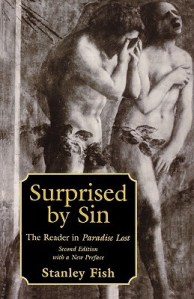
  2. Affective Stylistics: a good example, Stanley Fish’s Surprised by Sin, his argument for “the reader in Paradise Lost.”
  3. Subjective reader response theory: the readers response are the text–about as far from New Criticism as one could get.
  4. Psychological reader response: the readers interpretations are based in their psychology (defenses, fantasies, etc.)
  5. Social reader response theory: Fish returns, focused here on the idea of an “interpretive community,” the ways that we all read based on assumptions given or expected by the institutions within which we work, read, think.

I’d like to give some further thought to Stanley Fish. We can apply and combine the two approaches he is known for to a broader discussion of how we can read and write the sort of critical thinking and rhetorical knowing we do in English, and will be developing throughout the seminar. In other words: argumentation, the work we do (read, research, write, revise) to put forth a “thesis.”

What is a thesis? It is a name for a dynamic structuring of an argument that has a very basic core, whether that argument is 2 pages or 200 pages. Discovering a good argument (the word I tend to use instead of “thesis”) is as simple (and as complex) as asking the question: what’s the difference if we understand things this way instead of that way, if we rethink the topic, or reread the text in a different way? In other words, an argument is a re-sponse, re-lating and re-vising what is known with what is new, thus developing new ideas by re-thinking existing ones. This is what Kenneth Burke has in mind with the parable of the parlor, and why Burke argues that all thinking, by which he means therefore all rhetoric, is by nature dramatic–or what he called dramatism. Here is a basic dramatic structure  for argumentation we will be using and practicing throughout the semester gets at the dynamics of response:

1.     Context/Topic/Given/Premise—what’s already known: the conventional view

2.     Problem or Question or Challenge to conventional view

3.     Response—how the author will resolve the issue or answer the question 

or in a variation of this structure (The Craft of Research refers to this as the “elevator speech” for any research project):

I am working on X [Topic, Author, Context]

To learn more about Y [a particular Problem, Question, Issue raised with regard to the topic]

So that my readers can better understand Z [What’s at stake, what’s the difference when we resolve the issue or question, and thus rethink X and understand it differently]

I would call this very basic structure and its variations a kind of Affective Stylistics that our interpretive community (in this department, English majors and English professors) expects to see and hear in an argument. The structure signals what’s at stake in an argument or critical reading. Why do we expect this “stake”? Because we know that this is an effective way to move our readers into and through our argument toward a level of persuasion and understanding we, as writers, want them to reach. It helps the reader understand why our thinking (and by hopeful extension, their thinking) matters, why they should care.

We can think of this combination of rhetorical knowledge and critical reading we bring to our writing in English as “effective stylistics.” We pay attention to the rhetorical matters of our style and syntax and organization not just because our interpretative community (faculty, editors, other readers in the field) expects this from us, but because we can also use this knowledge to move our readers.

Like Milton with Satan in Paradise Lost. To speak metonymically: We can surprise our readers out of  the syntax of their conventional views and suggest ways to rewrite and rethink our sentences.

Reader, what would you do with reader response theory in your critical reading and writing? We will continue to think about various projects and the critical theories that best illuminate their problems and issues and the questions we want to pursue. Reader response theory is yet another. But I am also suggesting that whenever we think about and work on our own critical writing, reflect on its effects and think about our audience of readers, we are inevitably engaging in some version of reader response.

The Death of the Author and the Birth of the Text

That ominous phrase and concept, “the death of the author,” has long been attached to deconstruction, or deconstructive criticism. Deconstruction is a leading critical theory of a larger grouping of literary and critical theory that emerges in the 1960s and 1970s in Europe, and thrives in American academic institutions (mostly) in the 1980s and 90s. That larger grouping is known as “poststructuralism,” a phrase which in some ways overlaps with the term “postmodernism,” but not entirely.
“Poststructuralism” (as an umbrella term for theories like deconstruction) is useful for our purposes this week since the phrase reminds us that deconstructive criticism follows and replaces structuralism, but does so by way of relation. Both focus on an understanding of language and writing as the foundation of any text–not the author, not the reader, not the historical era in which that text was composed or published.

To some extent, we are still talking about “text without contexts,” as we encountered in our readings of the New Criticism. But structuralism and then deconstruction take things a step further. In New Criticism, we had an author’s work (Brooks consistently refers to Keats and Eliot to “the individual talent”), but we understood that what mattered was interpretation of the poem/poetry, not the poet. Now, with structuralism and deconstruction, that individual author and work disappear into the writing of the text. Now, the text is all context–or as Derrida, leading proponent of deconstruction famously  put it: “there is no outside the text.” We move, as Roland Barthes phrases it, “From Work to Text.”  We will read that essay for Thursday, from a collection (Image/Music/Text) that includes his essay “The Death of the Author.” Barthes is a useful guide for us this week since his earlier work such as “The World of Wrestling” (from Mythologies) is a good example of a structuralist interpretation.

As a way to distinguish structuralism from what comes after it, poststructuralism, I think it is particularly helpful to focus on the linguistic “structure” that both emphasize in understanding the birth of the text and the death of the literary work grounded in the authority of the author. Structuralism would have us think in metaphors and analogies of surface and depth, the structures we can see and the deep structure we can’t. Here are some relevant surface/deep structure relations:

structural linguistics:

parole (individual speech) / langue (the underlying language, grammar, syntactic structures

cultural (also called structural) anthropology: culture (individual practices or rituals) or myths (individual stories, mythemes) / underlying kinship rules or archetypal mythology across groups, cultures [Levi-Strauss: “incest is bad grammar”]

psychoanalytic theory: conscious/unconscious

Marxism: superstructure/substructure or base

New Criticism: Denotation/Connotation or Tension/Opposition/Paradox in the poem/organic wholeness underlying the poetry


Poststructuralist theory, most especially deconstruction, learns from the structuralist insights on language (Saussure is a key figure for both) and what is called semiotics (the science of signs, the understanding the a sign is comprised of something signified but also its signifier). But rather than believing, as strucutralism does, that the acts of signification are contained or closed off by the signified, deconstruction argues that one signifier suggests another signifier. The process of signification continues without end. Instead of a surface/depth metaphor where the signifier is grounded by the signified, deconstruction shifts attention to the metonymy of signifying: one sign leads to the next sign that is near it or in part related, which leads to the next sign, and so on. From the deconstructive perspective, there is no underlying deep structure in language that somehow stands apart from language. The very idea of a deep structure, and the very act of interpreting or perceiving a deep structure in anything, exists only in the thinking we do with language and signs.

deconstruction: sign–>sign–>sign / signification (but: signification is itself more signs)

mise en abyme: a phrase from French used by Derrida and others: “placed into the abyss.” Think of a mirror held up to a mirror–where does it stop? Or a play within a play (which also has a play within it, and so on). This is where “undecidability” comes into play.

In other words, from the perspective of deconstructive theory, there is no end to the signifying process, since there is no one or no thing outside the process of signification. (The sign tells us there is another sign ahead; but when we get up to that sign, we are still looking at a sign.) There is no “transcendental signified” that can stand apart from the language we use to think. According to deconstruction, traditional names for some transcendental signifieds used to (falsely) suggest a stable ground apart from the process of signification: Author, God, Nature, Being.

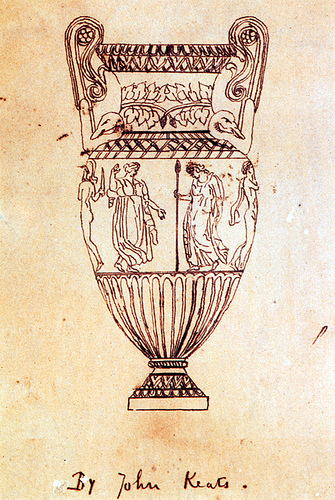
Last week we suggested that Brooks’ new critical perspective on Keats’s “Ode” is on to something valuable. The poem is contradictory, paradoxical, maybe even noisy–and close reading of the symbols and language help us to hear the noise more clearly. That makes it interesting to both the new critic and the deconstructionist. But Brooks in the end has to sweep the mess (all the stuff he can’t account for) under the rug, saying the paradox is resolved by Paradox (his transcendental signified). It’s circular (just as the statement made by the Urn: this poem is art because true art is poetic). Deconstruction calls out that circularity as a lie, but says it’s a lie that all texts, all poets and critics, can’t escape, due to the nature of language. Instead of sweeping the mess under the rug, deconstruction suggests that the rug is indistinguishable from the mess.

But does that mean we should stop caring about cleaning up the room, stop sweeping the floor since the rug in the end isn’t separate from the floor or the mess? And are we, in fact, separate from that mess? Doesn’t contemporary physics suggest that we–the stuff that really makes us–can’t be decidable or certain in the ways we used to think of nature (Descartes, Newton) before Einstein and Heisenberg? I fear that the metaphor of my analogy is slipping away from me into quantum physics, sliding into the abyme of my thinking of thinking, my language about the nature of language.

For some further reading and thinking about structuralist principles in the real world, for example the idea of “archetypes”:  The 7 Story Archetypes, suggesting that any story  or narrative (including film) can be read at a deep structural level.

And for more on Derrida and deconstruction, you can’t go wrong with YouTube.

To hear Robert Frost reading “Mending Wall” (the poem used as an example in the Deconstruction chapter). Consider what a structuralist reading of this poem would do compare to what a deconstructive reading would do.

Texts Without Contexts

Keats_urnIs there a text in this class? That’s a famous line (and title) from reader-response literary theory, coming later in the semester. For the first two weeks of our exploration of critical theory, the answer to that question is decidedly: “yes, there is only text in this class.” Beginning with the New Criticism, one of the oldest of the critical/literary theories we will study, and then continuing into structuralism and deconstruction, scholars and critical readers focus thoroughly and rigorously and entirely on texts. Although those texts are produced by authors who live in various historical contexts and bodies, and are read by readers who also live in various and different historical contexts and bodies, New Critics, structuralists, and deconstructionists will exclude those other contexts and focus on (a refrain) “the text itself.”

You and I, as English majors, are particularly familiar with this commitment to the text from New Criticism. Its primary strategy, still with us, is close reading. We have been trained to focus on what’s in front of us, the language and its complexities, recognizing that literary texts, and maybe any text at all, if they are worth our attention and interpretation, are highly connotative, not merely denotative. Such texts say what they mean, but they don’t necessarily mean what they say. That’s where the critic comes in.

As we make our way through the various critical theories and strategies, I will continually ask you to consider the uses and limits of each approach. Another phrasing I would use, borrowed from media and design studies: what are the affordances and constraints of the theory? What does it allow us to do and understand and see (theory comes from a Greek word related to vision)? What does it keep us from doing and seeing? This is where critical theory and rhetoric meet up. The rhetorician Kenneth Burke characterized rhetoric as the understanding that “every way of seeing is a way of not seeing.” I think Spivak has this in mind with her understanding of the “double bind.”

And so, with the New Criticism, close reading, close, careful, thoughtful attention to the text and the complexities that attend language and its symbolic uses (“language as symbolic action,” another phrase from Burke)–this legacy of close reading remains a rich and useful legacy of the tradition. We will continue it. Think, for a moment, about your encounters with close reading in the classroom, or in your scholarship. What have you done with this fundamental strategy of literary and textual interpretation? What did it enable you to do?

But also, think for a moment about being limited only to the text and its close reading. Have you had that experience as well? I am thinking of the student who brings into discussion of a text an idea not directly evident in the text, or maybe deliberately brought from outside the text. Something like: that image reminds me of X, where X might be something historical, or personal, or biographical. In the tradition of New Criticism, that student’s contribution would be knocked down by the teacher as “heretical” because it is external to the text. These are the terms used in the critical tradition: “The Intentional Fallacy,” “The Heresy of Paraphrase,” and “the extinction of personality” (Eliot).

Are these, in your view, legitimate and necessary constraints? Should we only focus on the text in our interpretation–and exclude, for example, what the text might mean to us (a kind of paraphrase), or what we think it meant to the author (intention), or where the text comes from (context)? These are matters for further interrogation and application this week as you begin your first “Further Reading.”

One insight to consider. New Criticism was particularly effective with poetry. This made it highly useful in the college classroom, where a poem could be approached within one class period and (perhaps) brought to resolution. This is a key to New Criticism: all the complexities and paradoxes and ironies and tensions so crucial to literary language–what makes it worth interpreting–must be resolved in the end if the work is to be literary art. We will be testing this out with a famous poem about art, Keats’s “Ode on a Grecian Urn.”

But does every poem necessarily resolve its contradictions and tensions? Does a poem need to be art in order to be a poem? And, what about reaching beyond poetry? You might begin to test out the limits of New Criticism by applying it to a novel. What about other kinds of texts and uses of language that Spivak and Emerson have in mind: speeches, film, the “philosophy of the street”? Should New Critical perspectives and interpretive strategies also be of use to us beyond the classroom?


Slowly Reading Spivak, Thinking of Emerson

We will return to Gayatri Spivak later in the semester when we explore postcolonial criticism and theory. She is a leading figure from that school of critical theory. But in reading “Thinking about the Humanities,” we listen in on more general views she has about what it means to be a reader, to be a scholar in the humanities, regardless of the critical methods and theories one develops and uses to do that work. We hear an argument for the relevance of the humanities positioned against the presumption that they–and we English majors–are no longer relevant. (“English? Humanities? What are you going to do with that?”)

Spivak, one could easily argue, has little to do with Emerson. And yet, her definition of the humanities and her emphasis, in particular, on “patience” and “the slow curricular process of the humanities” evokes, at least to my ears, concerns also echoed in Emerson’s “American Scholar.” You might recall that Emerson worries there about a culture too busy and too distracted for letters and he counsels in the end: “Patience,–patience.” Emerson writes of the scholar’s task of observation as “slow, unhonored, and unpaid,” while Spivak refers to the “untimely” aspect of humanistic study. I can’t help but also hear in Spivak’s concerns resonance with another essay I teach at the beginning of my English 101 course: “In Defense of Literacy” by Wendell Berry. Berry argues for a more traditional purpose and focus for English and literary study, one that would make it, as Berry knows, highly unfashionable in the specialized university. And Spivak’s notion of the “double bind” also brings to mind a famous phrase and concept from Emersons’ essay “Fate,” “double consciousness,” a phrase later made more famous by W.E.B. DuBois.

If we read and pursue humanistic scholarship, inspired by these two scholars, Spivak and Emerson, what should or might we do? What does Spivak add to Emerson’s notion of “creative reading”? How does her vision of slowly reading and studying extend Emerson’s? How does Spivak’s vision challenge or complicate it?

If you, today, were to begin the “slow curricular process” of a project, later to develop into your seminar project, or your SCE, or your dissertation or first published essay or book, what might that project do? And how would you do it?

One way I might apply Spivak’s thinking to my own area of scholarship and research (Emerson, 19th c. American literature and culture): take her concluding focus on globalization, and its contradictory, double-blind relation to the humanities, and apply back to Emerson. One could align Emerson, or certain readings of Emerson, with the sort of isolationist and solipsistic “American humanism” Spivak decries. I share her concerns with that pedagogical tradition. But as she notes, that tradition is also for her a double bind, more complicated and contradictory than we might think. And I think this can apply to Emerson’s place in that tradition. Emerson, also, is more global than we think. This is a point of interest in more recent Emerson scholarship. And, if you think about, it’s there already in “American Scholar.” Emerson urges the scholars away from the European muses, but note all his references and points of inspiration from the past are global, not parochial. That’s a contradiction, a double bind that’s worth further study in Emerson. Spivak, unbeknownst to her, and to Emerson, could help me do that. That’s how humanistic reading and critical thinking work.


On the Art of Creative Reading

The phrase in the title of this digital home for the Junior Seminar comes from Ralph Waldo Emerson. The action, “creative reading” is set in some sort of relation (is it also opposition?) to the phrase most people, certainly English majors, are more familiar with, “creative writing.” In his “American Scholar” address to the Phi Beta Kappa Society at Harvard in 1837 (as it turns out, Henry David Thoreau’s graduating class), Emerson says the following:

One must be an inventor to read well. As the proverb says, “He that would bring home the wealth of the Indies, must carry out the wealth of the Indies.” There is then creative reading as well as creative writing. When the mind is braced by labor and invention, the page of whatever book we read becomes luminous with manifold allusion. Every sentence is doubly significant, and the sense of our author is as broad as the world. We then see, what is always true, that, as the seer’s hour of vision is short and rare among heavy days and months, so is its record, perchance, the least part of his volume. The discerning will read, in his Plato or Shakspeare [sic], only that least part, — only the authentic utterances of the oracle; — all the rest he rejects, were it never so many times Plato’s and Shakspeare’s.

Let’s begin to think about what “creative reading” could mean for us and what we will be doing in our Junior Seminar for English majors–we, scholars engaged in the critical study of literature. (A brief note on terminology: in Emerson’s day, “literature” included the study of what we now call English, as well as rhetoric, as well as philosophy, as well as the sciences. That’s an interest area in my scholarship; more later). We know what “creative writing” means and why we need to distinguish that act from what scholars do when they read Plato or Shakespeare. Or, I assume we know that, given the staying power of the phrase “creative writing.” However, I’m not sure that Emerson necessarily views “creative” the way we have come to understand the adjective. I get that sense from his attempt to define “creative reading” on the analogy of what he calls creative writing.

What’s the difference? What’s the relation or correlation between creative writing and reading? Whatever the answers are, I’d like to suggest that we will be exploring the relations and differences in this seminar. Our language, informed by our primary guide, Critical Theory Today, will be more recent than Emerson’s. But it will be similarly theoretical  and critical. Indeed, Emerson argues against the assumption that theory or speculation is a bad thing. We will be using words to think about, reflect on, interrogate, and better understand how words are used in the books we read and the texts we study.

Let’s start with a kind of pre-test, before we know what we think and before we recognize the keywords and concepts you will have in hand by the end of the course and the culmination of your seminar project. 

Question 1: How would you characterize Emerson’s critical approach to literature? What assumptions motivate his assertion of “creative reading”? What terms or critical methods (perhaps ones you have already encountered in your studies to this point) would you apply to Emerson, as similar as well as different from what he envisions for reading? In other words, how would you as a scholar (today) describe how Emerson conceived the work and character of the scholar?

Question 2: If we were to pursue a critical reading of the text that serves as the header image for our syllabus, the image of Marilyn Monroe reading Walt Whitman (a real image, as it happens; favorite authors included Whitman, Joyce, and Ellison), what could we do with it and what could we say about it? What critical/theoretical approaches might this text invite?

cropped-marilyn-reads-walt.jpg

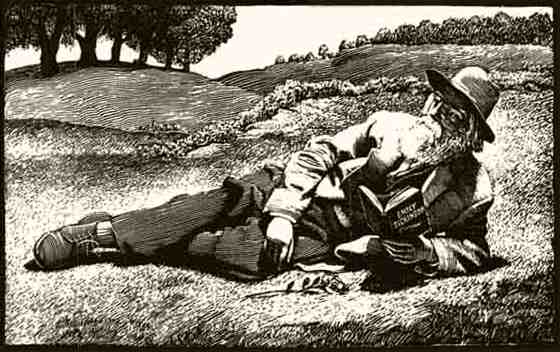
Consider another image which imagines Whitman reading Emily Dickinson. What kinds of critical and theoretical ideas do these images assume or embody? What does that question mean? Stay tuned.

walt