
Feminist Criticism and Angela Carter: Burning Down the Patriarchy?

Within feminist criticism, there is, of course, an inherent attempt to explain the relationship between men and women in order to critique the life-long oppression and exploitation of women. The “French feminist psychoanalytic” and “the male gaze” seek to define the internalized effects of a patriarchal system on women. The French feminist psychoanalytic theory is “interested in patriarchy’s influence on women’s psychological experience and creativity,” thus this mode of criticism transcends economic, political, and social structures (Tyson 95). Within feminist criticism, there seems to be a micro and macro-level of analysis that could be applied; for example, one could look at the larger economic and gender relationships within a text, or one could look at the psychological effects male power has on a specific character. In literature, I think that analyzing the presence of a male gaze would allow for a better interpretation of the female character. If the critic, or reader, acknowledged the presence of the male gaze, then they will be better able to form judgments on how gender is working in the text and why the author decided to include the male gaze. The male gaze is a projection onto the female character, therefore, the female character’s perception of herself and the world are altered. In texts where there is a female protagonist, how can that protagonist escape the male gaze? Once a female character is under the male gaze, can she regain power and a true sense of self? Tyson introduces the idea of a “patriarchal woman,” or “a woman who has internalized the norms and values of patriarchy, which can be defined, in short, as any culture that privileges men by promoting traditional gender roles” (Tyson 102). If this is the case, then what allows a text to move beyond traditional gender norms, and does female power and expression exist only because of the patriarchy? To what extent must a text conform to a structure in order to then break it?

Something I am specifically interested in is how a female author can “burn down the patriarchy” without first conforming to a patriarchal society or set of norms. For example, to deconstruct the patriarchy, an author must first create the space and narrative for male power to rule. This ironic and paradoxical structure conforms to the male gaze in some ways, for the author must accept the “patriarchy’s influence on women’s psychological experience and creativity,” as explained by French feminist psychoanalytical theory, and use the patriarchy as a structure to build their creative work off of (Tyson 95). In Angela Carter’s The Magic Toyshop, Carter creatively breaks down the patriarchy by using satire and elements of the French feminist psychoanalytic theory. Her satirization of the patriarchy complicates her text and alludes to the complex relationship between female freedom and the ever-present patriarchy. Carter comically conforms to and then breaks the male gaze by creating a parody puppet-show of Leda and Swan in which Uncle Philip (male power) pulls the strings and Melanie (young protagonist) plays Leda. While the myth of Leda and the Swan is disturbing and explicitly violates the female body, Carter gives Melanie the power to laugh at Uncle Philip and the swan, for Melanie observes that “it was a grotesque parody of a swan… she nearly laughed again to see its lumbering process” (Carter 165). Carter ironically deconstructs myths, like Leda and the Swan, to allude to how the patriarchy is also a myth that is reinforced by society. The swan symbolizes the patriarchy and as it clumsily walks about Uncle Philip’s dumpy stage, Carter is explicitly humiliating the charade of male dominance. In this way, a psychoanalytic critic may argue that the patriarchy, as seen in Carter’s novel, exists within our subconscious and social levels. While Carter has Melanie make fun of Uncle Philip’s swan, she also creates moments of intense violence and fear; therefore, I think it would be worth exploring how Carter balances gendered power and upholds an ironic tone so that the violent actions against women ultimately point towards a feminist analysis of the text. In this way, feminist theory is reliant on other theories like deconstructionism and psychoanalytical theory to bring meaning to the text’s symbolic gestures and structural choices. 

7974545622e014e86f46a9eb0bb39ccd
https://www.pinterest.com/pin/65231894581154509/?lp=true


Works Cited

Carter, Angela. The Magic Toyshop. Penguin Books, 1996.

Tyson, Lois. Critical Theory Today. 3rd ed., Routledge, 2015


Updated Elevator Pitch; Nicole Hatfield

X: I am working on the transparent and ecocritical portrayal of land injustice among the Australian Aboriginal people in Judith Wright’s collected poetry. 

Y: With regard to land injustice, I am interested in how Judith Wright (a white woman) addresses her whiteness and inherent guilt when writing about environmental issues and racial injustices in Australia. Specifically, how does she bridge the gap between literary activism, which deliberately calls out political and social issues, and poetics? To what extent has environmental literature shifted from being romantic, idealistic, and existential? And does this shift reflect the modern urgency for policy change and literary activism? Does Judith Wright participate in an active conversation about systemic racism and land injustice, to what extent are her poems doing cultural work? 

Z: Using Judith Wright’s poetry as an example of literary activism, I hope to show how there is a concrete connection between environmental injustice and the oppression of the Aboriginal people. If we rethink how poetry uses natural imagery and reflective metaphors, we can understand the cultural connections to people and their landscape. In addition, in grounding her poetry in realistic landscapes and environments, Wright participates in an environmental conversation about humanity’s degradation of both land and marginalized groups of people. 

Sources:

  1. Slow Violence And The Environmentalism Of The Poor by Rob Nixon
  2. Bad Environmentalism by Nicole Seymour 

History and Literature as a Cultural Spectrum

Within new historical and cultural criticisms, a literary text “functions as a part of a continuum with other historical and cultural texts from the same period” (Tyson 285). Observing the historical and cultural context of a text bridges the gap between the literary and the real-world, thus making the text applicable to realistic and shared experiences. I feel that new historical and cultural criticism allows texts to give voices to those to the marginalized. Tyson defines this literary theory using the term discourse which is “a social language created by particular cultural conditions,” and this refers to the shared experiences of a culture and how a text can reflect those experiences. Discourse “draws attention to the role of language as the vehicle of ideology” and is dependent upon time period and situation because discourse is never a permanent state (Tyson 270). This idea makes me question the permanency of literature and to what extent can a text reference history while still being relevant to the current time period. Does new historical and cultural criticism limit the sustainability of a text or does it put the work on the reader to learn about historical context and periodization? To what extent does literature retain its relevance as time goes on? Is literature and history both cyclical entities and does literature always inherently evoke a historical and cultural reading because of its social implications such as publishing dates and popularity? In general, I think that cultural criticism seeks to define texts as social conversations and archives that do cultural work regardless of the time period.

Professor Rydel’s talk about new historicism and her own critical essay (dealing with the middle ages) demonstrated how both close reading and cultural criticism can form a strong argument. In addition, Professor Rydel drew a long timeline/flow chart of all the different versions and translations of a primary text. This visual aid helped me visualize how history, even book or publication history, is all connected to the text and how the audience interprets that text. 

In Le Thi Diem Thuy’s novel, The Gangster We Are All Looking For Thuy writes about the immigrant experience. Although the novel is set in 1978 when there was a great influx of Vietnamese immigrants to the United States, the novel is still relevant today for it transcends generations and can be applied to other cultural groups. In the following excerpt from her novel, Thuy uses new historicism and intersectionality to bridge the gap between figurative language/story and actual, social issues.  (Thuy pg 52):

Screen Shot 2019-10-03 at 8.47.00 PM.png

In the above excerpt, the boys jumping off of the railing and into the pool are apart of the narrator’s predominantly immigrant community. Whereas the landlord is a white America, the boys are of mixed race and make up a marginalized community. Prior to this passage, the neighborhood community is described as being filthy and full of mayhem and this usually the case for marginalized communities that are treated as the “other” in America. Due to systemic racism and the otherization of immigrants, this community is already separated from the rest of the state. The boys fly off of the second-floor railing and into the pool, and these striking images symbolize the immigrant’s dream to attain the “American dream,” or freedom. Despite their shortcomings, the boys find freedom in falling and crashing into the water. Throughout the novel, the water represents home and their journey to America; therefore, they metaphorically jump into a sense of belongingness and make this foreign country their home. However, the landlord is quick to say that they are “going to break your [their] necks!” and this represents how white America often tries to discourage the immigrant from succeeding. The boys literally fly over the landlord, thus reversing the power dynamic and alluding to the social tension between immigrants and white Americans. Cultural assimilation and the strangeness associated with a new land are all topics covered in this novel. While the novel does not give an explicit history of the immigrant’s experience or the racially-charged prejudices of the time, things like the author’s bio and basic plot points infer that this text is making a cultural critique. The very basic fact that this novel was published and circulated infers that it is historical and impactful. Therefore, even though Thuy uses magical realism, a child’s perspective, and a nonlinear narrative her story connects to a greater history of the immigrant’s experience. I believe that you cannot take the history or cultural context out of a novel or text. Like Professor Rydel’s paper, a story can always be analyzed on a micro (within the text) and macro (outside of the text) way, but I believe that a strong argument considers both of these things. 

Works Cited

Lê Thi Diem Thúy. The Gangster We Are All Looking For. Anchor Books, 2016.

Tyson, Lois. Critical Theory Today. 3rd ed., Routledge, 2015
 

Satire in Environmental Art and Surrealist Literature

I am looking at how irony and satire links the environmental movement to modern feminist, surrealism, and post-modern texts. I am specifically interested in how the idyllic contrasts with the realistic in the environmental movement, thus creating a complex binary between real and surreal concepts. I would like to argue that like nature itself, literature uses the binary of idyllic/realistic in order to create some greater truth that reveals the messiness of the human experience. Using a modern lens, one can read romanticized visions of nature as self-indulgent and unrealistic, and this category of environmental literature works against the notion that art can enact policy or social change. Does some environmental art exist just for art’s sake? Or is it pushing a specific political or social agenda to actually better the environment and correct environmental injustices? Common themes I am interested in: how the female body is romanticized as being an ecofeminist symbol, while it is much more than simply a natural symbol; how art can function as both a social critique and as a beautiful entity; how all meaning is derived from an ironic outlook on life—making meaning through satire. I will use a deconstructive and psychoanalytical lens.

X: Irony and satire in environmental art

Y: How does the environmental movement create tension between the realistic and idealistic? How does this binary result in a meaningful critique of society and its representation of nature/the female body? 

Z: Through irony/satire, one is able to address the shortcomings of all humans and accept the greatness and vastness of nature in order to create a sustainable reading experience where the environmental movement is both critiqued and lifted. In creating tension/irony around environmental art, it forces people to question the social implications real-life environmental injustices have (systemic racism etc). This “care for the earth, care for the self” mentality (permaculture) ultimately leads to social change (or it at least raises questions around social issues) 

Other interests: creating satirical collages (visual art) to accompany my project

Possible primary texts:

Angela Carter: The Magic Toyshop

Sisters of the Earth (anthology

Pleasures of Nature (anthology)

Secondary Source:

Szerszynski, Bronislaw.  (2007) “The Post-Ecologist Condition: Irony As Symptom and Cure.” Environmental Politics, vol. 16, no. 2, 2007, pp. 337-355, DOI: 10.1080/09644010701211965

https://www.tandfonline.com/doi/pdf/10.1080/09644010701211965?needAccess=true


Reader Response: Affected by Affect

Finally, the reader is allowed to participate in the critical analysis of a text. However, the reader-response theory (outlined in Tyson’s textbook) is more complex than just analyzing how the reader (or you) feels about the text; in fact, there are a lot of formal considerations that go into making a successful reader response analysis. In Tyson’s chapter “Reader Response Criticism,” one of the types of reader response is affective stylistics. This category of reader response focuses on how the mechanics of the text shape reader response. Affect stylistics argues that “the text consists of the results it produces, and those results occur within the reader” (Tyson 167). I found affect stylistics appealing because it seemed to balance authorial intention—or the actual writer’s craft—with reader response and interpretation. Fish writes that affect stylistics should ask: “How does the reader of this sentence make meaning?” (167). Using textual clues, the reader can then make claims about the text and analyze how their reading experience was shaped by the text. While this technique of mapping “the pattern by which a text structures the reader’s response while reading” allows for active and close reading, I found that combining affect stylistics with social reader response would produce a more rounded argument (Tyson 168). Social reader response considers the “interpretive community” and evaluates how institutional assumptions influence the text (Tyson 176). If one were to combine affect stylistics with social reader response, they would produce an argument that not only looks to the text for structural clues but goes beyond the text to analyze historical or social context. Therefore, the reader response is a robust analysis of the textual craft and the social implications that surround the text. After reading about reader response, I still wonder whether it is the reader or the author who creates meaning—what came first, the reader or the meaning? Is the text completely reliant on a reliable reader to be interpreted and created into the meaningful analysis? Is there such a thing as reading for fun, or must there always be meaning and connection to the self? 

Professor Charles’ essay “Meeting ‘Me’: Charles Dickens’s Moments of Self-Encounter” uses both affect stylistics and social response to craft a complex yet clear argument about Dickens. Reading her essay helped me understand how formal linguistics and stylistic choices help the reader close read and make meaning of a text. She active includes the reader into her critical essay and does so by setting up the reader response with close analysis of the text and sentence level. In addition, she addresses the reader’s responsibility to decode Dickens’s language and his social impacts on the culture at the time. Her evidence, which goes directly back to the text (affect) and the greater context (social response) continuously points towards the greater theme of reader experience and what kind of atmosphere Dickens is trying to create. Moving forward with my own critical analysis, I hope to combine affect stylistics with a social response. 

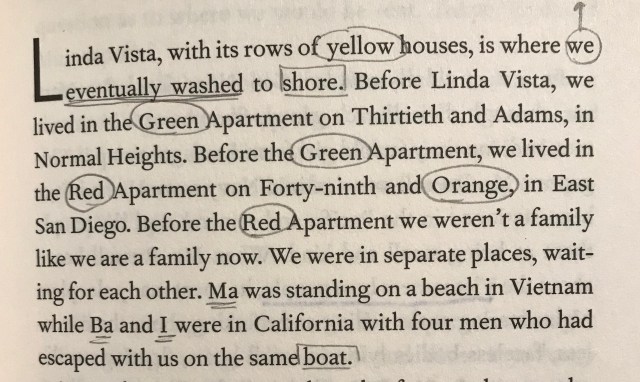
In Le Thi Diem Thuy’s novel The Gangster We Are All Looking For, Thuy begins the book with the following paragraph: (pg. 3)

img_2026-copy.jpg

Reading this text using an affect stylistic reader response, one would notice the repetitious use of colors to describe places, such as “yellow house,” “Green apartment,” “Red Apartment,” and “Forty-ninth and Orange.” This childish way of identifying places and the use of the past tense then leads the reader to believe that our narrator is a child looking back on her past experiences. Time and place are now established, but the textual analysis is needed to grasp what the text wants us to feel. The narrator withholds names, as she only gives pronouns for the first seven lines. The ambiguous “we” sets the reader up to believe that the “we” group was always the same, but “we” never stood for a complete family or group dynamic. Ma was across the water in Vietnam, and the child was with her dad and four men. This observational yet delayed response to her situation gives the reader insight into the narrator’s subconscious and way of processing information. We now know that this novel is going to first overload our senses, like with the colors, and then sneak in a blunt, but profound statement that changes our course of thinking and feeling about the previously mentioned sensory images. This contrast between image and statement speaks to the emotional and intellectual minds of the readers. Also, diction such as “we eventually washed ashore” implies that the journey was tiresome and that they washed up like debris. Using a social reading response, one would understand that immigrating to American from Vietnam was common in the 1970s and that the immigrant experience in America was not simple. The child narrator implies that she washed ashore as if she drifted there—unwanted by the Americans and far from home. Her life as a Vietnam refugee has just begun in this first paragraph, but the reader is keyed into cultural details about the immigrant experience. This reading now gives the readers context for why the child narrator may be describing locations in colors: because everything in this new world seems unreal and strange. Moreover, affect stylistics and social reader response can work well together to identify meaning from the language itself and the cultural context. 

Works Cited

Lê Thi Diem Thúy. The Gangster We Are All Looking For. Anchor Books, 2016.

Tyson, Lois. Critical Theory Today. 3rd ed., Routledge, 2015
 

Deconstruction and the Beauty of Being Meaningless

When considering the deconstructive method of literary criticism, I immediately imagine a never-ending food chain in which a string of organisms (both micro and macro-sized) evolve as life goes on. I think that deconstructive theory relates to an ever-growing ecosystem in the sense that language, meaning, and semantic codes are always tumbling forward, building off one another, and leading to new life or interpretation. In Tyson’s chapter on deconstruction, she uses terms such as undecidability, dissemination, and plurality to describe how language is always changing. I find it helpful how Tyson defines undecidability as meaning “that reader and text alike are inextricably bound within the language’s dissemination of meanings” (Tyson, 245). Dissemination is defined as the action of spreading, diffusing, or distributing, and I believe that a deconstructive outlook on language would view the text as constantly diffusing and expanding across the page and the world. In analyzing a text with a deconstructive lens, one must accept that “the ‘meaning’ of the text is really an indefinite, undecidable, plural, conflicting array of possible meanings and that the text, therefore, has no meaning” (Tyson, 245). Once we can accept that language is a messy, slippery form of expression, we can allow the text to unfold in an unforced and organic way. This natural progression of a text, or dissemination, can also be applied to one’s mental and spiritual state. For example, Tyson writes that “our mental life consists not of concepts — not of solid, stable meanings — but a fleeting, continually changing play of signifiers” (Tyson, 238). Moreover, I am interested in how a deconstructive lens can be applied to both literature and a state of mind, and how this affects the structural unfolding of a text. Also, I want to explore texts that use deconstruction, rather than a formal and “meaningful” structure, to celebrate words and breath life into the beautiful, ambiguous mess of linguistics. 

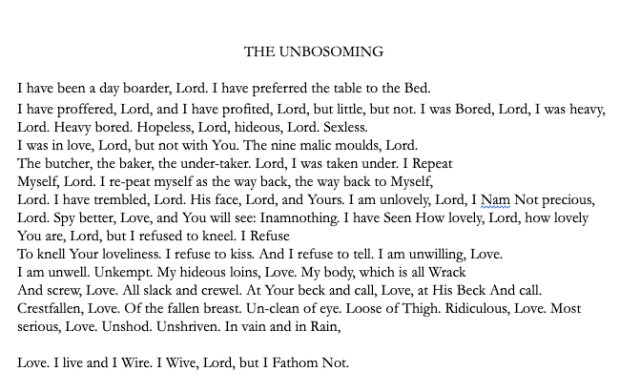
Roland Barthes writes in her essay “From Work to Text” that “the work is a fragment of a substance” (Barthes, 156). This ambiguous and abstract concept works so well to describe the deconstructive theory. Each word is a fragment of an essence, and this essence is neither absolute or tangible. Therefore, language is simply an organism that has feasted on the previous organism to gain depth and movement (going back to my food chain analogy). A work of art does not have to have a concrete meaning. This is especially present in Olena Kalytiak Davis’ poem “The Unbosoming.” Davis creates a long, associative string of nonsensical words that all recall auditory connections with previous words. Her poem is highly musical and contains so much consonance and assonance that the language simple takes over any possible meaning. I would argue that her poem completely deconstructs language. Her use of sonic wordplay propels the poem forward. Her reliance on language’s instability also highlights the tension between language and expected meaning. Deconstruction aims to sustain tension by leaving the text unresolved, and Davis defers inherent meaning by stringing together impressionistic and musical words. The poem unfolds like a stream-of-consciousness that is free from any critical or structural judgment. The words and images work as associative sequences that debunk the poet’s illusion of control over the poem. She truly embraces the messy and decentralizing nature of deconstructionism by creating “nonsense” words. 

Overall, her poem would be celebrated by deconstruction critics because they would argue that her nonsensical diction and lack of narrative control is a testament to literature’s continuous journey towards nothingness. Davis writes: “Lord, I was taken under. I Repeat /Myself, Lord. I re-peat myself as the way back, the way back to Myself” (5-6). She is taken under by the power of language. The limits of language and self-expression are materialized by her poem. The narrator swallows sounds and images as if they have agency over us as if they will keep moving regardless of whether humans find meaning in them. After applying deconstructionism to “The Unbosoming” I understand how existentialists are constantly questioning whether there is a fixed existence. In reading Davis’ poem, which is a great manifestation of deconstructionist thinking, I was able to forget about authorial intention, structural form, and thematic meaning to simply follow the words and they grow and change. 

Screen Shot 2019-09-12 at 10.07.38 PM.png


Works Cited

Barthes, Roland. “From Work to Text.” Image Music Text. Translated by Stephan Heath. Fontana Press, 1977.

Davis, Olena Kalytiak “The Unbosoming” 

Tyson, Lois. Critical Theory Today. 3rd ed., Routledge, 2015
 

Certified “Organic”

After reading Critical Theory chapter 5 “New Criticism” and T.S. Eliot’s “Traditional and the Individual Talent” I considered the complicated relationship between art and the individual, specifically whether or not they can be separated. I think that it is impossible to completely depersonalize a piece of creative art. Therefore, I struggle to completely accept the New Criticism theory. I think that the new critic’s fascination with paradox, irony, ambiguity, and tension results in compelling and complex arguments. However, I prefer to contextualize these abstract contradictions using more concrete methods. As an English major, I have struggled to imagine the real-life effects that literature has on the world, often leading me to wonder whether all of literature’s great questioning is done in vain. And while the new critics would argue that close reading stylistic and imagistic choices help us gain a better understanding of the representative truth or greater theme, I think one must balance both an affective fallacy and intentional fallacy to create a meaningful, and well-judged interpretation. Because as much as new critics want to believe that art can stand on its own, there will always be the authors’ and readers’ intrinsic biases. Therefore, I struggle to agree on the new critic’s idea of organic unity, because the new critic also believes that the art is unchanging and that each interpretation should have closure. Despite using organic unity to show harmony within a piece, the new critic still adheres to strict structures, such as analyzing form, language, and objects, instead of focusing on the natural movement or ever-changing essence of a piece. The new critic idealistically categorizes everything as a meaningful paradox that points towards greater meaning, but this alienates the reader and makes art less personal, and therefore (in my opinion) less meaningful. Art and literature are like a mirror, and in the end, everyone yearns to learn something about themselves. This is often accomplished when great art causes the audience to experience a metaphysical or artistic self-projection. I would like to further investigate the particular idea of organic unity and how the connotation of “organic” pushes against the new criticism theory. 

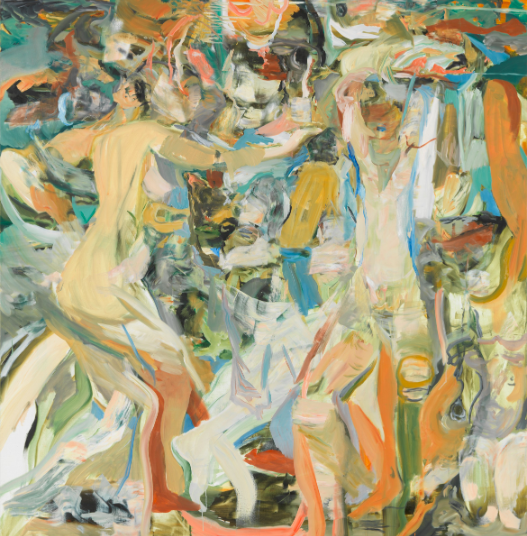
I analyzed Cecily Brown’s abstract painting “The River’s Tent Is Broken” using the new criticism lens, but then I also approached the painting in a more organic way. In order to show how new criticism could be improved upon by considering the natural connotation of the word “organic,” such as how organic matter often decomposes or grows as time progresses, I will address the interpretative possibilities of this painting when freed from the constraints of being a new critic. 

  • New critic analysis: The painter chose the symbolic colors blue and beige to allude to the unattainable and surreal connection between heaven and humans. The heavens being the blue, sky-like color and the humans being the abstract, beige shapes. The warm and cool tones of the painting juxtapose the tangible and intangible creations in our world. This painting uses the malleable medium of oil paints in order to tie all these themes together and illustrate the interconnectedness of man, nature, and the uncontrollable. 
  • Alternative, “organic” analysis: The painter, Brown, has created an oil painting in which the observer is bound to see a reflection of herself in the painting. Even though the shapes are abstract and ambiguous, our brains recognize the human shapes in the painting and immediately make personal, bodily connections. Therefore, the reader is automatically placed into the painting—going against the new critic theory of objectification. In addition, the painting is always changing because it embodies different stories depending on how you piece each part together. Abstract art is meant to change based on someone’s personal perspectives. Brown describes her work as taking from the classical expressionism but creating a “new aesthetic reality.” In this way, she conforms to T.S. Elliot’s idea that there is perhaps no individuality, but there are moments of reinventing the past in fresh, and timeless ways. Both artists embrace history and use it as a springboard to create new ideas that mesh with the past in order to create a dynamic present.

Screen Shot 2019-09-04 at 7.21.40 AM.png

https://gagosian.com/artists/cecily-brown/

“The River’s Tent Is Broken” 

Works Cited

Eliot, T. S. “Tradition and the Individual Talent by T. S. Eliot.” Poetry Foundation, Poetry Foundation, 13 Oct. 2009

Tyson, Lois. Critical Theory Today. 3rd ed., Routledge, 2015