
Proposal: Guidelines
The real-world, academic model for the SCE you will complete (in your senior year) is a 25-30 page essay that we scholars publish in journals, books, and other venues, based on extensive research (an Annotated Bibliography due in the fall of your senior year) and substantial drafting and revision (the essay composed in the spring of your senior year). You have likely encountered and started to work on initial ideas in other English courses that could serve as the foundation for the SCE. But you probably don’t know it yet.
So, how do we work toward that substantial project, explore a direction before we know where we are going? There are various models scholars use to explore and develop their initial thinking/reading/writing on the way to more substantial, publishable scholarship: sometimes they’ll take the form of a conference presentation, other times a proposal for a grant or fellowship.
For this assignment, you’ll be writing a substantial proposal for future research. At 1750 words or so (inclusive of abstract), it will be on the longer end for SCE proposals in the English department, but this length is common to professional research proposals and as such will give you the space to fully articulate your research findings and your claims in relation to them.
Guidelines:
1500 words + 250 word abstract. Your project proposal should begin with a re-revised abstract summarizing your proposed project. Remember, that proposed project is essentially an academic article, examples of which you’ve been reading all semester. The body of your proposal should:
- describe the project, explaining the topic and the significance of the argument;
- place the work in the context of your field (methodological, geographical, and period-based as applicable);
- indicate how the project would contribute to that field;
- be clear about the critical theory and methodology informing your argument; and
- make sure to situate your work in relation to others. You may use *revised* portions of your literature review to do this.
For some further guidance on an Academic Proposal, consult this resource from the University of Toronto.
Proposal: Brainstorming–Particle/Wave/Field
For further development and complication of your project’s argument as it stands now, use this heuristic (in classical rhetoric: a model or structure to generate or organize thinking for an essay, argument, project, a device for invention) known as the particle/wave/field heuristic. I summarize it below by way of the rhetoric book Form and Surprise in Composition: Writing and Thinking Across the Curriculum by John Bean and John Ramage [they take the heuristic from the Young, Becker and Pike’s Rhetoric: Discovery and Change]. They suggest it as a method that helps develop an argument on a given topic by enabling the writer to switch perspective systematically.
First, take your topic X and view it as a static, unchanging entity (particle): note its distinguishing features, characteristics; consider how this entity differs from other similar things. You will know some of these details and characteristics from your research–how other critics and scholars have defined your topic in the past.
Second, view the same topic as a dynamic changing process (wave): note how it acts and changes through time, grows, develops, decays. Think of this as where your Y enters the topic: issues, questions, problems that you might pose, wanting to learn more about the topic, recognizing (from your research and review) that there are some gaps, there is more to know or do with this topic.
Third, view the topic as a Field, as related to things around it and part of a system, network or ecological environment. What depends on X? What does X depend on? What would happen if X doesn’t exist? Who loves (hates) X? What communities (categories) does X belong to? What is X’s function in a larger system? This is a way to identify critical and theoretical implications for your argument–the larger field and conversation that your study participates in, relates to (and lots of other “reverbs”), potentially revises, but also (this is what is complicated about “field”) is potentially revised by. This is your stake, your “So What.”


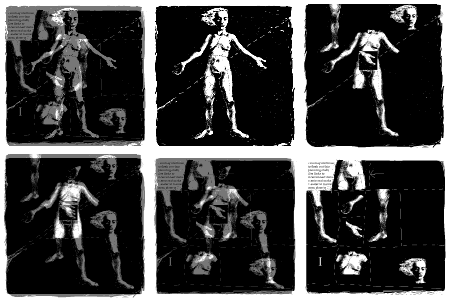 Where, when, how, why, and in what forms do we experience gender and sexuality in life? In literature and culture–in other words, as readers/writers/scholars in English? Much as we discussed recently with postcolonial criticism and its overlapping interest in issues of race, I propose that we interrogate how various concepts and keywords from feminist criticism, gender and sexuality studies, and queer theory speak to our experiences with literature and culture.
 Creative Reading
You must be logged in to post a comment.