New Historicism and Cultural Criticism: Reconstructing Contexts

In the first two weeks of our studies, New Criticism and variations of structuralism and deconstruction largely removed the author and the reader from our critical view. We had just the text. Over the last couple weeks we have slowly returned to the reader (reader response) and the author (psychoanalytic criticism). Now we turn, or perhaps return, to context. How do cultural and historical contexts of the texts we study, and of the people doing the studying, matter in literary interpretation and criticism?

We get a rich and complex exploration of that question in the critical example we are reading for Tuesday’s class, “The Classroom in the Canon: T. S. Eliot’s Modern English Literature Extension Course for Working People and The Sacred Wood.

Their scholarship and book in progress, The Teaching Archive, has its own archive of materials [linked]. This example gives us a way to do some further thinking about a point made by Tyson, identified as “self-positioning”: “the inevitability of personal bias makes it imperative that new historicists be as ware of and as forthright as possible about their own psychological and ideological positions relative to the material they analyze so that their readers can have some idea of the human ‘lens’ through which they are viewing the historical issues at hand” (275).

As Kenneth Burke puts it, “Every way of seeing is a way of not seeing.” I see this problem of “self-positioning” as both a useful insight with regard to new historicism and cultural studies, and one of its constraints or limits. Critics need to qualify their vision regarding the lenses they are using. That’s a good thing, and can strengthen the argumentation and persuasion, to the extend that we critics thereby engage our readers in the work we do. We can be more deliberate in the lenses we use. The potential limit is that in the end we need and want our readers to see what we see. We can’t qualify things beyond recognition. We can’t proclaim our own interpretation invalid because it is not free of bias. Or, we can’t do that and expect our readers to be persuaded of our reading. Which, in the end, is the goal. That’s my bias, I recognize: all critical reading and writing are thoroughly rhetorical. The aim is not certainty or objectivity. It is persuasive plausibility.

I think Buurma and Heffernan achieve this, a persuasively plausible argument for rewriting and revaluing the “received idea of the Eliotic canon” by way of reconstructing and recovering the pedagogical and collaborative contexts of his essays collected in The Sacred Wood. As part of their argument, they are thinking and positioning their own scholarship in relation to the archive of teaching.

Why am I persuaded? What am I not entirely seeing? Perspectives from new historicism can help me answer both questions, and that will enable me to strengthen my argument, even as it keeps me from providing final and certain answers.

As I look to the seminar projects (and elevator pitches) you have begun to entertain, I wonder what role history and culture have played thus far in your studies in English, and what you might do differently, or additionally, with a better grasp on these critical concepts from new historicism and cultural criticism. Are you interested in a new historical lens? What will that enable you to see? What will it keep you from seeing?

What Trauma is She Failing to Repress?

Christine de Pizan takes on an argumentative tone in her works, a good deal of them condemning male scholars before her for their portrayal of women in their writing. She is very straightforward with her arguments in each work, boldly confronting them for their misogynistic characterization of women and toxic portrayals of masculinity. However, in Le Livre de la Cité des Dames (The Book of the City of Ladies), Christine chooses to lay out her argument very differently, instead constructing 3 divine female figures to make her arguments for her, providing strong counterclaims to common misogynistic presumptions using textual evidence. 

Something that sticks out to me about this work is the way in which the seventh section, in which Christine herself asks Lady Justice if women were meant to practice law, citing the writing of multiple male scholars on the subject not even 5 years preceding this novel. Unlike in recent sections, the angel does not give any evidence as to why this sentiment is inaccurate but instead gives an answer that she defends using strategic essentialism This answer gave a major shift in tone, as the argument is less assertive and straightforward. This made me question why this sudden change in attitude was included, and specifically what Christine was going through/what prior events were on her mind as she wrote it. 

I am interested in exploring this subject using psychoanalytic criticism, to figure out if the seventh section of The Book of the City of Ladies is the manifestation of Christine’s internalized misogyny reflected onto text or if this specific choice was made in response to a specific trauma, or both. I would also like to use reader response theory in my analysis of this topic to explore how her use of affective stylistics influences the message she sends. 

Satire in Environmental Art and Surrealist Literature

I am looking at how irony and satire links the environmental movement to modern feminist, surrealism, and post-modern texts. I am specifically interested in how the idyllic contrasts with the realistic in the environmental movement, thus creating a complex binary between real and surreal concepts. I would like to argue that like nature itself, literature uses the binary of idyllic/realistic in order to create some greater truth that reveals the messiness of the human experience. Using a modern lens, one can read romanticized visions of nature as self-indulgent and unrealistic, and this category of environmental literature works against the notion that art can enact policy or social change. Does some environmental art exist just for art’s sake? Or is it pushing a specific political or social agenda to actually better the environment and correct environmental injustices? Common themes I am interested in: how the female body is romanticized as being an ecofeminist symbol, while it is much more than simply a natural symbol; how art can function as both a social critique and as a beautiful entity; how all meaning is derived from an ironic outlook on life—making meaning through satire. I will use a deconstructive and psychoanalytical lens.

X: Irony and satire in environmental art

Y: How does the environmental movement create tension between the realistic and idealistic? How does this binary result in a meaningful critique of society and its representation of nature/the female body? 

Z: Through irony/satire, one is able to address the shortcomings of all humans and accept the greatness and vastness of nature in order to create a sustainable reading experience where the environmental movement is both critiqued and lifted. In creating tension/irony around environmental art, it forces people to question the social implications real-life environmental injustices have (systemic racism etc). This “care for the earth, care for the self” mentality (permaculture) ultimately leads to social change (or it at least raises questions around social issues) 

Other interests: creating satirical collages (visual art) to accompany my project

Possible primary texts:

Angela Carter: The Magic Toyshop

Sisters of the Earth (anthology

Pleasures of Nature (anthology)

Secondary Source:

Szerszynski, Bronislaw.  (2007) “The Post-Ecologist Condition: Irony As Symptom and Cure.” Environmental Politics, vol. 16, no. 2, 2007, pp. 337-355, DOI: 10.1080/09644010701211965

https://www.tandfonline.com/doi/pdf/10.1080/09644010701211965?needAccess=true


Psychoanalytic Criticism: Paging Dr. Freud!

Psychoanalytic literary theory and criticism is by no means limited to the insights and theories developed by Sigmund Freud, the father of psychoanalysis. As Lois Tyson demonstrates, a great deal comes after Freud and the classical psychoanalysis that he establishes in the early 20th century, and much of that challenges while also building upon Freud’s “discovery” of the unconscious: Jung, Lacan, French feminists such as Kristeva and others who build upon Lacan and psychoanalytic theory. It’s complex stuff, and even though I took an entire course in graduate school on psychoanalytic theory, much of it is beyond my limited powers of understanding.

But there is something fundamental to Freud and–I’m generalizing here–insightful about psychological approaches to literary interpretation that we might trace back to Freud. It is the notion, the recognition, that human consciousness, all we think and do and feel and speak, is fundamentally ironic. We can never exactly mean what we say, or say what we mean, because of the split between the conscious and the unconscious. As a result, life becomes something like a dream, and dreams become something like an alternative text of life. Such is the insight of Freud’s dream interpretation, established by his book The Interpretation of Dreams (1900). He takes this psychological concept of dream interpretation and extends it directly to literature in a 1908 essay  titled “The Relation of the Poet to Day-Dreaming” (also known as “Creative Writers and Day-Dreaming”). Dreams are phantasies, with symbolic meaning that relates to the real world, but in need of critical interpretation since the symbols (and images) are phantasmal–they mean differently than what they say or suggest. And by extension, Freud suggests, writers create phantasies in writing that work something like their dreams.

Here we see the great use of psychoanalytic theory for interpretation, or at least Freud’s version of it: every literary text is dream-like, phantasy, even those that are seemingly real. They are and they aren’t. That gives us something to interpret and critique. We can always page Dr. Freud for help. Sometimes it’s obvious (Victor’s freaky nightmare after he creates the “monster”); other times it’s more subtle and arguable (sometimes a cigar is just a cigar).

But this also suggests a limitation or constraint: every writer, and this would include us as creative writers and critics, is always subject to mis-interpretation. Every thing we write is somehow about us, familiar to issues in our lives; but at the very same time, the real source of our writing must remain unfamiliar. We can’t simply say what we mean.

This last point about the familiar being unsettled by the unfamiliar is an insight from another essay Freud writes where he further relates his theories to literary interpretation and language: “The Uncanny” (1919). For some notes and a summary of this concept, read here. Freud discovers through a study of language that the uncanny means something different than being surprised or frightened by the unfamiliar, but in fact is when the unfamiliar is revealed to be related to the familiar. The word in German for “uncanny” Freud shows means two exactly opposite things: heimlich (familiar, homely) and unhemilich.

Pretty ironic, isn’t it? As we have seen, since we began with New Criticism and worked through deconstruction, irony factors significantly into literature and many theories for understanding and interpreting literature. Given that, what do psychoanalytic theories of literature and interpretation enable us to do with the ironies of literature? Are irony and misinterpretation inescapable for literature and reading?  Can we read and write without psychological motivations and unconscious drives, without needing to page Dr. Freud?

The love-hate relationship between Milton and his Paradise Lost readers

In examining Stanley Fish’s article, “Surprised by Sin: the Reader in Paradise Lost,” our class discussed the different ways in which writers interact with their readers and attempt to incite a particular reader-response from them. Of course, each reader has their own unique reading experience, and each reader brings with them their own individual intentions and beliefs, so the reader-response will be different for every reader in some facet. The same reader usually even has a significantly different reader-response when analyzing the same text for a second time. There are still however, main points and ideas that are driven home by the writer that in some way or another will be analyzed similarly by multiple readers. In Paradise Lost, Fish argues that John Milton is attempting to both educate and humiliate his readers through subverting the reader’s expectations and questioning his own stances.
Fish claims that “Milton consciously wants to worry his reader, to force him to doubt the correctness of his responses, and to bring him to the realization that his inability to read the poem with any confidence in his own perception is its focus” (Fish, 4). I believe in Milton’s strategy of filling his readers with doubt that he is teaching them the importance of questioning themselves as well as authority. In this case, Milton is the authority as the writer of Paradise Lost, and guides the reader in their thinking but knows that while he can present his own ideas, they can be interpreted in a multitude of ways by different readers.
From Fish’s perspective, Milton seems to be very consciously aware of his readers throughout Paradise Lost. Fish uses Milton’s harassment of his reader as an example of his interaction with the reader. The reader is set up to believe one thing and then becomes disappointed with the shock that their expectation was subverted. An example of this is the character of Satan, who readers first assume to be purely evil but then are intrigued by his human-like interior struggles. Even though Satan is the villain of the story, he is immediately shown as an underdog with outstanding qualities of leadership and resilience. By unsettling his readers through his break of traditional epic molds and making his opinions ambiguous, Milton gives power to the reader to interpret the text the way they want to.
The center of Paradise Lost’s subject is in fact the reader, because as Milton states at the beginning of the epic, he hopes to “justify the ways of God to men” (Milton). Milton uses Paradise Lost as a creative way to open readers’ minds up to questioning authority and seeing things through different lenses. In my opinion, at least some form of reader-response criticism would need to be used to have an accurate analysis of Paradise Lost since Milton is so in tune with the importance of his text as an event that occurs within the reader rather than an object.

Works Cited:
“Surprised by Sin – Stanley Fish.” – Stanley Fish | Harvard University Press, https://www.hup.harvard.edu/catalog.php?isbn=9780674857476.
Milton, John. Paradise Lost. Oxford University Press, 2008.

Reader Response: Surprised by Syntax

Finally, the reader. After working our way through New Criticism, structuralism, and the poststructuralist critical theory of deconstruction, we finally take up a key subject in the literary experience heretofore forgotten by analysis of “the text itself”: the reader. As we saw, in a variety of ways, all three previous theories and methods of literary interpretation–from Brooks to Barthes to Derrida–focus so thoroughly on the text as object and linguistic construct that the reader (and also the author, another kind of reader, an embodied subject) seemed to matter not in the least. Even to the point of the critic’s own unimportance in the end: the text, after all, deconstructs itself. If there is no outside the text, there’s also no reader separate from the text, waiting to take it up.

We have thus far considered the apparent loss of the reader and the author for its limitations and constraints. With reader response theory, we perhaps have a way to solve the problem of too much text. Here we still have a text, but the reader’s role in reading, in relating to, and perhaps even creating, the text is given prominence. The reader returns.

Tyson does good work in the chapter summarizing 5 different kinds or categories of reader response theory that are out there, or were out there at an earlier point in the study of English (roughly from the 1970s forward), and might be of use to you as you develop your ideas for a project and the most effective methods of interpretation you would bring to it.

  1. Transactional theory: Rosenblatt; the reader creates the “poem” out of the text.
  2. Affective Stylistics: a good example, Stanley Fish’s Surprised by Sin, his argument for “the reader in Paradise Lost.”
  3. Subjective reader response theory: the readers response are the text–about as far from New Criticism as one could get.
  4. Psychological reader response: the readers interpretations are based in their psychology (defenses, fantasies, etc.)
  5. Social reader response theory: Fish returns, focused here on the idea of an “interpretive community,” the ways that we all read based on assumptions given or expected by the institutions within which we work, read, think.

I’d like to give some further thought to Stanley Fish. We can apply and combine the two approaches he is known for to a broader discussion of how we can read and write the sort of critical thinking and rhetorical knowing we do in English, and will be developing throughout the seminar. In other words: argumentation, the work we do (read, research, write, revise) to put forth a “thesis.”

What is a thesis? It is a name for a dynamic structuring of an argument that has a very basic core, whether that argument is 2 pages or 200 pages. Discovering a good argument (the word I tend to use instead of “thesis”) is as simple (and as complex) as asking the question: what’s the difference if we understand things this way instead of that way, if we rethink the topic, or reread the text in a different way? In other words, an argument is a re-sponse, re-lating and re-vising what is known with what is new, thus developing new ideas by re-thinking existing ones. This is what Kenneth Burke has in mind with the parable of the parlor, and why Burke argues that all thinking, by which he means therefore all rhetoric, is by nature dramatic–or what he called dramatism. Here is a basic dramatic structure  for argumentation we will be using and practicing throughout the semester gets at the dynamics of response:

1.     Context/Topic/Given/Premise—what’s already known: the conventional view

2.     Problem or Question or Challenge to conventional view

3.     Response—how the author will resolve the issue or answer the question 

or in a variation of this structure (The Craft of Research refers to this as the “elevator speech” for any research project):

I am working on X [Topic, Author, Context]

To learn more about Y [a particular Problem, Question, Issue raised with regard to the topic]

So that my readers can better understand Z [What’s at stake, what’s the difference when we resolve the issue or question, and thus rethink X and understand it differently]

I would call this very basic structure and its variations a kind of Affective Stylistics that our interpretive community (in this department, English majors and English professors) expects to see and hear in an argument. The structure signals what’s at stake in an argument or critical reading. Why do we expect this “stake”? Because we know that this is an effective way to move our readers into and through our argument toward a level of persuasion and understanding we, as writers, want them to reach. It helps the reader understand why our thinking (and by hopeful extension, their thinking) matters, why they should care.

We can think of this combination of rhetorical knowledge and critical reading we bring to our writing in English as “effective stylistics.” We pay attention to the rhetorical matters of our style and syntax and organization not just because our interpretative community (faculty, editors, other readers in the field) expects this from us, but because we can also use this knowledge to move our readers.

Like Milton with Satan in Paradise Lost. To speak metonymically: We can surprise our readers out of  the syntax of their conventional views and suggest ways to rewrite and rethink our sentences.

Reader, what would you do with reader response theory in your critical reading and writing? We will continue to think about various projects and the critical theories that best illuminate their problems and issues and the questions we want to pursue. Reader response theory is yet another. But I am also suggesting that whenever we think about and work on our own critical writing, reflect on its effects and think about our audience of readers, we are inevitably engaging in some version of reader response.

The Death of the Author and the Birth of the Text

That ominous phrase and concept, “the death of the author,” has long been attached to deconstruction, or deconstructive criticism. Deconstruction is a leading critical theory of a larger grouping of literary and critical theory that emerges in the 1960s and 1970s in Europe, and thrives in American academic institutions (mostly) in the 1980s and 90s. That larger grouping is known as “poststructuralism,” a phrase which in some ways overlaps with the term “postmodernism,” but not entirely.

“Poststructuralism” (as an umbrella term for theories like deconstruction) is useful for our purposes this week since the phrase reminds us that deconstructive criticism follows and replaces structuralism, but does so by way of relation. Both focus on an understanding of language and writing as the foundation of any text–not the author, not the reader, not the historical era in which that text was composed or published.

To some extent, we are still talking about “text without contexts,” as we encountered in our readings of the New Criticism. But structuralism and then deconstruction take things a step further. In New Criticism, we had an author’s work (Brooks consistently refers to Keats and Eliot to “the individual talent”), but we understood that what mattered was interpretation of the poem/poetry, not the poet. Now, with structuralism and deconstruction, that individual author and work disappear into the writing of the text. Now, the text is all context–or as Derrida, leading proponent of deconstruction famously  put it: “there is no outside the text.” We move, as Roland Barthes phrases it, “From Work to Text.”  We will read that essay for Thursday, from a collection (Image/Music/Text) that includes his essay “The Death of the Author.” Barthes is a useful guide for us this week since his earlier work such as “The World of Wrestling” (from Mythologies) is a good example of a structuralist interpretation.

As a way to distinguish structuralism from what comes after it, poststructuralism, I think it is particularly helpful to focus on the linguistic “structure” that both emphasize in understanding the birth of the text and the death of the literary work grounded in the authority of the author. Structuralism would have us think in metaphors and analogies of surface and depth, the structures we can see and the deep structure we can’t. Here are some relevant surface/deep structure relations:

structural linguistics:

parole (individual speech) / langue (the underlying language, grammar, syntactic structures

cultural (also called structural) anthropology: culture (individual practices or rituals) or myths (individual stories, mythemes) / underlying kinship rules or archetypal mythology across groups, cultures [Levi-Strauss: “incest is bad grammar”]

psychoanalytic theory: conscious/unconscious

Marxism: superstructure/substructure or base

New Criticism: Denotation/Connotation or Tension/Opposition/Paradox in the poem/organic wholeness underlying the poetry


Poststructuralist theory, most especially deconstruction, learns from the structuralist insights on language (Saussure is a key figure for both) and what is called semiotics (the science of signs, the understanding the a sign is comprised of something signified but also its signifier). But rather than believing, as strucutralism does, that the acts of signification are contained or closed off by the signified, deconstruction argues that one signifier suggests another signifier. The process of signification continues without end. Instead of a surface/depth metaphor where the signifier is grounded by the signified, deconstruction shifts attention to the metonymy of signifying: one sign leads to the next sign that is near it or in part related, which leads to the next sign, and so on. From the deconstructive perspective, there is no underlying deep structure in language that somehow stands apart from language. The very idea of a deep structure, and the very act of interpreting or perceiving a deep structure in anything, exists only in the thinking we do with language and signs.

deconstruction: sign–>sign–>sign / signification (but: signification is itself more signs)

mise en abyme: a phrase from French used by Derrida and others: “placed into the abyss.” Think of a mirror held up to a mirror–where does it stop? Or a play within a play (which also has a play within it, and so on). This is where “undecidability” comes into play.

In other words, from the perspective of deconstructive theory, there is no end to the signifying process, since there is no one or no thing outside the process of signification. (The sign tells us there is another sign ahead; but when we get up to that sign, we are still looking at a sign.) There is no “transcendental signified” that can stand apart from the language we use to think. According to deconstruction, traditional names for some transcendental signifieds used to (falsely) suggest a stable ground apart from the process of signification: Author, God, Nature, Being.

Last week we suggested that Brooks’ new critical perspective on Keats’s “Ode” is on to something valuable. The poem is contradictory, paradoxical, maybe even noisy–and close reading of the symbols and language help us to hear the noise more clearly. That makes it interesting to both the new critic and the deconstructionist. But Brooks in the end has to sweep the mess (all the stuff he can’t account for) under the rug, saying the paradox is resolved by Paradox (his transcendental signified). It’s circular (just as the statement made by the Urn: this poem is art because true art is poetic). Deconstruction calls out that circularity as a lie, but says it’s a lie that all texts, all poets and critics, can’t escape, due to the nature of language. Instead of sweeping the mess under the rug, deconstruction suggests that the rug is indistinguishable from the mess.

But does that mean we should stop caring about cleaning up the room, stop sweeping the floor since the rug in the end isn’t separate from the floor or the mess? And are we, in fact, separate from that mess? Doesn’t contemporary physics suggest that we–the stuff that really makes us–can’t be decidable or certain in the ways we used to think of nature (Descartes, Newton) before Einstein and Heisenberg? I fear that the metaphor of my analogy is slipping away from me into quantum physics, sliding into the abyme of my thinking of thinking, my language about the nature of language.

For some further reading and thinking about structuralist principles in the real world, for example the idea of “archetypes”:  The 7 Story Archetypes, suggesting that any story  or narrative (including film) can be read at a deep structural level.

And for more on Derrida and deconstruction, you can’t go wrong with YouTube.

To hear Robert Frost reading “Mending Wall” (the poem used as an example in the Deconstruction chapter). Consider what a structuralist reading of this poem would do compare to what a deconstructive reading would do.

Limiting Genius with the New Criticism Method

The New Criticism model of literature evaluation forces us to compare a text against itself. It constrains us to what has been provided for us by the author. All arguments must stem from what is on the page, all evidence to support those arguments must come from that same page. We are asked not to consider the author’s background, their intent in writing the text, or the impact the artifact has had upon the reader.

The effect of this model of criticism is to limit the brilliance of some pieces of literature, by removing from their merit the huge emotional response a reader may have to the piece to avoid the “affective fallacy” (Tyson, 131). Removing the author’s background or purpose in writing to avoid the “intentional fallacy” (130) can also hobble appreciation of the piece; by not including their experiences or lack of experiences, we don’t fully appreciate what they’ve accomplished with the text.

The piece “Incarnations of Burned Children” by David Foster Wallace is a piece that suffers from the avoidance of the two fallacies Tyson describes. The text is a visceral stream of consciousness narrative from the internal dialogue of a father whose child has just been critically injured. The text itself does not follow many of the traditions that Eliot espouses authors building upon. Wallace’s concept is not a new one. The words he chooses, while well chosen, aren’t especially academic or inventive. What is new, or “temporal” (Eliot) about the piece is the effect the structure and words chosen have upon the reader.

If the reader is limited solely to the text, they will find little formal structure here. Even punctuation often goes by the wayside to accomplish the frantic, pell-mell feeling of the text. The piece is so appallingly real that many parents struggle to read the piece or listen to the work being read. When reading this piece, the reader fights to get through the piece quickly, desperately seeking resolution to the horrors unfolding before them, much as the father himself is trying to remedy his child’s distress. Wallace forces the reader to become the parent. The reader’s urgency is evidence of the brilliance of the piece. If we remove their response to the piece, we miss out entirely on the genius of the structure.

Where Wallace’s work might please Eliot is in his depersonalization. Eliot describes depersonalization as “a continual surrender of himself as he is at the moment to something which is more valuable” (Eliot). Wallace, who had no children of his own, steps into the shoes of a parent on the worst day of their lives. He surrenders himself to the experience that many parents have experienced to varying degrees. He fully explores the helplessness and rage and frustration a parent cast into those circumstances feels, with little personal experience to draw from.

To remove the reader’s response to “Incarnations of Burned Children” and to remove the incredibly real way Wallace explored a situation he had no experience in is to detract from the genius of the piece. Wallace’s ability to cast the reader into the same emotional crisis as the protagonist of his work using commonplace words arranged and paced in a deliberate way detracts from the piece’s value. His ability to conceptualize the emotional state of the man without having experienced it himself is remarkable.

For these reasons, the New Criticism model of evaluating literature cannot effectively assess the merits of some works. In works such as this, the New Criticism model becomes merely a starting point to look at the structure of the piece, its patterns, and overall tone. We as scholars must then step outside the model to truly evaluate the whole of the piece.

https://www.esquire.com/entertainment/books/a500/incarnations-burned-children-david-foster-wallace-0900/

Works Cited

Eliot, T. S. “Tradition and the Individual Talent by T. S. Eliot.” Poetry Foundation, Poetry Foundation, 13 Oct. 2009, https://www.poetryfoundation.org/articles/69400/tradition-and-the-individual-talent.

Tyson, Lois. Critical Theory Today: a User-Friendly Guide. Routledge, 2015.

Wallace, David Foster. “Incarnations of Burned Children.” Esquire, Hearst Magazine Media Inc., 11 Oct. 2017, https://www.esquire.com/entertainment/books/a500/incarnations-burned-children-david-foster-wallace-0900/.

Far From Close Reading

Megan Walsh

The critical concept that interested me most was one that I was not unfamiliar with. In high school, close reading was emphasized as part of a New Criticism-leaning curriculum. However, I have never questioned or considered the potential limitations or relevancy of close reading, nor its connection to New Criticism. Lois Tyson explains New Criticism as a movement characterized by a dedication to the text as a singular entity (130). It moves away from the earlier method of analysis, focus on authorial intent and historical context, and focuses singularly on the work itself (Tyson 130). New Critics emphasize a strict focus on the work in question with no outside knowledge or contextualization; they believe that the text speaks for itself and all other information is irrelevant.

New Criticism holds that in order to analyze and understand a work’s underlying meaning, one must only look for the answers in the text itself by reading closely. Close reading can also mean slow reading, or deliberately and carefully looking for deeper meaning and connections in a text. Even individual words can be analyzed within a text and change the meaning of the overall piece through connotation. Close reading recognizes this and, as a strategy, aims to reach a broader understanding of a text and its relevancy to humanity and overarching themes by analyzing details within the text. The strategy of close reading aims to examine “all the evidence provided by the language of the text itself: its images, symbols, metaphors, rhyme, meter, point of view, setting, characterization, plot, and so forth, which, because they form, or shape, the literary work are called its formal elements” (Tyson 131). I found that although new criticism has waned in popularity, close reading is still a key part of current literary practice.

However, form does dictate close reading’s relevancy to a certain extent. There may be limitations to close reading that I had not previously thought possible. I realized this while reading Cleanth Brooks’ “An Account of Keats’ Urn”, a close reading analysis of “Ode on a Grecian Urn”. Brooks draws evidence stanza by stanza to support his claim of a larger connection that justifies the final paradox of the poem as “in character”: “But to return to the larger pattern of the poem: Keats does something in this fourth stanza which is highly interesting in itself and thoroughly relevant to the sense in which the urn is a historian” (Brooks 9). I agree with Brooks in that I believe formally close reading may be necessary to ascertain the overlying meaning of this poem or justify the last few lines. Poetry lends itself to close reading on a formal level. However, Brooks’ writing points out a glaring flaw of the strategy; the double bind of close reading is revealed.

Brooks close reads in order to pick out evidence for his argument, glossing over lines that do not support his claim. It is nearly impossible to close read everything in the poem, but entirely necessary to do so in order to create the unity and wholeness desired by those who uphold close reading. In order to look at the whole text and nothing but the text, and to achieve a singular effect, close reading must be applied to every stanza in order to not miss any chance for analysis that might change the poem’s meaning. After all, if every word counts, doesn’t glossing over lines leave potential analysis out? This is the paradox that created the biggest limitation of close reading for me. I decided to apply this to another work that differed in form, The Great Gatsby, in order to look at Tyson’s example in a different light. To look at The Great Gatsby from a New Criticism lens is to risk close reading for the wrong reasons. To decontextualize Gatsby from the American Dream and the time period is to miss greater themes that characterize the novel. Also, depending on which parts of the novel one close reads, very different types of criticism become necessary. For instance, one could hypothetically perform a close reading of The Great Gatsby which focuses only on Nick’s interactions with Gatsby, thus leading to an analysis centered around themes of hero worship and even homosocial bonding, missing the larger themes Daisy represents in the text and Gatsby’s real motivations.

To go further with this idea, I wondered if it were possible to close read a text in a way that goes completely against its purpose as a work, and I believe that by picking and choosing which passages one reads from, this is a legitimate problem. How much of a given text are we missing by close reading? Is it possible to apply close reading wholly to longer texts, such as Moby Dick, without skipping over parts of the novel? I wondered if close reading could get too close and miss the point of a text. I think that sometimes it may be necessary to get further away from close reading, to contextualize a text and look for broader themes in the novel by looking at a text without a (potentially too narrow) New Criticism lens.

Works Cited:

Brooks, Cleanth. “History without Footnotes: An Account of Keats’ Urn.” The Sewanee Review, vol. 52, no. 1, 1944, pp. 89–101.

 Fitzgerald, F. Scott. The Great Gatsby. New York: Scribner, 2004.


Tyson, Lois. Critical Theory Today. 3rded., Routledge, 2015. 

Poetryfoundation.org. (2019). Ode on a Grecian Urn by John Keats: The Poetry Foundation. [online] Available at: http://www.poetryfoundation.org/poem/173742

Texts Without Contexts

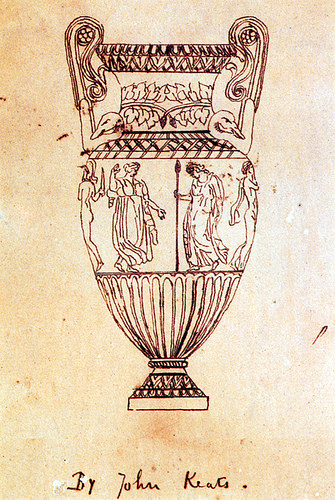
Keats_urnIs there a text in this class? That’s a famous line (and title) from reader-response literary theory, coming later in the semester. For the first two weeks of our exploration of critical theory, the answer to that question is decidedly: “yes, there is only text in this class.” Beginning with the New Criticism, one of the oldest of the critical/literary theories we will study, and then continuing into structuralism and deconstruction, scholars and critical readers focus thoroughly and rigorously and entirely on texts. Although those texts are produced by authors who live in various historical contexts and bodies, and are read by readers who also live in various and different historical contexts and bodies, New Critics, structuralists, and deconstructionists will exclude those other contexts and focus on (a refrain) “the text itself.”

You and I, as English majors, are particularly familiar with this commitment to the text from New Criticism. Its primary strategy, still with us, is close reading. We have been trained to focus on what’s in front of us, the language and its complexities, recognizing that literary texts, and maybe any text at all, if they are worth our attention and interpretation, are highly connotative, not merely denotative. Such texts say what they mean, but they don’t necessarily mean what they say. That’s where the critic comes in.

As we make our way through the various critical theories and strategies, I will continually ask you to consider the uses and limits of each approach. Another phrasing I would use, borrowed from media and design studies: what are the affordances and constraints of the theory? What does it allow us to do and understand and see (theory comes from a Greek word related to vision)? What does it keep us from doing and seeing? This is where critical theory and rhetoric meet up. The rhetorician Kenneth Burke characterized rhetoric as the understanding that “every way of seeing is a way of not seeing.” I think Spivak has this in mind with her understanding of the “double bind.”

And so, with the New Criticism, close reading, close, careful, thoughtful attention to the text and the complexities that attend language and its symbolic uses (“language as symbolic action,” another phrase from Burke)–this legacy of close reading remains a rich and useful legacy of the tradition. We will continue it. Think, for a moment, about your encounters with close reading in the classroom, or in your scholarship. What have you done with this fundamental strategy of literary and textual interpretation? What did it enable you to do?

But also, think for a moment about being limited only to the text and its close reading. Have you had that experience as well? I am thinking of the student who brings into discussion of a text an idea not directly evident in the text, or maybe deliberately brought from outside the text. Something like: that image reminds me of X, where X might be something historical, or personal, or biographical. In the tradition of New Criticism, that student’s contribution would be knocked down by the teacher as “heretical” because it is external to the text. These are the terms used in the critical tradition: “The Intentional Fallacy,” “The Heresy of Paraphrase,” and “the extinction of personality” (Eliot).

Are these, in your view, legitimate and necessary constraints? Should we only focus on the text in our interpretation–and exclude, for example, what the text might mean to us (a kind of paraphrase), or what we think it meant to the author (intention), or where the text comes from (context)? These are matters for further interrogation and application this week as you begin your first “Further Reading.”

One insight to consider. New Criticism was particularly effective with poetry. This made it highly useful in the college classroom, where a poem could be approached within one class period and (perhaps) brought to resolution. This is a key to New Criticism: all the complexities and paradoxes and ironies and tensions so crucial to literary language–what makes it worth interpreting–must be resolved in the end if the work is to be literary art. We will be testing this out with a famous poem about art, Keats’s “Ode on a Grecian Urn.”

But does every poem necessarily resolve its contradictions and tensions? Does a poem need to be art in order to be a poem? And, what about reaching beyond poetry? You might begin to test out the limits of New Criticism by applying it to a novel. What about other kinds of texts and uses of language that Spivak and Emerson have in mind: speeches, film, the “philosophy of the street”? Should New Critical perspectives and interpretive strategies also be of use to us beyond the classroom?


Slowly Reading Spivak, Thinking of Emerson

We will return to Gayatri Spivak later in the semester when we explore postcolonial criticism and theory. She is a leading figure from that school of critical theory. But in reading “Thinking about the Humanities,” we listen in on more general views she has about what it means to be a reader, to be a scholar in the humanities, regardless of the critical methods and theories one develops and uses to do that work. We hear an argument for the relevance of the humanities positioned against the presumption that they–and we English majors–are no longer relevant. (“English? Humanities? What are you going to do with that?”)

Spivak, one could easily argue, has little to do with Emerson. And yet, her definition of the humanities and her emphasis, in particular, on “patience” and “the slow curricular process of the humanities” evokes, at least to my ears, concerns also echoed in Emerson’s “American Scholar.” You might recall that Emerson worries there about a culture too busy and too distracted for letters and he counsels in the end: “Patience,–patience.” Emerson writes of the scholar’s task of observation as “slow, unhonored, and unpaid,” while Spivak refers to the “untimely” aspect of humanistic study. I can’t help but also hear in Spivak’s concerns resonance with another essay I teach at the beginning of my English 101 course: “In Defense of Literacy” by Wendell Berry. Berry argues for a more traditional purpose and focus for English and literary study, one that would make it, as Berry knows, highly unfashionable in the specialized university. And Spivak’s notion of the “double bind” also brings to mind a famous phrase and concept from Emersons’ essay “Fate,” “double consciousness,” a phrase later made more famous by W.E.B. DuBois.

If we read and pursue humanistic scholarship, inspired by these two scholars, Spivak and Emerson, what should or might we do? What does Spivak add to Emerson’s notion of “creative reading”? How does her vision of slowly reading and studying extend Emerson’s? How does Spivak’s vision challenge or complicate it?

If you, today, were to begin the “slow curricular process” of a project, later to develop into your seminar project, or your SCE, or your dissertation or first published essay or book, what might that project do? And how would you do it?

One way I might apply Spivak’s thinking to my own area of scholarship and research (Emerson, 19th c. American literature and culture): take her concluding focus on globalization, and its contradictory, double-blind relation to the humanities, and apply back to Emerson. One could align Emerson, or certain readings of Emerson, with the sort of isolationist and solipsistic “American humanism” Spivak decries. I share her concerns with that pedagogical tradition. But as she notes, that tradition is also for her a double bind, more complicated and contradictory than we might think. And I think this can apply to Emerson’s place in that tradition. Emerson, also, is more global than we think. This is a point of interest in more recent Emerson scholarship. And, if you think about, it’s there already in “American Scholar.” Emerson urges the scholars away from the European muses, but note all his references and points of inspiration from the past are global, not parochial. That’s a contradiction, a double bind that’s worth further study in Emerson. Spivak, unbeknownst to her, and to Emerson, could help me do that. That’s how humanistic reading and critical thinking work.


On the Art of Creative Reading

The phrase in the title of this digital home for the Junior Seminar comes from Ralph Waldo Emerson. The action, “creative reading” is set in some sort of relation (is it also opposition?) to the phrase most people, certainly English majors, are more familiar with, “creative writing.” In his “American Scholar” address to the Phi Beta Kappa Society at Harvard in 1837 (as it turns out, Henry David Thoreau’s graduating class), Emerson says the following:

One must be an inventor to read well. As the proverb says, “He that would bring home the wealth of the Indies, must carry out the wealth of the Indies.” There is then creative reading as well as creative writing. When the mind is braced by labor and invention, the page of whatever book we read becomes luminous with manifold allusion. Every sentence is doubly significant, and the sense of our author is as broad as the world. We then see, what is always true, that, as the seer’s hour of vision is short and rare among heavy days and months, so is its record, perchance, the least part of his volume. The discerning will read, in his Plato or Shakspeare [sic], only that least part, — only the authentic utterances of the oracle; — all the rest he rejects, were it never so many times Plato’s and Shakspeare’s.

Let’s begin to think about what “creative reading” could mean for us and what we will be doing in our Junior Seminar for English majors–we, scholars engaged in the critical study of literature. (A brief note on terminology: in Emerson’s day, “literature” included the study of what we now call English, as well as rhetoric, as well as philosophy, as well as the sciences. That’s an interest area in my scholarship; more later). We know what “creative writing” means and why we need to distinguish that act from what scholars do when they read Plato or Shakespeare. Or, I assume we know that, given the staying power of the phrase “creative writing.” However, I’m not sure that Emerson necessarily views “creative” the way we have come to understand the adjective. I get that sense from his attempt to define “creative reading” on the analogy of what he calls creative writing.

What’s the difference? What’s the relation or correlation between creative writing and reading? Whatever the answers are, I’d like to suggest that we will be exploring the relations and differences in this seminar. Our language, informed by our primary guide, Critical Theory Today, will be more recent than Emerson’s. But it will be similarly theoretical  and critical. Indeed, Emerson argues against the assumption that theory or speculation is a bad thing. We will be using words to think about, reflect on, interrogate, and better understand how words are used in the books we read and the texts we study.

Let’s start with a kind of pre-test, before we know what we think and before we recognize the keywords and concepts you will have in hand by the end of the course and the culmination of your seminar project. 

Question 1: How would you characterize Emerson’s critical approach to literature? What assumptions motivate his assertion of “creative reading”? What terms or critical methods (perhaps ones you have already encountered in your studies to this point) would you apply to Emerson, as similar as well as different from what he envisions for reading? In other words, how would you as a scholar (today) describe how Emerson conceived the work and character of the scholar?

Question 2: If we were to pursue a critical reading of the text that serves as the header image for our syllabus, the image of Marilyn Monroe reading Walt Whitman (a real image, as it happens; favorite authors included Whitman, Joyce, and Ellison), what could we do with it and what could we say about it? What critical/theoretical approaches might this text invite?

cropped-marilyn-reads-walt.jpg

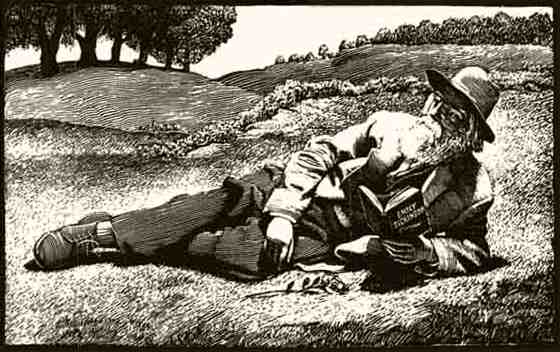
Consider another image which imagines Whitman reading Emily Dickinson. What kinds of critical and theoretical ideas do these images assume or embody? What does that question mean? Stay tuned.

walt