Feminist Criticism and Angela Carter: Burning Down the Patriarchy?

Within feminist criticism, there is, of course, an inherent attempt to explain the relationship between men and women in order to critique the life-long oppression and exploitation of women. The “French feminist psychoanalytic” and “the male gaze” seek to define the internalized effects of a patriarchal system on women. The French feminist psychoanalytic theory is “interested in patriarchy’s influence on women’s psychological experience and creativity,” thus this mode of criticism transcends economic, political, and social structures (Tyson 95). Within feminist criticism, there seems to be a micro and macro-level of analysis that could be applied; for example, one could look at the larger economic and gender relationships within a text, or one could look at the psychological effects male power has on a specific character. In literature, I think that analyzing the presence of a male gaze would allow for a better interpretation of the female character. If the critic, or reader, acknowledged the presence of the male gaze, then they will be better able to form judgments on how gender is working in the text and why the author decided to include the male gaze. The male gaze is a projection onto the female character, therefore, the female character’s perception of herself and the world are altered. In texts where there is a female protagonist, how can that protagonist escape the male gaze? Once a female character is under the male gaze, can she regain power and a true sense of self? Tyson introduces the idea of a “patriarchal woman,” or “a woman who has internalized the norms and values of patriarchy, which can be defined, in short, as any culture that privileges men by promoting traditional gender roles” (Tyson 102). If this is the case, then what allows a text to move beyond traditional gender norms, and does female power and expression exist only because of the patriarchy? To what extent must a text conform to a structure in order to then break it?

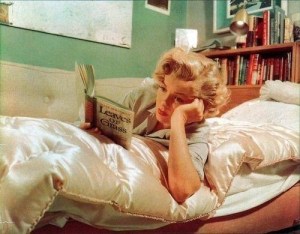
Something I am specifically interested in is how a female author can “burn down the patriarchy” without first conforming to a patriarchal society or set of norms. For example, to deconstruct the patriarchy, an author must first create the space and narrative for male power to rule. This ironic and paradoxical structure conforms to the male gaze in some ways, for the author must accept the “patriarchy’s influence on women’s psychological experience and creativity,” as explained by French feminist psychoanalytical theory, and use the patriarchy as a structure to build their creative work off of (Tyson 95). In Angela Carter’s The Magic Toyshop, Carter creatively breaks down the patriarchy by using satire and elements of the French feminist psychoanalytic theory. Her satirization of the patriarchy complicates her text and alludes to the complex relationship between female freedom and the ever-present patriarchy. Carter comically conforms to and then breaks the male gaze by creating a parody puppet-show of Leda and Swan in which Uncle Philip (male power) pulls the strings and Melanie (young protagonist) plays Leda. While the myth of Leda and the Swan is disturbing and explicitly violates the female body, Carter gives Melanie the power to laugh at Uncle Philip and the swan, for Melanie observes that “it was a grotesque parody of a swan… she nearly laughed again to see its lumbering process” (Carter 165). Carter ironically deconstructs myths, like Leda and the Swan, to allude to how the patriarchy is also a myth that is reinforced by society. The swan symbolizes the patriarchy and as it clumsily walks about Uncle Philip’s dumpy stage, Carter is explicitly humiliating the charade of male dominance. In this way, a psychoanalytic critic may argue that the patriarchy, as seen in Carter’s novel, exists within our subconscious and social levels. While Carter has Melanie make fun of Uncle Philip’s swan, she also creates moments of intense violence and fear; therefore, I think it would be worth exploring how Carter balances gendered power and upholds an ironic tone so that the violent actions against women ultimately point towards a feminist analysis of the text. In this way, feminist theory is reliant on other theories like deconstructionism and psychoanalytical theory to bring meaning to the text’s symbolic gestures and structural choices. 

7974545622e014e86f46a9eb0bb39ccd
https://www.pinterest.com/pin/65231894581154509/?lp=true


Works Cited

Carter, Angela. The Magic Toyshop. Penguin Books, 1996.

Tyson, Lois. Critical Theory Today. 3rd ed., Routledge, 2015


Marxist Criticism: more matter, less art

Atget_-_Avenue_des_Gobelins
Atget (1927)

Marxist criticism is arguably the most politically and socially engaged of the various critical theories we have explored. As Tyson describes it, Marxist criticism has an agenda: “If  a work criticizes or invites us to criticize oppressive socioeconomic forces, then it may be said to have a Marxist agenda.” But the name “Marx,” and certainly the political legacy of Marxism, evoke various abstracted images that will strike many as problematic and at best irrelevant for English majors. What do we do?

Forget the abstractions and think about the materials. And in the process, we can think more about the ideologies (another keyword in Marxist theory) that are at work in the texts we interpret, and also at work in our interpretations.

In focusing on class and the socioeconomic forces that inform our beliefs, politics, culture, and society, Marxism extends the discussion of identity we began with African American criticism and continued with critical theories of gender and sexuality. Class and economics are another marker and shaper of identity. And as Marxists would argue, class is often the least recognized determinant of identity due to the often hidden (occluded) powers of capitalist ideology.

I have borrowed elements of Marxist literary and cultural criticism second hand, from the German critic Walter Benjamin. We will be reading his famous essay “The Work of Art in the Age of Mechanical Reproduction” from 1936. I studied and applied Benjamin to my doctoral dissertation, since he provides insights on rethinking art from the perspective of photography. That’s what I was interested in doing with 19th c American autobiography, a study that eventually became my first book: Mediating American Autobiography: Photography in Emerson, Thoreau, Douglass, and Whitman.

The key insight from Benjamin, and in my admittedly otherwise limited view, a key to understanding the uses of Marxist criticism, is the focus on materiality. We have cultural works and texts–all the things you are thinking about for your projects, or that you have been studying and reading. Those works and texts, though they come to us (usually) as finished products, in fact those products are abstracted from the concrete social and economic contexts in which they were produced. Marxism literary criticism trains its eye on rethinking cultural works by way of their material conditions. If we want to think more about the material conditions of the works we are studying, reading, writing, then Marxist theory might be of use. And if we want to think about what Benjamin calls the “politics of art,” this critical theory is very relevant.

One useful distinction he makes, thinking about photography as a technology of reproduction that undermines (and thus politicizes) traditional art and its aura: exhibition value displaces cult value. Consider this image from the photographer Atget that Benjamin has in mind, and contrast with something like a Van Gogh. What’s the difference, and how might that difference be viewed in terms of politics?

Applications.

As an application, in addition to the Benjamin essay, I think of the Robert Pinsky poem “Shirt.”  [Here is Pinsky reading it in a video from the New Yorker.] We can read this text from any and all of the critical perspectives studied thus far: New Criticism/Formalism, Structuralism, Deconstruction, Reader Response, Psychoanalytic, New Historicism, Critical Race, Postcolonial, Gender/Sexuality.

What does Marxist critical theory help us to see and do with this poem? Would you say that this poem is particularly relevant for a Marxist reading? And if so, are there texts that are less relevant? How might concepts and questions from Marxist criticism be of use to you in the development of your seminar project?

For another example that foregrounds, or perhaps re-envisions, the materiality of reading and literacy, consider this scene from the recent movie The Post. We are reminded of the labor that goes into writing, the production and the process of getting words into print.

Rhetorical Materials.

If we focus more materially and deliberately on our own ideologies (call them also “theories” and “critical perspectives” and “interpretations”), we will strengthen our argumentation. Marxist criticism, in its concern with “false consciousness” and the belief that every idea potentially masks or hides its social and political conditions, can help us think more about our rhetoric: credibility, validity, counterargument.

With our seminar projects, we should address the credibility of our critical sources. What makes a source credible? [In the older rhetorical terms used by Aristotle, this is the appeal to ethos]

We need to think about the validity of our reasoning, specifically the warrants linking our reasons to our claim [This is a matter of logos, the presentation of our evidence and logic. For further discussion, see chapter 11 in The Craft of Research]

We must also consider the potential weaknesses in our own argument and the potential strengths in perspectives other than our own. In other words, take up a counterargument. [Related to logos, this is also an appeal to pathos]


Idol Worship around Israel

My seminar project is to look into the transition from polytheistic culture to a more modern monotheistic culture. I will be focusing this on Biblical scripture which will of course limit my scope to Judeo-Christian beliefs around the area of Israel.

One source which I would like to use is a book by Frank Stockton Dobbins called False Gods: Or, The Idol Worship of the World. The book focuses on the worship of Gods from polytheistic cultures around the world, many of which would be considered pagan in some degree. Dobbins is very interested in what pushes people towards faith in a more logical approach.

The way in which this source fits with the project I am trying to do is the ways in which it discusses overlaps of culture in neighboring regions. For the purposes of my research and subject I will be focusing on the Middle East and Israel in particular. As that is the heart of the Judeo-Christian belief in a geological stand point it makes sense that much of the idea of modern monotheism stems from this area as well. Dobbins is able to touch on this through discusses the surrounding Empires and Kingdoms that had a great deal of influence over the developing culture of Israel. One example that Dobbins has much focus on is Egyptian culture and their entire roster of Gods and mythology all to their own.

By using this source I can help to explain specific examples of crossover between Judeo-Christian beliefs and the Egyptian pantheon. I can look into what ways particular Gods had some characteristics rub off on the singular God of Israel as well as the many clashes between the two peoples. A huge example to be related to this subject is the Hebrew population living in Egypt for a time before being enslaved and highlighting that crossover. However, the book has its limits as it talks very little of monotheism and therefore leaves half of my subject out. This should at least get me half of the story I need to make the argument and further research.

Dobbins, Frank S. False Gods; or The Idol Worship of the World. A Complete History of Idolatrous Worship throughout the World, Ancient and Modern. Describing the Strange Beliefs, Practices, Superstitions, Temples, Idols, Shrines, Sacrifices, Domestic Peculiarities Etc., Etc., Connected Therewith. Blackall.

Annotation

Annotation

My SCE project will look at how colonial violence spans generations through hereditary trauma in three texts, Chimamanda Ngozi Adichie’s novel Purple Hibiscus, Mai Der Vang’s book of poems Afterland, and lê thi diem thúy’s novel The Gangster We are All Looking For. The motif of family in these texts is used to explain transgenerational trauma responses to past and current psychological effects of colonization and war. I will be looking at critical perspectives of postcolonial theory, family trauma, and literary criticism in order to show my audience the importance of heritage and transgenerational narratives in postcolonial literature.

Abubakar, Sadiya. “Traumatic Experiences of Nigerian Women: An Archetypal Representation in Adichie’s Purple Hibiscus.” IRA-International Journal of Management & Social Sciences (ISSN 2455-2267) [Online], 4.3 (2016): 602-611. Web. 24 Oct. 2019

Abubakar’s article, “Traumatic Experiences of Nigerian Women: An Archetypal Representation in Adichie’s Purple Hibiscus”, provides an insight into how literature talks about trauma, and how trauma shapes generations. Abubakar talks about women’s oppression and trauma due to sexual assault, abuse, and poverty in Nigeria. She relates the patriarchal oppression of women to Purple Hibiscus, which she calls “an epitome of Nigerian women’s difficulties and their traumatic experiences” (Abubakar 603). Abubakar’s article discusses trauma theory in relation to literature and delves into the psychology of several of Adichie’s characters. Abubakar’s argument is that multiple traumas, from domestic violence to the trauma of oppression, affect and shape the Adichie’s characters and their familial relationships. These character relationships reflect to the trauma postcolonial Nigerians face. Abubakar’s main project is to show through literary analysis the necessity of trauma centers in Nigeria, and that literature is “unveiling such issues of trauma and letting it to penetratingly reach out to the world through narration” (610). This text is important to my SCE because it provides an overview of trauma and how it affects Nigerian people, and specifically Purple Hibiscus.  Abubakar’s article focuses specifically on women, but I believe that this is not a limitation because of women’s role in affecting the culture of both families and generations. My argument that trauma is hereditary, and that Purple Hibiscus shows an example of this psychological phenomenon, is supported by Abubakar’s examples of women’s trauma in postcolonial Nigeria and her analysis of Adichie’s writing.  I will use Abubakar’s article to support my argument that the characters in Purple Hibiscus inherit the postcolonial trauma of their parents and ancestors through the way this trauma shapes their family dynamic.

Annotation

My topic is currently how specific reinterpretations of the Cinderella tale are affected by the changing gender roles of the surrounding time period.

Dundes, Alan. Cinderella, a Folklore Casebook. Garland Pub., 1982.

The source I will be looking at is Cinderella, A Folklore Casebook by Alan Dundes.  This book contains both a small collection of early Cinderella tales, such as Perrault’s and the Grimm Brothers’, as well as small essays analyzing different aspects of the tale and its interpretations.  I find this source useful for its translation of both Perrault’s and the Grimm Brothers’ versions, as they were written in French and German, respectively, and the first section of this book gives me easy access to the translated versions and annotates where they came from.  This will give me original texts to work with and compare to other versions.  I had been planning on using some of the essays in the next section of the book, but the one I was looking at specifically turned out to use psychoanalysis theory rather than cultural, feminist, or gender theory as I had hoped.  I plan on looking at a few more of the essays included, but I don’t hold much hope of finding something useful, not least of all because this book was published in the 1980’s and uses essays from a few decades before.  What I find more useful is the bibliography of this book.  It will hopefully lead me to more helpful sources.  I plan on using both the bibliographies of the essays that are included as well as the selected bibliography at the back that is intended for further research.

Feminism, Gender, and Sexuality: bodies that matter

Where, when, how, why, and in what forms do we experience gender and sexuality in life? In literature and culture–in other words, as readers/writers/scholars in English? Much as we discussed recently with postcolonial criticism and its overlapping interest in issues of race, I propose that we interrogate how various concepts and keywords from feminist criticism, gender and sexuality studies, and queer theory speak to our experiences with literature and culture.

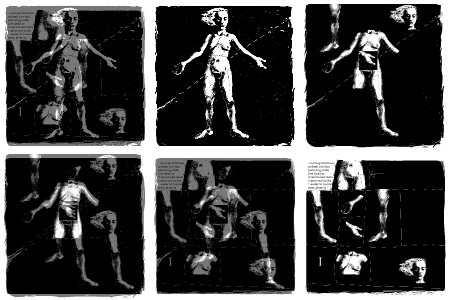
For a possible application this week, I turn our attention to the writer Shelley Jackson. Her work brings to mind several concepts and issues that intersect with the reading this week, perhaps most prominently the idea of “ecriture feminine” from Cixous and French feminism: a writing that is “fluidly organized and freely associative” and and “resists partriarchal modes of thinking and writing” (Tyson 96).

Jackson engages with this and other critical theories while also performing it in her hypertext novel Patchwork Girl, her imaginative rewriting and extension of Mary Shelley’s Frankenstein. Unfortunately, you need special software to “run” this computer-based novel (and my copy is out of date). To get a sense of how hypertext reads, take a look at Jackson’s essay/memoir “My Body”–this one you can read since it is on the web. And here is Jackson writing about hypertext and Patchwork Girl, in a critical essay “Stitch Bitch.” Notice how she describes hypertext as a “feminine” writing:

Bad writing is all flesh, and dirty flesh at that: clogged with a build-up of clutter and crud, knick-knacks and fripperies encrusted on every surface, a kind of gluey scum gathering in the chinks. Hypertext is everything that for centuries has been damned by its association with the feminine (which has also, by the way, been damned by its association with it, in a bizarre mutual proof without any fixed term). It’s dispersed, languorous, flaunting its charms all over the courtyard. Like flaccid beauties in a harem, you might say, if you wanted to inspire a rigorous distaste for it. Hypertext then, is what literature has edited out: the feminine. (That is not to say that only women can produce it. Women have no more natural gift for the feminine than men do.)

Another text by Shelley Jackson extends her interest in the intersectionality of writing and gender and the body in some remarkably vivid ways. Check out “Skin: A Mortal Work of Art,” a text published on the bodies of 2095 volunteers.

Jackson’s work as a contemporary writer and performance artist might be something to pursue for further research, perhaps an SCE project. But even if we don’t want to study a contemporary writer thoroughly engaged in the issues and actual texts of feminist and gender theory (she quotes Derrida, Cixous, and others in Patchwork Girl), how might concepts from those theories apply to other texts and authors elsewhere in our study of English, even works that might not seem to be particularly relevant for thinking about gender and sexuality.  As we discussed last week, at the very least, we can seek out our necessary “counter-discourse.” And in the process, we might discover that a work in question is more gendered or queer than we first assumed.

For example, we could return to Emerson’s “American Scholar” and give more thought to his gendering of the scholar, ‘Man Thinking.” What are the implications? What questions and problems regarding this passage do the critical theories of gender and sexuality help us identify? Are there gendered or queer or, as Halberstam puts it, “trans*” readings of the passage we could or should consider?

It is one of those fables, which, out of an unknown antiquity, convey an unlooked-for wisdom, that the gods, in the beginning, divided Man into men, that he might be more helpful to himself; just as the hand was divided into fingers, the better to answer its end.

The old fable covers a doctrine ever new and sublime; that there is One Man, — present to all particular men only partially, or through one faculty; and that you must take the whole society to find the whole man. Man is not a farmer, or a professor, or an engineer, but he is all. Man is priest, and scholar, and statesman, and producer, and soldier. In the divided or social state, these functions are parcelled out to individuals, each of whom aims to do his stint of the joint work, whilst each other performs his. The fable implies, that the individual, to possess himself, must sometimes return from his own labor to embrace all the other laborers. But unfortunately, this original unit, this fountain of power, has been so distributed to multitudes, has been so minutely subdivided and peddled out, that it is spilled into drops, and cannot be gathered. The state of society is one in which the members have suffered amputation from the trunk, and strut about so many walking monsters, — a good finger, a neck, a stomach, an elbow, but never a man.

Man is thus metamorphosed into a thing, into many things. The planter, who is Man sent out into the field to gather food, is seldom cheered by any idea of the true dignity of his ministry. He sees his bushel and his cart, and nothing beyond, and sinks into the farmer, instead of Man on the farm. The tradesman scarcely ever gives an ideal worth to his work, but is ridden by the routine of his craft, and the soul is subject to dollars. The priest becomes a form; the attorney, a statute-book; the mechanic, a machine; the sailor, a rope of a ship.

In this distribution of functions, the scholar is the delegated intellect. In the right state, he is, Man Thinking. In the degenerate state, when the victim of society, he tends to become a mere thinker, or, still worse, the parrot of other men’s thinking.

In this view of him, as Man Thinking, the theory of his office is contained. Him nature solicits with all her placid, all her monitory pictures; him the past instructs; him the future invites. Is not, indeed, every man a student, and do not all things exist for the student’s behoof? And, finally, is not the true scholar the only true master? But the old oracle said, `All things have two handles: beware of the wrong one.’ In life, too often, the scholar errs with mankind and forfeits his privilege. Let us see him in his school, and consider him in reference to the main influences he receives.


My subtitle echoes the title of an important theoretical work in gender and sexuality studies by the philosopher Judith Butler, Bodies that Matter: On the Discursive Limits of “Sex.” 

Tyson refers to some cultures that do not have a male/female gender binary. Here is discussion of a photographer exploring that with regard to Tahitian culture.


Elevator Pitch Revised

X: The subject I would like to look further into is the Torah concerning the characterization of God. While looking back it seemed as though I should stick to just one character or book of the story that seems to be too limiting.

There is a gradual realization of God as a deity/character over the course of the Torah. The book of Genesis begins the writings of God and has an early conception of his identity. This development began with the idea of monotheism from a world that was filled with polytheistic cultures. Judaism had its beginnings with Egyptian and Canaanite Gods before leading into times with Babylonian and Assyrian Gods as opposition. These other cultures had an influence over the eventual monotheistic culture that spans Judaism, Christianity and Islam.

Y: The Question I want to ask is how did the Textual Scripture show this transition from polytheistic cultures into a monotheistic culture? How is the Bible itself able to make slowly more distinct images and rules of God being a singular being that isn’t supported by a cast of other deities?

Z: This Question would help to answer the early characterizations of God. It would help to explain why there is a distinct difference in God in his early scripture as being mistake at times for one of many or having different personalities assigned to him. This can also be easily seen in God’s early actions being much more violent than his later actions.

One source I would like to use aside from the King James Bible is a book called False Gods; or the Idol Worship of the World by Frank Stockton Dubbins. The book discusses idolatry or the worship of other Gods which makes for a great point to be made about God’s characterization in Biblical scripture. One of the first establishing parts of God being a singular God is when he is confronted with his people worshipping God’s other than himself. This subject should make for a bulk of the transition but not all of the idea needed.

Dobbins, Frank S. False Gods; or The Idol Worship of the World. A Complete History of Idolatrous Worship throughout the World, Ancient and Modern. Describing the Strange Beliefs, Practices, Superstitions, Temples, Idols, Shrines, Sacrifices, Domestic Peculiarities Etc., Etc., Connected Therewith. Blackall.

Updated Elevator Pitch: Reader Response to Paradise Lost in colonial American rhetoric

Throughout the epic poem Paradise Lost by John Milton, there are many instances in which the reader is presented with complex ideas that are soon after refuted, causing a joint empowerment and humiliation of the reader. It seems as though the text is written specifically to influence the reader to Milton’s opinions on power and free thinking while simultaneously giving readers the power to make their own conclusions about what Milton is presenting to them. I plan to argue in my seminar project that Milton’s awareness and intentional engagement with his reader throughout Paradise Lost adds to the effectiveness and success of the text. The reception of this epic poem in 18th century colonial America is of particular importance due to the significant influence of Puritan and republican themes portrayed in Paradise Lost on the foundation of America’s government and culture.
This seminar project will work in conjunction with my thesis to help analyze secondary sources and incorporate different literary criticisms into my paper. I want to incorporate reader-response criticism specifically into the project because I feel that my argument can be best supplemented using this criticism and I believe that it will help in the development of my SCE paper as well. Creating a connection between Paradise Lost and particular influences on the American Revolution using reader-response criticism will allow for a greater understanding of Milton’s political undertones in his writing and the subsequent possibility of influence from Paradise Lost into aspects of the American Revolution. Focusing in on the rhetoric of colonial America such as pamphlets and persuasive texts such as Common Sense by Thomas Paine and seeing the impact of Milton in those texts will help me to see more directly how large of an impact Milton’s ideas had on the American revolution.
Evidence will be drawn from Paradise Lost itself, as well as secondary sources that focus on the reader-response and interaction between Milton and his readers in Paradise Lost. Some key words I would like to incorporate into this project are reader experience, intention, affective stylistics, and resymbolization. By assessing the relationship between Milton and his readers in Paradise Lost, I can gain a better understanding of the text itself and how it could have influenced other writers and events. I will be further analyzing Paradise Lost and the Rise of the American Republic by Lydia Schulman as part of my seminar project.
Works Cited:
Fish, Stanley. “Surprised by Sin” – Stanley Fish | Harvard University Press, https://www.hup.harvard.edu/catalog.php?isbn=9780674857476
Milton, John. Paradise Lost. Oxford University Press, 2008.
Schulman, Lydia D. Paradise Lost and the Rise of the American Republic. Northeastern Univ. Press, 1992.

Ableism in Focus: Disabling and Disembodying Ways of Knowing (revised)

X: Ableism within hegemonic literary structures, particularly forms of epistemological centrism (ocularcentrism, phonocentrism).

Y: The most basic tenet of ocularcentrism is the idea that “seeing is believing,” the best way we can know something is by seeing it firsthand. Phonocentrism works slightly differently, prioritizing sound and speech over image and text. Phonocentrism further posits that written text is subpar as a method of acquiring knowledge as it is derived from and tries, but ultimately fails, to replicate speech. For the able-bodied, a person may prefer one method over another, but both are likely to appear valid. Both structures assume that all people interacting with them are both sighted and hearing, having the ability to choose with which sense they experience something. What happens, however, when someone doesn’t have the privilege of sight or hearing? Are those people then unable to know? Does their knowledge become secondary? Must they inherently endorse a kind of centrism? Who benefits from the prioritization of knowledge?\

Z: Looking at structural ableism, deconstruction, and theories of disability I plan to address the inherent ableism of prioritizing the Aristotelian senses, particularly of placing one sense above all others. Deaf poet Meg Day’s collection Last Psalm at Sea Levelabandons musicality for rich tactile and flavorful description. Helen Oyeyemi’s surrealist short fiction found in What is Not Yours is Not Yoursattempts to make sense of arcane knowledge—characters with ideas of the world they can’t explain with sensory experience. Using these texts, I hope to further expose ableist structures in literature and argue against any kind of epistemological centrism that disadvantages or others the reader/viewer (terms which are themselves ableist).


A secondary text I may use is Martin Jay’s “The Rise of Hermeneutics and the Crisis of Ocularcentrism,” an article that argues against the triumph of either the eye or ear as a dominant mode of imagery production.

Jay, Martin. “The Rise of Hermeneutics and the Crisis of Ocularcentrism.” Poetics Today 9, no. 2 (1988): 307-26. doi:10.2307/1772691.

Familial Trauma in Postcolonial Literature

For my SCE project, I will be looking at three primary texts: Chimamanda Ngozi Adichie’s novel Purple Hibiscus, Mai Der Vang’s book of poems Afterland, and lê thi diem thúy’s novel The Gangster We are All Looking For. These texts differ in form, content, culture and country. Purple Hibiscus is a coming-of-age novel about a young girl, Kambili, living in an abusive Catholic household in postcolonial Nigeria. Afterland is a collection of poems about the Hmong people’s displacement from Laos after the Vietnam War, where there were attempts at colonization through the military. The Gangster We are All Looking For is the story of a young, unnamed Vietnamese immigrant whose family has fled to San Diego. Though these texts are in many ways dissimilar, each of them deals with postcolonial life and the aftereffects of colonialism. I am thinking about the way that each of these texts deals with family, either ancestral or living, and how familiar ties shape and define trauma. I want to look at the reality of hereditary trauma in postcolonial societies, and how family dynamics can be affected by this trauma. In my SCE, I aim to explore how colonial violence spans generations in order to show my audience the importance of heritage and trans-generational narratives.

I will be looking at critical perspectives of postcolonial theory, psychological theory surrounding family trauma, and literary criticism concerning these three texts. Postcolonial criticism will help me to shape my argument and my readings of these three texts. I will suggest that the motif of family in these texts is used to explain trans-generational trauma responses to past and current psychological effects of colonization. This is extremely important to understand not only the history of colonization, but the lasting psychological effects that are passed down in family dynamics. I argue that these effects are not created through genetics but through hereditary trauma, making it possible for children to take on the postcolonial trauma of their ancestors. These texts show this notion through the motif of the family, using metaphor, character, and imagery.

Keywords: Family, Trauma, Motif, Postcolonial

Provisional Works Cited:

Jacob, John. “Hmong American Identity in Literature.” Salem Press Encyclopedia of Literature, 2019.

Quan Manh Ha. “Conspiracy of Silence and New Subjectivity in Monkey Bridge and The Gangster We Are All Looking For.” Journal of Southeast Asian American Education and Advancement, 2013, p. 1.

Bhattcharjee, Partha, and Priyanka Tripathi. “Ethnic Tensions and Political Turmoil: Postcolonial Reading of Chimamanda Ngozi Adichie’s Purple Hibiscus.” Language in India, vol. 17, no. 3, Mar. 2017, p. 433.

Elevator Pitch (Revised)

Chase Berggrun’s poetry book, R E D, is an erasure of Bram Stoker’s novel, Dracula. According to Berggrun’s website, “R E D excavates from Bram Stoker’s Dracula, through the process of erasure, an original narrative of violence, sexual abuse, power dynamics, vengeance, and feminist rage, and wrestles with the complexities of gender, transition, and monsterhood.”

I am interested in looking at the way Berggrun deconstructs Stoker’s text not only to create erasure poems, but to completely flip the narrative on its head to explore ideas of gender using queer theory. By applying deconstruction to the Dracula through R E D, and applying queer theory to R E D directly, I will explore how queer voices have been historically erased, and Berggrun uses literal erasure to begin to give them back some of their power.

X: Exploration of gender in R E D by Chase Berggrun.

Y: How have queer voices been historically erased? In what ways are they fighting back against that?

Z: By pushing back on these traditional and exclusionary structures, queer voices are able to reclaim their stories in the very ones that cut them out in the first place.

As a preliminary secondary source, I may look at “Out of Time: Queer Temporality and Eugenic Monstrosity” by Thomas Stuart. “Out of Time” explores Dracula and how the titular character “stand[s] in opposition to the progress- and procreation-oriented culture of fin-de-siècle England. This paper examines the Gothic queerness of stopped time, arguing that a subtle figuration of these characters as trans- underlies their radical break from a contemporary eugenic logic. A trans- impulse in these texts—one that encompasses taxonomic, temporal, and gender boundaries—initially marks the monstrous body but ultimately engulfs the English subject,” according to the article’s abstract.

As a second secondary source, I may look at “‘Nothing is Left Out’: Kenneth Goldsmith’s Sports and Erasure Poetry” by Brian C. Cooney. According to the abstract, this essay takes “a closer examination of [erasure poetries] beginning with their antecedents in the visual arts reveals a number of disparate techniques resulting in erasure and a wide variety of political and aesthetic results.” While not all of this essay will apply, it may make a good starting point for defining terms and looking at erasure poetry. It will also give me some more ideas for secondary sources, based on the ones Cooney uses in his article.

Works Cited:

Berggrun, Chase. “Home: Chase Berggrun.” Website, 2017, http://www.chaseberggrun.com/.


Potential sources (primary and secondary):

Berggrun, Chase. R E D. Birds, LLC, 2018.

Cooney, Brian C. “‘Nothing Is Left Out’: Kenneth Goldsmith’s Sports and Erasure Poetry.” Journal of Modern Literature, vol. 37, no. 4, 2014, pp. 16–33. JSTOR, http://www.jstor.org/stable/10.2979/jmodelite.37.4.16.

Stuart, Thomas M. “Out of Time: Queer Temporality and Eugenic Monstrosity.” Victorian Studies, vol. 60, no. 2, Winter 2018, pp. 218–227. EBSCOhost, doi:10.2979/victorianstudies.60.2.07.

Tarner, Margaret, and Bram Stoker. Dracula. Macmillan Heinemann, 2005.


Updated elevator pitch: Trauma’s Role in Young Adult Literature

I am still interested in looking at young adult literature that addresses topics that are often seen as taboo or censored. I am shifting my focus to look at the role of trauma in these texts and the function that this role has for readers of these texts. I would still like to use this focus to allow readers to better understand where the line between representation and activism falls in young adult literature.

X: Young adult literature that addresses topics that are often seen as taboo or censored.

Y: What is the role of trauma in these texts and what function does that role have for readers of censored young adult literature?

Z: There is a point at which representation in a text shifts to become activism.

I still think that a combination of reader-response theory and psychoanalytical theory will be most useful for my project. Using psychoanalytical theory, I can analyze the ways in which the characters in the text cope with their trauma. Making a distinction between the author as activist and the reader as being inspired to engage in activism, reader response theory could be beneficial in analyzing where a text falls between representation and activism. Specifically, I can use affective stylistics to further look at how the reader responds to how the text is written.

Another article that could be useful is Power in Our Words: Finding Community and Mitigating Trauma in James Dashner’s The Maze Runner by Amy Elliot.

Works Cited

Elliot, Amy. “Power in our Words: Finding Community and Mitigating Trauma in James Dashner’s the Maze Runner.” Children’s Literature Association Quarterly, vol. 40, no. 2, 2015, pp. 179-199. ProQuest, https://washcoll.idm.oclc.org/docview/1686768135?accountid=14892.

Until Proven Guilty: The Lack of Justice in And Then There Were None

I want to question the idea of justice in Agatha Christie’s And Then There Were None.  There are arguments aplenty on if U. N. Owen is justified or even interested in justice when they (singular) murder ten people, each of whom is accused of getting away with killing someone.  A closer look at how Owen accomplishes their idea of justice, and the people who are punished under it, reveals much more ambiguity. First, we must consider the “criminals” killed. One character, Emily Brent, is accused of causing a teenage girl’s suicide—even though Brent didn’t cause the suicide or tell the girl to kill herself.  Two other characters are never even confirmed guilty. They also happen to be, some say, the most minor: Thomas and Ethel Rogers, the butler and cook. But a New Critical lens reveals the Rogerses’ so-called underdevelopment makes them ripe for a range of interpretations, and their opaqueness is not classist ignorance on Christie’s part, but an unsolved mystery within a mystery.  Because we know so little about them and we never hear their thoughts, we never know if they’re guilty or innocent. In fact, there’s no conclusive evidence they committed murder. This ambiguity severely disrupts U. N. Owen’s master plan.  

Second, we must ask if Owen can enforce justice alone.  Under the English system, justice was jointly administered by the police, jury, judge, and executioner.  While Owen finds this unable to bring every killer to justice, Marti’s and Saks’s meta-analysis shows the importance of having many people involved in court proceedings.  When only one person is police, judge, jury, and executioner, it inherently contaminates the system’s integrity.  

Considering the potential innocence of the “guilty,” and the limitations of the one-person judgment, it becomes apparent that U. N. Owen’s plan for “justice” is poorly thought out at best.  At worst, it’s not justice at all.  

Potential Sources

Saks, Michael J., and Mollie Weighner Marti. “A Meta-Analysis of the Effects of Jury Size.” Law and Human Behavior, vol. 21, no. 5, 1997, pp. 451–467. JSTOR, www.jstor.org/stable/1394327.

Vurmay, M. Ayça.  “Detection or Endless Deferral/Absence in Detective Fiction: Agatha Christie’s And Then There Were None.”  DCTF Dergisi, 57.2, 2017, pp. 1127-1150.  

Lesser Known Keats, Refined

I am still interested in Keats’ lesser known poetry, namely the poems from his collection published in 1817, as well as individual poems that were published in 1816. These are the earliest of his poems, and they are quite distinct next to his famous odes, which were mostly written in 1819-1820. Thus, this project now specifically acknowledges that these works were his early works, though I implied as much in my last pitch. I am still interested in examining the literary discourse around these works in Keats’ own moment and now, as I have found minimal discussion in both periods. This discussion is dwarfed by the conversation around the poems Keats wrote later. At the least, though, these poems are practice for the odes. More likely, in my opinion, they are genius of their own. In looking at the little criticism around these lesser known works, and the relatively large lack thereof, I want to get to the core of what Keats’ “genius” actually is and how these poems feed into that rather than detract from it. I believe this will create a more dimensional and cohesive understanding of Keats’ entire body of text, rather than finding certain pieces in contention with each other or simply not acknowledging large sections.

 Since there is an element of examining the criticism around Keats’ work over the past two hundred years, I believe there is a historical and/or cultural context here that is working for some of his poems and perhaps working against other. I plan to implement New Historicism in parsing this out. I think perhaps part of the answer to the secondary question of what Keats’ genius is could lie in that as well, but I also feel like there’s another type of criticism that would be useful for specifically outlining that. I’m not sure about any of the ones we have studied already right now.

As for an additional source, I found an old examination of two critiques that came out when Keats first published his initial collection. This gives me a clearer idea of what people were thinking at that time and why, specifically in terms of Keats in relation to other poets. This relationship to the other Romantics, who seem to have cast a long shadow over Keats, could very well be relevant to why these works are left relatively untouched.

Additional Secondary Source

 Cornelius, Roberta D. “Two Early Reviews of Keats’s First Volume.” PMLA, vol. 40, no. 1, 1925, pp. 193–210. JSTOR, www.jstor.org/stable/457276.

Updated Elevator Pitch- Transactional Reader Response Theory and “The World According to Garp”

Despite my deep curiosity about writing groups who have enjoyed lasting success, I’m shifting gears in a big way. As much as I’d like to go down that path, the questions that are emerging from my research seem to be pointing toward answers that are primarily sociological and historical. I’d like to use my opportunity in Junior Seminar to explore a textual or literary artifact through the application of a critical theory.

John Irving has always been a favorite author of mine. In his 1976 novel, “The World According to Garp”, he deals with many controversial topics for that time (and even in this time) such as rape, asexuality, marriage, paternal love, feminism and more. As I researched this novel and its impact, something that came up in several critiques of the work was the reader response to the text.

Professor Harold Harris writes, “no novel that I have taught was so well liked, talked and written about as well, or succeeded nearly as well in getting students to think seriously about what novels are, what novelists do, and what we as readers can do with novels” (Harris, p. 111) Harris acknowledges that there are certainly finer novels. But no other novel has sparked such a reaction from his students.

Benjamin Percy states, “He has sold tens of millions of copies of his books, books that have earned descriptions like epic and extraordinary and controversial and sexually brave. And yet, unlike so many writers in the contemporary canon, he manages to write books that are both critically acclaimed and beloved for their sheer readability. He is as close as one gets to a contemporary Dickens in the scope of his celebrity and the level of his achievement; the two of us couldn’t walk down the street or order a coffee in Toronto without his being hyperventilatingly recognized by a fan” (Percy).

So what makes the novel “The World According to Garp” so compelling to its readers? What makes them tremble with excitement at meeting its author?

One reason is that Irving’s well-crafted novel leaves enough room in the text for “multiple explanations – which allow or even invite readers to create their own interpretations” (Tyson, p. 166). This is a novel where the author means for the reader to find a position, discuss it, and even defend it. Transactional reader response theory allows the author the opportunity to create experiences for the reader to engage in “retrospection… anticipation… fulfillment or disappointment…revision… and so on” (Tyson, p. 166). This text, that positions itself as the biography of a writer as he develops, “guides us through the processes involved in interpreting… it” (Tyson, p. 166). As the writer Garp grows and evolves, so does the reader’s interpretation of him and the events and characters of the story.

The transaction between Irving and his readers is what makes this novel and others he’s written compelling and exciting to discuss and write about.

Works Cited

Harris, Harold J. “Teaching Garp.” Journal of Aesthetic Education, vol. 16, no. 2, 1982, pp. 108–111. JSTOR, www.jstor.org/stable/3332284.

Percy, Benjamin. “THE Wrestler.” TIME Magazine, vol. 179, no. 19, May 2012, pp. 40–45. EBSCOhost, search.ebscohost.com/login.aspx?direct=true&db=a9h&AN=75053051&site=eds-live.

Tyson, Lois. Critical Theory Today: a User-Friendly Guide. Routledge, Taylor & Francis Group, 2015.