
Elevator Speech 2 – Cinderella and Gender Roles

My project has changed since the last post, so here is a new elevator speech. For my project, I want to use New Historical and Cultural theory to look at how multiple renditions of the Cinderella fairy tale reflect the gender roles of that time and how they have changed.  The Cinderella tale is very popular, appearing in many different cultures and having many popular retellings, to the point where it has become a standard story type.  Because this story is so popular, and because it is something that is told to our children literally from birth so many times that they have it memorized for the rest of their lives, I think there is an interesting connection between how Cinderella is portrayed and what we want her portrayal to teach the children who are absorbing this story.  My topic is the cultural impact of the Cinderella tale, my question is how does the portrayal of Cinderella reflect the gender roles of the culture that produced that particular tale, and my hypothesis is that they show the ideal girl to fit those roles and that they show the qualities that are valued in women at that particular time.  One of the sources I plan on using is Cinderella: A Folklore Casebook by Alan Dundes which is a collection of both different versions of the Cinderella tale from different cultures and essays analyzing them and how they relate to one another.  This will be a useful source for me because it will give me both tales to look at and comparisons between them, which will show me how the retelling have changed.  The specific versions I want to look at are the Charles Perrault, the Brothers Grimm, the Disney 1950’s animated film, and the Ella Enchanted film.

Dundes, Alan. Cinderella: a Folklore Casebook. Garland, 1982.
Updated Elevator Pitch: Becca Kanaskie

I am looking at Gretel Ehrlich’s experiences, depictions, and interactions in the West in her memoir The Solace of Open Spaces in order to analyze the ways in which she uses this platform to transform personal experiences into universal concepts so that my readers can better understand the function, purpose, and effect of memoirs as a genre and the relationship formed between author and reader in the sharing of personal anecdotes within the text. 

I think that applying a structuralist lens is appropriate here as it allows me to see how Ehrlich plays with the form of her experiences chronologically, but also gives me contrast to see how she breaks from that form and what the purpose would be. I also think that addressing reader response is essential because memoirs are meant to create a bond between author and reader, and the author is trying to convey a key message to the reader through personal stories and the effect on the reader is necessary to consider as it can determine how effective the author/memoir is. Finally, I believe looking at this memoir through a psychoanalytical lens will help me to determine why Ehrlich chose to write this memoir and thus how she and her readers can benefit from reading/writing these texts. I ultimately seek to understand why memoirs are so successfully and compelling to readers, but I also wish to find out why the author felt compelled to share his or her story.

Greiner, D.Rae. “Negative Response: Silence in Gretel Ehrlich’s The Solace of Open Spaces.” Women’s Studies, vol. 29, no. 2, Mar. 2000, p. 217-248. EBSCOhost, doi:10.1080/00497878.2000.9979309.

Updated Elevator Pitch; Nicole Hatfield

X: I am working on the transparent and ecocritical portrayal of land injustice among the Australian Aboriginal people in Judith Wright’s collected poetry. 

Y: With regard to land injustice, I am interested in how Judith Wright (a white woman) addresses her whiteness and inherent guilt when writing about environmental issues and racial injustices in Australia. Specifically, how does she bridge the gap between literary activism, which deliberately calls out political and social issues, and poetics? To what extent has environmental literature shifted from being romantic, idealistic, and existential? And does this shift reflect the modern urgency for policy change and literary activism? Does Judith Wright participate in an active conversation about systemic racism and land injustice, to what extent are her poems doing cultural work? 

Z: Using Judith Wright’s poetry as an example of literary activism, I hope to show how there is a concrete connection between environmental injustice and the oppression of the Aboriginal people. If we rethink how poetry uses natural imagery and reflective metaphors, we can understand the cultural connections to people and their landscape. In addition, in grounding her poetry in realistic landscapes and environments, Wright participates in an environmental conversation about humanity’s degradation of both land and marginalized groups of people. 

Sources:

  1. Slow Violence And The Environmentalism Of The Poor by Rob Nixon
  2. Bad Environmentalism by Nicole Seymour 

Postcolonial Criticism: double consciousness and slow violence

We observed “double consciousness,” one of the keywords of African American criticism and theory, at work in Frederick Douglass’s Narrative. It’s a phrase that takes us back to our first reading and Spivak’s notion of the double bind. You might recall at that time that I heard echoes there of the phrase “double consciousness” coined by Emerson (thinking of Plato), but also the version made more famous later by the African American essayist W. E. B. Du Bois (in Souls of Black Folk, 1903).

There are lots of new keywords and concepts we encounter in postcolonial criticism, but also much that relates to issues and ideas from African American and critical race theory. One way to explore them further would be to continue to listen and look for issues of “double consciousness” in postcolonial concepts such as the following:

  • mimicry
  • unhomeliness/unhomed
  • diaspora
  • othering
  • hybridity
  • intersectionality
  • margin/center
  • canonical counter-discourse

Indeed, the very disputes that are ongoing within postcolonial critical discourse, recounted by Tyson (is it still relevant? has globalization put an end to postcolonialism?) speak to another kind of double consciousness. On the one hand it seems to be a thing of the past, no longer relevant; on the other hand, as Rob Nixon argues (discussed by Tyson), postcolonial criticism can be very relevant to current matters such as environmentalism. And as we learn from Toni Morrison and her conception of “whiteness” and the “Africanist presence” in American literature, these implications of double consciousness are in the texts we read, even when we don’t (initially) see them.

I would take it a step further, remembering the rhetorical principle from Kenneth Burke: every way of seeing is a way of not seeing. In order to make a persuasive and informative argument, regardless of our texts, we need to consider and explore the double consciousness of our argument. We need to engage in counter-discourse with our own position, and risk the unhomeliness of our ideas. What other perspectives might I consider, even if I don’t think (initially) they are relevant? What changes in my perspective when I do so? A more persuasive argument, in the language of postcolonial theory, is rhetorically hybrid and intersectional.

For those interested in Rob Nixon’s scholarship, combining environmental literary theory and criticism with postcolonial theory, check out his 2011 book Slow Violence and the Environmentalism of the Poor. Our library has a copy. It’s quite stunning.

And for a recent application of perspectives raised by both critical race and postcolonial theory, consider this NY Times discussion by Jenna Wortham, “White Filmmakers Addressing (Or Avoiding) Whiteness Onscreen.


African American Criticism: Within the Circle

African American literature has been around a long time. The critical study of African American literature, or African American criticism, emerged more recently, shaped in part by social and political changes, and guided in part by critical theories such as deconstruction and new historicism. If African American literature was largely excluded from American literary history until the twentieth century, we can now say (as budding new historicists) that the exclusion was a discursive formation. It was not a matter of objective history, but the inherent subjectivity of history as discourse. Knowledge is power, and the powers that be determine what counts as knowledge.

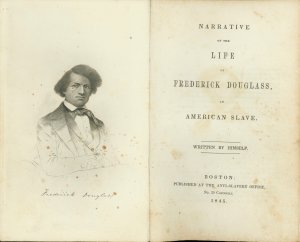
Frederick Douglass knew a thing or two about this overlap of power and knowledge. Here is the beginnings of an important text in the African American literary tradition, Frederick Douglass’ first autobiography, the Narrative of the Life of Frederick Douglass, an American Slave: Written by Himself (1845). The frontispiece and the title page.

First, review: How might we read this text, or begin to read its beginnings, informed by new historicism and cultural criticism? [What would Foucault say?] Or further back: Structuralism and Deconstruction? Reader Response? Psychoanalytic? New Criticism?

Next, interrogation: How can we read this text through the lenses of African American criticism and theory? What do we see that we might not have seen or considered previously? [What would Toni Morrison or Henry Louis Gates, Jr., say?] What are the complications that this text presents us with, and that these critical theories help us to address? As always, what are the uses and limits? To take up a complicated passage, there is this moment from the end of Doulgass’ second chapter.

 I did not, when a slave, understand the deep meaning of those rude and apparently incoherent songs. I was myself within the circle; so that I neither saw nor heard as those without might see and hear. They told a tale of woe which was then altogether beyond my feeble comprehension; they were tones loud, long, and deep; they breathed the prayer and complaint of souls boiling over with the bitterest anguish. Every tone was a testimony against slavery, and a prayer to God for deliverance from chains. The hearing of those wild notes always depressed my spirit, and filled me with ineffable sadness. I have frequently found myself in tears while hearing them. The mere recurrence to those songs, even now, afflicts me; and while I am writing these lines, an expression of feeling has already found its way down my cheek. To those songs I trace my first glimmering conception of the dehumanizing character of slavery. I can never get rid of that conception. Those songs still follow me, to deepen my hatred of slavery, and quicken my sympathies for my brethren in bonds. If any one wishes to be impressed with the soul-killing effects of slavery, let him go to Colonel Lloyd’s plantation, and, on allowance-day, place himself in the deep pine woods, and there let him, in silence, analyze the sounds that shall pass through the chambers of his soul,–and if he is not thus impressed, it will only be because “there is no flesh in his obdurate heart.”

I have often been utterly astonished, since I came to the north, to find persons who could speak of the singing, among slaves, as evidence of their contentment and happiness. It is impossible to conceive of a greater mistake. Slaves sing most when they are most unhappy. The songs of the slave represent the sorrows of his heart; and he is relieved by them, only as an aching heart is relieved by its tears. At least, such is my experience. I have often sung to drown my sorrow, but seldom to express my happiness. Crying for joy, and singing for joy, were alike uncommon to me while in the jaws of slavery. The singing of a man cast away upon a desolate island might be as appropriately considered as evidence of contentment and happiness, as the singing of a slave; the songs of the one and of the other are prompted by the same emotion.

Finally, some applied thinking: How might you apply aspects of this criticism to your studies, to your emerging seminar project? What if you are not focusing on a text by an African American author–what then? Consider borrowing theoretical insights from Toni Morrison and her argument (in Playing in the Dark: Whiteness and the Literary Imagination) for the Africanist presence in American literature by white authors.

Further Reading – Cinderella and Culture

When I read about Cultural Criticism, what came to mind was the Cinderella fairy tale.  This famous tale has been retold and reshaped so many times throughout history and across so many cultures.  Tyson says, “while we are constrained within the limits set for us by our culture, we may struggle against those limits or transform them.” (280)  I think the Cinderella tale reflects that.  Fairy tales are stories that we tell to children literally from birth so many times, kids can recite them off the top of their head years to decades later.  They become cultural references and familiar touchstones for other stories.  Fairy tales have been told so many times, they have been ground into our culture and affect it in many ways.  Looking at how could reveal some interesting truths about both the story and the culture around it.

I think a close look at the multiple versions of this fairy tale could show the cultural impact on gender roles that they had.  Cinderella is usually portrayed as a girl who does all of the house work and as someone who is submissive to a point.  More recent versions have changed Cinderella’s submissive personality or sometimes even her role in the story itself.  Many people are familiar with the 1950’s cartoon that was made by Disney, which shows Cinderella as the ideal 50’s house wife.  She cooks, cleans, sews, and does housework for most of the movie, singing the whole time.  She doesn’t even go to the ball until the Fairy Godmother intervenes.  This Cinderella really only does as she’s told and relies on her Prince Charming to get her out of her awful home situation.  On the other hand, if you look at an adaptation like the movie Ella Enchanted, it shows a girl who is much more in control of her situation.  In this particular movie, Ella, who is the Cinderella figure, is put under a curse to follow any and every command she is given.  This movie shows a much different girl, one who constantly rebels against what she is told and eventually finds a way to be her own person.  The movie ends with Ella breaking her curse herself, not having to rely on anyone else to help her.  This protagonist fits an entirely different mold than her predecessor and shows a completely different person to a new generation of children.  These movies are only 50 years apart, but show vast differences in how Cinderella is interpreted in these time periods.  Our culture is reflected in the stories we tell, as well as the ones we continuously re-adapt.  Cinderella is a prime example.

Tyson, Lois. Critical Theory Today: a User-Friendly Guide. Routledge, Taylor & Francis Group, 2015.

The Lifelong Process of Subjectivity

Lois Tyson tells us in Chapter 9 of “Critical Theory Today” that
New Historical Criticism prevents us from fully appreciating the context of the time in which we live, because we are part of the mechanism of that historical context. Society influences people who influence history that influences society. Culture is so interconnected that every action is shaped by or a response to the time and society in which we live. The reactions of artists then become part of the creative tapestry of their time.

Tyson explains, “our subjectivity, then, is a lifelong process
of negotiating our way, consciously and unconsciously among the constraints and freedoms offered at any given moment in time by the society in which we live” (270).

The texts of authors who frequently revisit their own works reflect this
process of navigating one’s own changing subjectivity. Over the course of her professional life, Marianne Moore whittled her 1919 poem “Poetry” down from the original 29 lines to merely 3.

“I too, dislike it: there are things that are
important beyond all this fiddle.

Reading it, however, with a perfect contempt for
it, one discovers that there is in

it after all, a place for the genuine.” (Moore,
1919)

As Moore navigated the world in which she lived and her own changing
subjectivity, she distilled her thoughts down and became more concise. She decided that the introductory lines of “Poetry” accomplished what she needed them to and did away with the other 26 lines. Many aspiring poets likely cringe at the idea of lopping off so many lines of well-worded imagery and commentary on the form, but Moore understood that they weren’t necessary to her point and may have even undermined the crucial message of those first lines by being a distraction. With only three keenly honed lines, her message was likelier to strike true in the mind of the reader.

Conversely, Walt Whitman’s “Leaves of Grass” ballooned over his lifetime. He not only edited his original 12 poems, the quantity of poems ballooned. The last edition he released before his death contained over 400 poems. He also shuffled and reordered his poems. Increasingly, his poems dealt with death and mortality as he considered his legacy. Rather than refine his texts like Moore, he bolstered them with other works. He lived in a perpetual state of reaction to his time and to his own life.

Moore and Whitman, as part of history, interacted with the changes in the world as they happened and reacted to them. The democracy of New Historical Criticism allowed both the daughter of a single mother and a son born to economically challenged parents to not only reflect on the eras in which they lived, but to shape the perception of those eras. Moore and Whitman are threads in the fabrics of their respective times.

Works Cited
Moore, Marianne. “Poetry by Marianne Moore – Poems | Academy of American Poets.” Poets.org, Academy of American Poets, https://poets.org/poem/poetry.

Tyson, Lois. Critical Theory Today: a User-Friendly Guide. Routledge, Taylor & Francis Group, 2015.

Reclaiming the Narrative

New historicism allows the reader to incorporate important historical information into the reading of the text, not only through factual information like names and dates, but also contextualizing that information to make it relevant to the text. I think one of the most important key terms of new historicism is “interpretation,” because new historicists understand that, “our understanding of what such facts mean, of how they fit within the complex web of competing ideologies and such social, political, and cultural agendas of the time and place in which they occurred is…strictly a matter of interpretation, not fact” (268-269). Recognizing that our understanding of a previous time period and the goings on during that period can only be interpreted means understanding that there is a limit to what we can know, and that what we think we know can be skewed over time as we misremember or misinterpret events from the past. Interpretation then opens the door for subjectivity, giving the new historicist the ability to decide what information is most relevant to the text, and how to apply it.

While new historicism is most obviously helpful when dealing with texts that are much older and requite a bit of background information to be understood. That being said, really any text has have new historicism applied to it. For example, it is extremely relevant to apply new historicism to Dracula, because it is an old text, so new historicism would help contextualize why women are portrayed the way they are, how religion factors into the book based on how important it was at the time the book was written, etc. New historicism could also be applied to R E D because understanding our current historical and political climate allows us to understand why a book like R E D is so important and how queer erasure and gender are being reclaimed and reapplied.

For most of recent history, the contributions of queer people have been erased, or their identities have been so that their contributions can be celebrated. Recently it was discovered that the skeletons of two people holding hands, known as the “Lovers of Modena,” were both men. There were then a frenzy of other labels being used including, “best friends,” “soldiers,” “brothers,” etc., erasing the fact that the skeletons were queer.

Knowing that the above is the kind of society in which we live today, where people are constantly trying to erase the identity of queer people, it increases the need for a book like R E D, which takes the story of Dracula and makes backout poetry out of it, literally erasing the original story to create a queer narrative of transitioning, survival, power dynamics, etc.

Cultural Criticism and the MCU

New historical criticism and cultural criticism are the broadest theoretical perspectives we’ve worked with thus far, and as such, don’t have many limits. Questions of historical context, cultural reception, rhetorical analysis, and group experience are boundless and could be used to support any number of arguments. This breadth is, perhaps, also a limitation of the perspectives as well. New historical and cultural criticism assume that experience and reality are largely subjective and, as such, believe interpretation is subjective as well. Unlike New Criticism which assumes objectivity and a single correct interpretation, new historical and cultural criticism can get lost in their subjectivity. This subjectivity means that any number of perspectives are valid and therefore any number of interpretations could also be valid. Any multiplicity of interpretation would also seem to indicate the impossibility of a single correct answer. While the inability to reach a single answer doesn’t invalidate the perspective, it can create some problems. New historical and cultural criticism thus become limited in the sense that they can only truly be used interpretively and to understand contextual information, not to provide definite answers about a text.

One of the largest cultural phenomena in the past decade surrounds the creation of the Marvel Cinematic Universe. This particular event provides the perfect site for cultural analysis. When it began in May of 2008 with the first Iron Man film, no one had ever heard of a “cinematic universe” and certainly some folks thought it would fail. The closest approximation at the time was the James Bond series, which, though successful, has a niche audience at best. Iron Man was a success, however, and soon The Incredible Hulk, Thor, and Captain America: The First Avengerwere too. After the first Avengersfilm, it became abundantly clear that the Marvel Cinematic Universe was incredibly lucrative and here to stay. There’s plenty of speculation around the initial success of the MCU. Perhaps there was space to be filled in the film industry for such a massive project, after successes like the original Spider Man trilogy there was a desire for more superhero blockbusters, or maybe the only reason it was able to stick around was Disney’s acquisition of Marvel Studios. In any case, its success at the time is undeniable.

Even more noteworthy, from the standpoint of cultural criticism, however, is the lasting effect the Marvel Cinematic Universe has had on the film and television industries as a whole. In the 11 years since its creation, the MCU has spawned 23 films and 12 television series. Its success has spawned such competitors as the DC Extended Universe and Sony’s Marvel Universe (for what it’s worth, neither has come anywhere close to the success of the MCU). Since the creation of these industry behemoths, standalone superhero films have been few and rather unsuccessful. The first Transformers film grossed 709 million in 2007 (pre-MCU). Before the mass MCU expansion that came after Avengers: Age of Ultronin 2015, the fourth film Transformers: Age of Extinction grossed 1.1 billion in 2014.  In 2017, Transformers: The Last Knightgrossed a comparatively small 605 million. In 2018 Bumblebee made only 468 million. That same year, Avengers: Infinity War grossed over 2 billion dollars.

For further proof of the Marvel Cinematic Universe’s strong grip on the industry we can look at other superhero films that don’t have the legacy of a franchise like Transformers. In the same year of Infinity War’s record-breaking success, the standalone superhero film Fast Colorwas held to a limited release by Lionsgate and failed to break the $100,000 line in box office sales despite generally positive reviews. It becomes clear to any cultural critic that the Marvel Cinematic Universe has changed the film industry and the way fans respond to that industry for decades to come.

Using New Historicism to rethink culture

While new historicism lacks a specific or clearer methodology than other criticisms, its most beneficial aspects lie in its progressive outlook and openness to subjective analyses of historical events and texts. Unlike old historicism, new historicism recognizes the fact that a historical analysis can never be truly objective because each person brings their own influences with them when viewing a particular event of text in time. This has allowed for new analysis on old literature or events that were deemed to be objectively and fully analyzed before a new critic was able to think about it differently using new historicism. Possibly one of its greatest contributions to the literary community is the fact that it allowed for critics to rethink and look at an old historical event or text in a different way when its meaning was at one time thought to be set in stone.
As shown through professor Rydel’s essay on sexual violence in medieval narrative, there are many different ways to view a narrative and provide your own perspective on a topic. Professor Rydel was able to shine some light on the fact that there were actually some male writers who gave voice to women through their narrative such as Gilte did with his legend about Winifred. She uses a feminist lens to analyze the Golden Legend story, noting that “Winifred’s quick thinking, determination to escape, and desire to live result in a permutation of the genre that would have been highly visible within the context of the collection” (Rydel). This view that the depiction of Winifred’s story and a community coming together to give voice to her allowed for the transformation of a genre was qualified through a new historicism way of thinking as opposed to traditional historians who would’ve only been concerned about what happened and what that tells us about the history of the story.
I may consider incorporating new historicism into my own analysis of Paradise Lost and how it could have affected colonial America in terms of the anti-establishment rhetoric that was popular in 18th century America during its separation from England. While my Junior seminar project will be more specifically focusing in on reader-response criticism to Paradise Lost, I can incorporate larger ideas from new historicism such as personal identity being shaped by the culture in which it emerges to help explain Milton’s narrative decisions and literary techniques.

Rydel, Courtney. “Lengendary Resistance: Critiquing Rape Culture in Virgin Martyr Passions.”

Accuracy vs. Bias

When looking into the principles of New Historicism the idea of a writer’s biases seems to hold a significant amount of weight. There seems to be a clear distinction between the ideas of accuracy versus bias and the value they have. In a more traditional form of writing or reading the idea would be to find an accurate story or depiction of a time period or culture. This is what gave texts values because they would work as a representation of their subject matter. Despite this there still exists inaccuracy within texts discussing historical events or set in the past. New historicism takes advantage of these inaccuracy by asking what they bring to the text. If a writer chooses a particular time period and brings to the table a number of things that seem unlikely to happen or down right would not have happened, then what is that saying about the time it was written? New Historicists take into account that these things would not have happened but instead look at the text through an almost double lens that asks about the time period being represented as well as that of the time the text was written. What is the purpose of these changes and what does the presence of bias tell about the time of publishing?

A text that represents these inaccuracies would be The Boy in the Striped Pyjamas by John Boyne. Boyne writes a story taking place during the holocaust following a young boy through their journey under the Nazi reign. Boyne manages to create an atmosphere of bleak outlooks on life but also keeps to story telling conventions for the most part. When writing a fictional story there are typical rules that most writers stay within to create a cohesive story that this novel in particular attempts to hold to. These unsaid rules help to make a more enjoyable experience for the reader. In reality life is much less rule based on cares less for what makes a good story. In reality victims of the holocaust had their stories cut short and that’s just part of cruel reality. On the other hand, there’s the similar text, Night, by Elie Wiesel that also tells the story of a young boy during their journey through the holocaust. This text differs though because the author is not just the author, they’re the main character. Wiesel wrote about his own experience in the holocaust therefore taking away the idea of a creative work of literature and becoming a historical account of someone’s life.

The questions that arise here are why did Boyne write in so many particular situations to his novel? What creative liberties did he take for the sake of storytelling? Why did he write his novel in the first place when so many novels exist based on the holocaust already? These questions can be placed against Wiesel’s novel as well to get a more accurate view of the second world war. This could also be used to better understand the 2000s as a decade and how the memories of the holocaust had aged over roughly sixty years.

Boyne, John, 1971-. The Boy in the Striped Pajamas : a Fable. New York :David Fickling Books, 2006.

Wiesel, Elie,Wiesel, Marion.Night. New York : Hill And Wang, 2006. Print.

Shots in the Dark: New Historicism in History

When I took American history in eighth grade, my teacher split us into groups to teach us about the Boston Massacre.  She gave us each an eyewitness account, which she told us to read and discuss as a group. (Oh, the censorship of 18th century writing: “g-d damn it!”)  We went on our merry way for a few minutes, then she called on each group and asked the members to describe what happened on March 5, 1770. Each group had a different explanation for who started it, who reacted, and what exactly happened.  We students wondered how this could be, but not my teacher. She explained, “I gave each group a different account: some of you got the Patriots’ perspective, and some of you got the British soldiers’ perspective.” It was especially thought-provoking for me, who learned the colonists were the poor unfortunate victims and the Redcoats were the perpetrators, to read a report from one of the wicked Redcoats himself.  He described angry colonists yelling at him and cursing the soldiers out, not exactly the innocent and helpless victims of a massacre. Clever, Miss Fleming.  

I never forgot that lesson, and I wonder how history class would be different if everything was taught that way.  It would make a more cumbersome history class, but perhaps more enlightening and engaging.  Can we ever factor in and represent every possible perspective? I think not, though my perspective as a writer in the ongoing diversity push comes into play here.  With intersectionality, there are so many groups and perspectives that I don’t think it’s possible or at least practical to include every one. Further, not every historical event involves every group, and not every group is accessible to us now.  For instance, the Chinese weren’t very involved in the Boston Massacre, and we know of the existence of Amazon tribes who are still uncontacted. We won’t be hearing their perspective on World War II or the Watergate scandal.  

Miss Fleming’s method follows the New Historical ideas of interpretation and subjectivity.  If a class were to go by this system, some may ask, “Well, if it’s all subjective, how can students ever learn facts about history?”  Really, it’s not all subjective: dates, most locations, and names, for instance, are generally undisputable. But as Miss Fleming showed us, subjectivity isn’t just limited to who was right or wrong.  Psychology class shows us the unreliability and variability of eyewitness accounts, which is how most history is learned at the root. It’s very deconstructive, looking at it that way: a fractal of interpretations and meanings.  And like deconstruction, a more varied perspective can help remake our identity as Americans and people.  

Social Construction and New Historical Criticism

New Historical Criticism, rather than seeing and analyzing historical events from a linear, objective perspective, approaches the past from a sociological lens. In New Historical Criticism, historical texts are analyzed with a focus on socioeconomic and cultural contextualization. Lois Tyson writes in “Critical Theory Today” that new historicists believe “there is no such thing as a presentation of facts; there is only interpretation” (269). A traditional, linear understanding of history presents only one objective version of reality. However, New Historical Criticism would argue that there are many different realities; each person has their own subjective worldview or “selfhood” which is influenced both by their individual personhood and by the society or culture they develop in (269). History is subjective, and there are multiple sides to every story. The limitation to this subjectivity is that usually only one side of the story is shown. The history that Americans learn in elementary school is not necessarily inclusive of multiple perspectives. History is often presented in an objective manner, presenting one version of reality as the truth. This “truth” often serves an existing power structure (271). Whoever controls the dominant narrative in society has the power to decide what is seen as objective. For example, the Church, a long-standing power structure, has produced the narrative that homosexuality is a sexual ‘perversion’ (271). The reason for this belief’s continuing popularity is because of the prominence of the social construct of the Church and the power it holds in society. Michael Foucault has suggested that all definitions of ‘insanity,’ ‘crime,’ and sexual ‘perversion’ are social constructs by meanings of which ruling powers maintain their control. We accept these definitions as ‘natural’ only because they are so ingrained in our culture’ (271). One can see form this quote that New Historical Criticism is rooted in sociological concepts. Sociologists, as well as New Historical Critics, believe that “what is “right,” “natural,” and “normal” are matters of definition (271). What is “true”, therefore, is subjective. The idea of subjectivity naturally lends itself to the theory of social constructs. Social constructionism is a theory first written about in “The Social Construction of Reality” by Peter L. Bergeer and Thomas Luckman in 1966. Essentially, social constructionists believe that human beings create their conceptualization of the world socially. Because of this, things that we believe to be true or objective often depend upon others’ perception of the same things. Perceptions can change over time, and as a society changes, so do its constructions. Traditional historicism tends to believe that societies change in a progressive, linear way. However, because of social constructionism, New Historical Critics believe that the way societies change over time is more subjective: “History cannot be understood simply as a linear progression of events. At any given point in history, any given culture may be progressing in some areas and regressing in others” (269). Each different historical event may be viewed as progressive or regressive within certain communities because of the social constructions that they have come to view as “natural” or “normal”. New Historical and Cultural Criticism tends to question these ideas and view history in multiple different perspectives, attempting to apply subjectivity to social constructions. For my further reading, I reread “The Things They Carried” by Tim O’Brien. O’Brien’s book contains many stories from soldiers fighting in the Vietnam War, a war much disputed by those not fighting it. This book revealed to me how soldiers struggle with the social construction of war, and the impact that this war has on their lives during and after the war. This book made it obvious to me how multiple perspectives are necessary in order to fully understand historical events and the breadth of human experience. O’Brien gives a chilling insight into the minds of soldiers in the midst of atrocities with the weight of the world’s expectations and their own actions on their shoulders. This book made me rethink my assumptions about the Vietnam War and about how history is presented from positions of power.

Tyson, Lois. Critical Theory Today. 3rd ed., Routledge, 2015

History, Culture, and Young Adult Literature

New historicists find that “the literary text and the historical situation from which it emerged are equally important” (Tyson 277), while cultural critics believe that  “a literary text… performs cultural work to the extent to which it shapes the cultural experience of those who encounter it, that is, to the extent to which it shapes our experience as members of a cultural group” (Tyson 282). In analyzing All American Boys by Jason Reynolds and Brendan Kiely with a new historicist and cultural lens, one finds strong historical and cultural connections to the time period in which the text was written and the history behind what led to the attitudes and actions being portrayed in the text.

All American Boys is about two high school students, Rashad and Quinn. Rashad is black and subjected to police brutality, while Quinn, who is white, not only witnesses this event, but also knows the cop brutally beating Rashad.  Since new historicists believe that “history is neither linear… nor progressive” (Tyson 275), new historicists would be interested in racial relations both in the time at which this text was written and whether there are any connections to race relations in society’s past. This novel was released in September 2015, and earlier in April 2015 the Baltimore protests over the treatment of Freddie Gray occurred. So there is definitely a significant relationship between the timing of the novel’s release and the current societal climate at the time. However, it is also important to look at the history of slavery and the historic treatment of blacks by white society to have a stronger understanding of the tensions surrounding racial relations in the novel and society. Since new historicists believe that history is not progressive, they would question how much of the tension between races that existed during slavery is now reappearing or has remained present to now have these moments of police brutality exist.

Tyson also states, “rather, literary texts are cultural artifacts that can tell us something about the interplay of discourses, the web of social meanings, operating in the time and place in which the text was written” (277). All American Boys is written from the perspective of both Rashad and Quinn in alternating chapters. Not only can critics analyze the time period in which this text was written, but they can directly read some of the discourse occurring around the top of race relations and police brutality, as it is directly addressed in the narratives from each of the boys. While Rashad’s chapters focus on giving his perspective of how trying to buy a bag of chips went wrong, Quinn’s chapters focus on Quinn grappling with how the situation led to police brutality and whether that was an appropriate reaction. Circling back to cultural critics belief that a literary text can “[shape] the cultural experience of those that encounter it” (Tyson 282), in offering these two perspectives from seemingly opposing sides, Reynolds and Kiely are hopefully able to then encourage new experiences and ways of thinking for those that encounter this text.

However, cultural critics belief in texts shaping experiences makes me question whether this is because the text reflects something currently occurring in society or if it’s the power of the words and the text itself that causes readers to think about their world and experiences in a new way. For example, while All American Boys does address police brutality in a way that I feel promotes thought, the most well-known novel in my eyes that addresses this topic is The Hate U Give by Angie Thomas. What led to one text being more prominent than the other? Since other factors such as the date published and author popularity contribute to the answer, perhaps this question goes beyond the scope of what cultural critics would be most interested in analyzing. I think cultural critics would be more interested in how the text has helped to shape each reader’s cultural experiences and look at how that is being done than to analyze how far reaching the text has become.

Works Cited

Reynolds, Jason, and Brendan Kiely. All American Boys. Atheneum/Caitlyn Dlouhy Books, 2015.

Thomas, Angie. The Hate U Give. Walker Books, 2018.

Tyson, Lois. Critical Theory Today. 3rd ed., Routledge, 2015

Toeing the Interpretive Line

The first tenant of New Historicism and Cultural Criticism that Lois Tyson gives us in Critical Theory Today is that “the writing of history is a matter of interpretation, not facts” (275). This means that when we interact with history – in a literary context or otherwise – must acknowledge that there is likely more than one way to take all the pieces of that New Historicists use to view a time, from the discourse to personal identity to events, to commentary on those events. But Tyson also warns that interpretation doesn’t mean that we have free reign to say whatever we want (275). This seems especially poignant in Cultural Criticism, where politics become much more important. So, this week I’m interested in the tension between interpretation and accurate political analysis in Cultural Criticism.

The key aspect of Cultural Criticism (and New Historicism) that I think will be most helpful to do this is the concept that everything happening in a moment is in conversation with everything else that is happening. This means we must draw from a large base of primary sources, some of which may conflict, and contextual information, such as the structure, conventions, and discussions happening in a particular area at a particular time, all of which probably conflict or complicate each other. With this in mind, it seems more likely that we could throw away “bad” interpretations with more ease than we could come to a cohesive and comprehensive “good” one. But, ever the optimist, I believe we can do better than that. These two theories have another important facet; they’re interested in giving equal voice to marginalized groups. Without delving into more specific theories, this is a jumping-off point for the direction Cultural Criticism should take. When we lift the voices of oppressed groups and give their experiences the weight that has been previously absent, then there is a way to begin tackling this constant, dynamic process we call “culture.”

To look at these broad concepts in the context of a specific text, I looked to Victor Hugo’s Les Misérables. Set in 19th century France, largely in Paris, it would be easy to fall into an “old” historicism line of thinking with this book. I’m sure in the past, scholars have made lists of key dates and important political figures and the like to try to parse out an analysis to this vast book. But Les Misérables is a piece in conversation with what is going on real-world France at the time, not simply a summary projected onto fictional characters. In fact, the characters themselves and their actions are reflective of Hugo’s interpretation of the tension between the people of France and the power structures that have put them in such terrible situations. Jean Valjean spends nineteen years in prison over bread, Fantine has to become a prostitute, Cosette is treated poorly by the Thénardiers,  Gavroche has no home but the streets, Les Amis de l’ABC rise up in rebellion later in the book – all these things are different facets of commentary on the situation in France that could be looked at alone or in correlation with “facts” but say something much more important in connection with each other. That is, that something is wrong with the way those in power exist outside of such misery. But even so, this is just a facet of the larger cultural exchange going on at the time, and to truly, properly derive some understanding from Les Misérables would require a vast number of texts from the same place and period, because one book is only one small piece of the culture it comes from.

Works Cited

Hugo, Victor. Les Misérables. 1862. Translated by Isabel F. Hapgood, Canterbury Classics, 2015.

Tyson, Lois. Critical Theory Today. 3rded., Routledge, 2015.