I am looking at Gretel Ehrlich’s depictions and interactions with the West in her memoir The Solace of Open Spaces in order to analyze the ways in which she uses this platform to transform personal experiences into universal concepts so that my readers can better understand the function, purpose, and effect of memoirs as a genre in relation to the constructed connection between author and reader.
X: The West in Gretel Ehrlich’s The Solace of Open Spaces Y: How can a personal anecdote become a universal concept? Z: The personal connection/link between author and reader opens a door for communication, association, and interpretation
I think that applying a structuralist lens is appropriate here as it allows me to see how Ehrlich plays with the form of her experiences chronologically, but also gives me contrast to see how she breaks from that form and what the purpose would be. I also think that addressing reader response is essential because memoirs are meant to create a bond between author and reader, and the author is trying to convey a key message to the reader through personal stories and the effect on the reader is necessary to consider as it can determine how effective the author/memoir is. I could potentially use “Desire of the Middle Ground: Opposition, Dialectics, and Dialogic Context in Gretel Ehrlich’s The Solace of Open Spaces” by Bonney MacDonald for my project. Article located through the Washington College Library & Archives OneSearch.
MacDonald, Bonney. “Desire of the Middle Ground: Opposition, Dialectics, and Dialogic Context in Gretel Ehrlich’s The Solace of Open Spaces.” Western American Literature, vol. 33, no. 2, 1998, pp. 126-148. JSTOR, https://www.jstor.org/stable/43021814. Accessed 26 Sept. 2019.
Psychoanalytic literary theory and criticism is by no means limited to the insights and theories developed by Sigmund Freud, the father of psychoanalysis. As Lois Tyson demonstrates, a great deal comes after Freud and the classical psychoanalysis that he establishes in the early 20th century, and much of that challenges while also building upon Freud’s “discovery” of the unconscious: Jung, Lacan, French feminists such as Kristeva and others who build upon Lacan and psychoanalytic theory. It’s complex stuff, and even though I took an entire course in graduate school on psychoanalytic theory, much of it is beyond my limited powers of understanding.
But there is something fundamental to Freud and–I’m generalizing here–insightful about psychological approaches to literary interpretation that we might trace back to Freud. It is the notion, the recognition, that human consciousness, all we think and do and feel and speak, is fundamentally ironic. We can never exactly mean what we say, or say what we mean, because of the split between the conscious and the unconscious. As a result, life becomes something like a dream, and dreams become something like an alternative text of life. Such is the insight of Freud’s dream interpretation, established by his book The Interpretation of Dreams (1900). He takes this psychological concept of dream interpretation and extends it directly to literature in a 1908 essay titled “The Relation of the Poet to Day-Dreaming” (also known as “Creative Writers and Day-Dreaming”). Dreams are phantasies, with symbolic meaning that relates to the real world, but in need of critical interpretation since the symbols (and images) are phantasmal–they mean differently than what they say or suggest. And by extension, Freud suggests, writers create phantasies in writing that work something like their dreams.
Here we see the great use of psychoanalytic theory for interpretation, or at least Freud’s version of it: every literary text is dream-like, phantasy, even those that are seemingly real. They are and they aren’t. That gives us something to interpret and critique. We can always page Dr. Freud for help. Sometimes it’s obvious (Victor’s freaky nightmare after he creates the “monster”); other times it’s more subtle and arguable (sometimes a cigar is just a cigar).
But this also suggests a limitation or constraint: every writer, and this would include us as creative writers and critics, is always subject to mis-interpretation. Every thing we write is somehow about us, familiar to issues in our lives; but at the very same time, the real source of our writing must remain unfamiliar. We can’t simply say what we mean.
This last point about the familiar being unsettled by the unfamiliar is an insight from another essay Freud writes where he further relates his theories to literary interpretation and language: “The Uncanny” (1919). For some notes and a summary of this concept, read here. Freud discovers through a study of language that the uncanny means something different than being surprised or frightened by the unfamiliar, but in fact is when the unfamiliar is revealed to be related to the familiar. The word in German for “uncanny” Freud shows means two exactly opposite things: heimlich (familiar, homely) and unhemilich.
Pretty ironic, isn’t it? As we have seen, since we began with New Criticism and worked through deconstruction, irony factors significantly into literature and many theories for understanding and interpreting literature. Given that, what do psychoanalytic theories of literature and interpretation enable us to do with the ironies of literature? Are irony and misinterpretation inescapable for literature and reading? Can we read and write without psychological motivations and unconscious drives, without needing to page Dr. Freud?
In The Uncommercial Traveller, Charles Dickens uses his writing to create his public, yet intimate, persona. I can think of only one other situation in which a writer uses their work to develop their persona, and that’s A Series of Unfortunate Events. Under the pen name Lemony Snicket, the author creates an elaborate backstory for himself-as-Snicket, who narrates and “researches” the lives of the Baudelaire orphans. He references, in vague terms, his personal tragedy surrounding Beatrice, who is connected to the characters in the series. He claims to visit the settings of the books, where he writes letters to his editor included as epilogues. He even writes an autobiography, which only adds to the mystery because it doesn’t really explain who he is. As a fifth grader reading the books, this vexed me greatly, but now that I’m a college student and a more professional writer, I find it clever and engaging.
Snicket’s literary persona is a mask, a character in itself that hides the author’s true identity, and his probably far less extraordinary life, from his audience. When I compare Snicket to the grown-up Dickens in The Uncommercial Traveller, I wonder if they both serve this hiding purpose. A public persona is, after all, not a complete image of the person in question. It inevitably includes, or more often leaves out, facets of the person.
I’m no Dickens expert, so I don’t know how much of the young Dickens in the story is true. The child is earnest and hopeful, longing to live in the house that Dickens owns as an adult, but believing it’s an impossible dream. Dickens works hard to evoke an endearing child we readers want the best for. Knowing the adult Dickens lives in Gadshill, I can practically hear him telling small, aspirational children, “You too can make your dreams come true if you persevere, just as my father told me!” It feels a little too classic rags-to-riches, which takes away the authenticity Dickens strives for in creating such a “queer, small boy” and such an unpompous manhood self. It also suggests that Dickens views himself as a rags-to-riches story, considering he makes little to no effort to draw any distinction between himself and his story-adult-self. If that is so, then this persona also masks Dickens’s true face, to himself as well as to his fans, by only showing a part of his history, an a nice part at that. This could be his coping mechanism for his difficult childhood: focusing only on the pretty, inspirational parts and leaving the rougher parts unsaid.
His you-too-can-make-your-dreams-come-true message comes across clearly through these two personas—like Lemony Snicket, another character and another story being told.
In examining Stanley Fish’s article, “Surprised by Sin: the Reader in Paradise Lost,” our class discussed the different ways in which writers interact with their readers and attempt to incite a particular reader-response from them. Of course, each reader has their own unique reading experience, and each reader brings with them their own individual intentions and beliefs, so the reader-response will be different for every reader in some facet. The same reader usually even has a significantly different reader-response when analyzing the same text for a second time. There are still however, main points and ideas that are driven home by the writer that in some way or another will be analyzed similarly by multiple readers. In Paradise Lost, Fish argues that John Milton is attempting to both educate and humiliate his readers through subverting the reader’s expectations and questioning his own stances.
Fish claims that “Milton consciously wants to worry his reader, to force him to doubt the correctness of his responses, and to bring him to the realization that his inability to read the poem with any confidence in his own perception is its focus” (Fish, 4). I believe in Milton’s strategy of filling his readers with doubt that he is teaching them the importance of questioning themselves as well as authority. In this case, Milton is the authority as the writer of Paradise Lost, and guides the reader in their thinking but knows that while he can present his own ideas, they can be interpreted in a multitude of ways by different readers.
From Fish’s perspective, Milton seems to be very consciously aware of his readers throughout Paradise Lost. Fish uses Milton’s harassment of his reader as an example of his interaction with the reader. The reader is set up to believe one thing and then becomes disappointed with the shock that their expectation was subverted. An example of this is the character of Satan, who readers first assume to be purely evil but then are intrigued by his human-like interior struggles. Even though Satan is the villain of the story, he is immediately shown as an underdog with outstanding qualities of leadership and resilience. By unsettling his readers through his break of traditional epic molds and making his opinions ambiguous, Milton gives power to the reader to interpret the text the way they want to.
The center of Paradise Lost’s subject is in fact the reader, because as Milton states at the beginning of the epic, he hopes to “justify the ways of God to men” (Milton). Milton uses Paradise Lost as a creative way to open readers’ minds up to questioning authority and seeing things through different lenses. In my opinion, at least some form of reader-response criticism would need to be used to have an accurate analysis of Paradise Lost since Milton is so in tune with the importance of his text as an event that occurs within the reader rather than an object.
The concept of Reader Response as a literary theory relies
on personal interpretation of individual works. Rather than letting an already
standing singular truth about a work dominate the reading of the work, reader
response lets each reader bring their own vision of the work to a discussion,
although it is made clear that vast departures from what is specified in the
text are viewed as less credible or valued as an interpretation. This aspect of
reader response sounds similar to productions of a literary text into some other
medium. The idea of taking a novel and turning it into a play, musical or even
movie seems to rely on reader response to keep the same story original across all
mediums it put in as well as the different variation of those same mediums.
Taking a novel that has been adapted more than once such as
It by Stephen King allows for wiggle room to be made in each interpretation of
the same story. It was originally published in 1986 with a story following multiple
characters across a large gap of time. In the original novel, as well as the television
miniseries, the story jumps between the late 50s and early 80s for its setting.
The recent film adaptation of the novel instead makes a clear two-part story,
the first set in the late 80s with the later half set in the mid-2010s. While
this change in setting is drastic as it pushes the events of the novel forward
by roughly thirty years, the same basic story is told. Changing the setting
proves to only be a stylistic choice made by the writer and director of the
film for the sake of their own personal vision of the film as well as relatability
to a modern-day audience.
Along with this the characters change slightly in appearance between the three versions of the story, for example Pennywise. In the original novel Pennywise is described more like a modern colorful clown that has been the norm for clowns throughout must of the last century. In the current film adaptation, he is seen in a more Victorian era outfit with muted colors and a large collar. The most color placed onto the character is on its head with red paint detailing on the face and bright orange hair. While this outward appearance is different from what Stephen King originally wrote, this again takes into account that reader response doesn’t rely on any one truth. The author only writes the book or work of literature and after that point it is up to each individual reader to make their own reality out of what is written, and it is expected to always have variation between readers. No one can limit the interpretations of each reader, or director of a film. No one person has a final say on what is “correct” for a work of literature, even if they are an instructor or even the author. The community as a whole can decide something is too far off from what is meant to be part of a story. This would be like if a film adaptation of It were to replace Pennywise or the actual Creature with more traditional killer with no cosmic horror qualities. This would sort of creative liberty would change the core of the story revolving around an intangible antagonist.
A key facet of the Reader Response
Critical Theory is the understanding that through the combination of the reader
and the text, meaning is created. Lois Tyson explains it as, “a written text is
not an object, despite its physical existence, but an event that occurs within
the reader, whose response is of primary importance in creating the text”
(164).
Julian Lennon arrived home from preschool with a painting he had made of his schoolmate and friend Lucy O’Donnell. When his father John asked him about his work of art, Julian simply said, “it’s Lucy in the sky with diamonds” (Runtaugh, 2018).
Julian Lennon’s Painting of his friend, Lucy O’Donnell
John, a fan of Lewis Carroll, connected the abstract nature of his son’s art with the “Which Dreamed It?” chapter of “Through the Looking Glass“. He sat down to write a song about the type of fantastical world that a three-year-old child might imagine, written in the style of Lewis Carroll’s descriptions of imagery.
When the song was released, more observant listeners connected the title “Lucy in the Sky with Diamonds” with the drug lysergic acid diethylamide (LSD), a hallucinogenic drug. John Lennon was known to experiment with the drug, and the surrealist world described in the song seemed to reflect the experience of an LSD trip. The belief was so pervasive that the song was banned from the radio.
John claimed that he was inspired to
write the song because of Julian’s painting and his reading of Lewis Carroll.
“This is the
truth: My son came home with a drawing and showed me this strange-looking woman
flying around,” he explained during an appearance on The Dick
Cavett Show in 1971. “I said, ‘What is it?’ and he said, ‘It’s Lucy
in the sky with diamonds,’ and I thought, ‘That’s beautiful.’ I immediately
wrote a song about it. After the album had come out and the album had been
published, someone noticed that the letters spelt out LSD and I had no idea
about it. … But nobody believes me” (Runtaugh2018).
His bandmate Ringo Starr, Julian’s
mother Cynthia Lennon, and friend Pete Shotton confirmed John’s story
(Runtaugh, 2018).
Readers believed he was making a thinly
veiled reference to drug use. They combined the letters in the title of the
song with the surreal imagery and applied what they knew of John’s use of
hallucinogens and came up with their own meaning. Reader Response Critical
Theory teaches us that the meaning created by the reader’s experiences and
beliefs while digesting the text is valid.
Ultimately, it doesn’t really matter what John Lennon intended, consciously or subconsciously. When the consumer of his art can make a sound argument for their perception, and back it with evidence, their argument becomes a valid critical response. When a large group of consumers, or an “interpretive community” (Tyson, 176), agree upon that meaning through the Social Reader Response Theory, that agreement demonstrates that societal influences inform the constructs readers apply to texts. “Lucy in the Sky with Diamonds” may always be associated with hallucinogens, and no protestations will convince many readers of the lyrics otherwise.
Julian Lennon’s painting currently hangs
in the home of musician David Gilmour (Raul, 2016). The song is played
regularly on the radio and there are dozens of videos to accompany the song on the
internet. Future listeners who don’t necessarily understand the drug culture of
1967 may indeed believe that the song is about the lovely painting by a three-year-old
boy as the experiences of the interpretive community change. John Lennon’s
author intent may someday align with the reader’s response, after all.
Glancing
over my peers’ blogposts, I can see that some of us had a similar thought about
reader-response theory in general; that it can be particularly useful and poignant
when viewing works that touch on sensitive or controversial topics. This, of
course, is because readers react in vastly different ways to these kinds of
issues, and so, if the reader is giving the text meaning, but many readers are
split from authorial intent or each other, this gives the text many possible
branches from which an understanding may be born. And I think Stanley Fish touches
on another reason why this happens, from a baser human level. He says, “Not
that the reader falls and becomes one of Satan’s party. His involvement in the
speech does not directly compromise his position… since his response (somewhat
unconscious) is to a performance rather than to a point of view…” (10). While Fish
is talking specifically about readers in Paradise Lost, this can be
taken in a broader sense. Readers do not want to feel like their morality is
compromised, challenged, or otherwise tested when reading about difficult topics.
But they do. And this is a response to a self-generated interpretation, which,
to me, becomes especially thought-provoking in psychological reader-response
theory.
In
Critical Theory Today, psychological reader-response theory is rooted in
the concept that readers react to what they’re reading as they would react to
real life situations, and people who adhere to this theory, like Norman
Holland, are focused on what this reaction reveals about the reader, not
the text (Tyson, 174). Lois Tyson goes on to explain the analytical descriptions
of how psychological reader-response theorist would figure out what a
reader’s reaction means about them, but I am more interested in the complexities
of why people interpret texts to make themselves feel more comfortable
in their reality, beyond just that they want to be comfortable. Since the process
is unconscious, I think it isn’t much of a stretch to say that it’s more
complicated.
On that note, I want to bring up one of the most emotionally charged and complicated texts that I know. I don’t have enough space to go fully into detail about VC Andrews’ My Sweet Audrina right here, but this gothic horror novel deals with everything from gang rape to child abuse, unexpected deaths to adulterous affairs to disabilities both mental and physical. It slams the button of issues people don’t normally want to think about, and so, unsurprisingly, it tends to be a banned book. So then how would a reader response to all the atrocities in this book and then adjust according to psychological reader-response theory? Why would they bother at all? I think a key point component of a reader’s interpretation goes into why they’re bothering to read a text. And a simple answer seems to be thank God that isn’t me. In My Sweet Audrina, the reader is hit with horror after horror without much room to breathe. To continue to engage with it, I think psychologically, it must provide people with the relief that it is only fiction, and it does this by distorting reality in interesting ways. But on the other hand, the readers who put the book down and never pick it back up are equally relevant. If the reader has the power to give meaning to a text as most of the different kinds of reader-response say, and if the reader’s reaction says something about them on the psychological axis, then there is something meaningful in halting the entire process and refusing to engage. This may seem like a half-finished analysis, but one that a reader certainly has the right to choose, especially if reader-response theorists are handing them the reigns.
Works Cited
Andrews, V.C. My Sweet Audrina.
Pocket Books, 1982.
Fish, Stanley. Surprised by Sin:
the Reader in Paradise Lost. New York, Macmillan, 1967.
Tyson, Lois. Critical Theory Today. 3rded., Routledge, 2015.
In reader response theory, how involved is authorial
intention? Authors write hoping their work will obtain a certain desired
response (if a writer intends to craft a thriller than they would hope readers respond
to it as a thriller and not as something else, like a comedy). Similarly, how
heavily do reader response critics care about any disconnects between authorial
intention and the reader’s response to the text?
In transactional reader response theory, the reader
needs to use an aesthetic approach where “we experience a personal relationship
to the text that focuses our attention on the emotional subtleties of its
language and encourages us to make judgement” (Tyson 165). There is also a
focus on indeterminate meanings, focused on “actions that are not clearly
explained or that seem to have multiple explanations” (Tyson 166). Both of
these approaches require closely analyzing language and what the author did and
did not decide to incorporate into their text. It seems impossible to
completely discount authorial intention when considering the response to a
text.
Another method of reader response theory that appears
to focus heavily on authorial intention is affective stylistics. In affective
stylistics, “the text consists of the results it produces, and those results
occur within the reader” (Tyson 167). This method appears to take the
relationship between authorial intention and reader response that is developed
in transactional theory one step further by taking a closer reading of the
text’s structure.
Going back to my question about authorial intention in
reader response theory, while authorial intention is important in crafting the
story, it does not always perfectly translate to the reader’s response to that
story. If we are meant to analyze the “emotional subtleties of its language”
(Tyson 165), and the author crafted the text with the reader’s response in
mind, then in a perfect world the reader’s response to the language should
match the author’s intent for the text.
However, we are not living in a perfect world, and
reader’s often respond to texts differently than authors intend. My primary
focus of evaluation is on a section from a chapter in The Darkest Minds
by Alexandra Bracken. In this novel, the protagonist, Ruby, has the ability to
get inside other’s heads and control their actions. However, she does not know
how to control this ability, so she seeks help from another character, Clancy, who
contains a similar ability to control the minds and actions of others. In this
specific section, Clancy uses his abilities on Ruby to force romantic thoughts
and actions regarding the two of them into her mind. Afterwards, Ruby is unable
to determine what, if anything, happened between the two of them.
Given that Ruby narrates the novel, and this is not
the first time Clancy has revealed interest in her, many readers have responded
to this section as a rape scene. This is not only a judgement call made by
readers based on the language of the passage, but also based on the determinate
and indeterminate meanings found in the text up until, and at that point.
In thinking of authorial intention and how well an
author is able to carefully curate a reader’s response, in this particular
section of the novel the two did not come together perfectly. In hearing of
reader’s responding to this section of the text, Alexandra Bracken has
expressed that it was not her intention at all for it to read like a rape
scene. Though this was not Alexandra Bracken’s intention in writing this scene,
it does not seem that reader response critics would care much about her
intentions. Affective stylistics would be beneficial in establishing the vast
amount of readers that responded to this section similarly. In contrary, I
could see reader response theorists using transactional reader response theory
to analyze the language of the text and the indeterminate and determinate
meanings to determine where Alexandra Bracken went wrong, and how this reader
response came about.
Works Cited:
Bracken, Alexandra. The
Darkest Minds. Hyperion, an Imprint of Disney Book Group, 2013.
Tyson, Lois. Critical Theory Today. 3rd
ed., Routledge, 2015
The critical concept I chose to focus on from this week’s reading was affective stylistics. Tyson writes that affective stylistics involves the piece of writing being “examined closely, often line by line…in order to understand how (stylistics) it affects (affective) the reader in the process of reading (167). In order to experiment with applying reader response criticism to a text, I reread “The Philosophy of Composition” by Edgar Allan Poe. Poe’s essay examines his own writing of “The Raven”, a poem which he himself deems “most generally known” (1). Poe says about “The Raven” that “it is my design to render it manifest that no one point in its composition is referable either to accident or intuition—that the work proceeded step by step, to its completion, with the precision and rigid consequence of a mathematical problem “ (Poe 1). Poe talks in this essay about a “unity of effect” that he strives for in his poems. Reader response criticism values the reader’s interpretation of the text, but this seems to be inherently tied to authorial intent. For example, in “The Philosophy of Composition”, Edgar Allan Poe writes about his thought process in planning “The Raven” not only in order to draw appreciation to his genius in method. He also writes it in order to but also more acclaim to an already highly acclaimed poem. He explains and analyzes his own poem, highlighting the same affects that a reader might point out in order to play off the reader-response mindset to his benefit.
Poe attempts to manipulate the reader’s response to his essay through his critique of other writers and thorough analysis of his own text. This text serves to deliver more attention to writing methodology as well as to the product. I believe Poe would agree with those who practice the criticism of affective stylistics because they believe that “the text consists of the results it produces, and those results occur within the reader” (167). I attempted to apply affective stylistics to “The Philosophy of Composition”, thinking about this essay as “an event that occurs in time” (Tyson 167). I took a small portion to focus on specifically, hoping to follow Tyson’s advice in describing this style of criticism. I looked at the “textual cues” from Poe’s introduction (169). Poe writes, “I have often thought how interesting a magazine paper might be written by any author who would—that is to say, who could—detail, step by step, the processes by which any one of his compositions attained its ultimate point of completion. Why such a paper has never been given to the world, I am much at a loss to say—but, perhaps, the autorial vanity has had more to do with the omission than any one other cause” (Poe 1).
To examine this sentence from a reader response standpoint, I believe it is possible to see how a writer consciously thinks about and can attempt to manipulate reader response. Poe writes at first in the hypothetical: “How interesting a magazine paper might be written” (Poe 1). The irony in this statement lies in the fact that he is essentially calling his own paper interesting. Poe then implies that he is one of the only authors capable of attempting such a feat: “by any author who would—that is to say, who could—” Poe draws a (1). Poe’s language differentiates himself from other writers, giving the cause for the lack of papers like his own as “autorial vanity” (1). This is an ironic statement, given that Poe has been patting himself on the back for the last few sentences, but it shows the conscious effort on Poe’s part to manipulate the opinion of the public in his favor. The result that this text produces, to borrow Tyson’s phrasing, is an essay that builds up Poe’s reputation as a writer of both poetry and analysis. I believe that the limit of affective stylistics is that it does not give as much credit to authors who also think of the text from a reader-response standpoint.
Reader response theory explores the idea that it is not author’s text that matters, but how the reader perceives it. While there are four types of reader response theory identified by Tyson, I was most interested in the psychological reader response theory because of the weight personal experiences have on the text. Through psychological reader response theory, the text is understood not as what is written down, but what the reader thinks about it and how their experiences [in]validates it.
When initially reading the chapter, I couldn’t help but think that reader response theory was stupidly subjective (not stupid, but so beyond subjective that it reached a whole other level). It wasn’t until I was reading through the section about psychological reader response that I understood why it was okay for the reader to be so subjective with the text–because their past experiences control the text. Reading that section of the chapter made me think of all the times I read something and had a visceral reaction to it, and validated those feelings. I would like to think that I can normally pull myself out of that subjectivity and speak about the piece objectively, if not only by stating the facts of the work and what it’s doing, but thinking about those types of responses is really interesting when considering the use of trigger and content warnings on texts.
Trigger and content warnings are effectively the same thing–seeing a “TW” or “CW” on a piece of media quickly indicates to the reader that they are about to interact with material dealing with sensitive topics. Typically the “TW” or “CW” is followed by an indicator of what the sensitive content is– sexual assault, abuse, gun violence, suicide, etc. These warning allows the reader to either 1) get into the correct head space to interact with that text or 2) give the reader the opportunity to avoid interacting with the content altogether without feeling guilty. By giving the reader these options, they are playing into the argument of psychological reader response, but are telling the reader upfront that that type of response is a strong possibility.
These warnings are most often used on social media platforms like Twitter, where people use the thread feature to talk about a topic in as much space at they need to, while recognizing that some of their followers may not want to interact with that content–in the world of social media, one can quickly get sucked into post after post of emotionally draining content, seeing a “TW” or “CW” can allow a user to decide whether or not they want to take on any additional emotional baggage.
(CW: school shootings and gun violence.) This week, one of the major trending videos on Twitter was a “back-to-school essentials” ad released by the Sandy Hook Promise account (the ad can be viewed here https://twitter.com/sandyhook/status/1174291982857883653). This account which, according to their bio, is committed to, “protecting children from gun violence with programs that work,” is based out of Newtown, CT, where the Sandy Hook Elementary School shooting took place in 2012. The ad, which is seemingly to showcase essential back-to-school items, shows how these items can be used save lives in a school shooter situation. The effectiveness of the ad comes from the calmness of the children’s voices as they use their supplies to save their own, and other’s lives–some of the more compelling essentials are mundane things like a skateboard, which a student uses to break a window and get out of the building, and a knee-high sock, that one student takes off their foot to wrap around a wounded student’s leg as a make-shift turnakit, and the student crouching on the toilet texting their mother on their new phone.
While the ad is extremely effective in showing why we need gun control (the actors are like 12 tops and speak very calmly throughout the video), it can be extremely triggering for Twitter users who have also been in school shootings or who have been involved in any shooting (which, unfortunately, is a lot of people). While Sandy Hook Promise tweet did not include a “TW” or “CW,” it did say, “This PSA contains graphic content related to school shootings and may be upsetting to some viewers,” and goes on to say that if watching it is “difficult for you, you may choose not to watch.”
Just a warning, domestic abuse is mentioned throughout this post.
While we were reading and discussing reader response theory,
there was one poem that I continually thought about, which was My Papa’s Waltz by Theodore Roethke. The reason I kept coming back to this
particular poem was because of the drastically different responses I have seen
people have after reading it for the first time. The majority of people, after reading this,
seem to think it is a cute poem about a father teaching his child how to dance.
Others interpret it as a child being
physically abused by the father. Since
these are two very different interpretations, I think this poem could benefit
from some reader response criticism. Reader
response criticism has many different subsections, all of which are useful, but
the most useful here are transactional reader response theory and psychological
reader response theory.
Transactional response theory looks at both the text and how
the reader reacts to it, which could explain how there are two different interpretations. My Papa’s
Waltz has a lot of “indeterminate meaning, or… ‘gaps’ in the text… which
allow or even invite readers to create their own interpretation.”[1] The images of the drunk father moving around
while the child clings to them, the pots and pans falling in the kitchen, the
frowning mother, and the father’s battered hand can either lend themselves to a
picture of an abusive family or a father that is having fun with his child
despite hard times. This piece also has
a lot of syntax that can be interpreted multiple ways. The father “beats time on [the child’s] head
/ with a palm caked hard by dirt”.[2] Beat, here, can be used to describe some sort
of tapping or similar motion to keep time with the music they are dancing to,
or to describe the father hitting the child.
“At every step you missed / My right ear scraped a buckle” can similarly
be interpreted two ways.[3] Either the child is being hit with a belt, or
the child is so small that their ear only comes up to the father’s belt. This poem leaves a lot of what is being shown
up to the reader to interpret, which is what makes it a good candidate for
reader response criticism.
Psychological response theory looks at how the reader’s
motives and experiences influence how the reader interacts with the text, which
could explain how the readers are coming to different responses. Everyone brings their own experiences and
biases with them when they go to read something. In my experience, someone who has a less than
good home life is more likely to read this poem through the domestic abuse lens
than someone who has a great home life. It
could be that the reader is projecting their own experiences onto the poem or
that their experiences just set them up to see it a certain way. Either way, something psychological seems to
be at play in reader interpretation of this poem.
[1] “Reader-Response Criticsim.” Critical Theory Today: a User-Friendly Guide, by Lois Tyson, Routledge, Taylor & Francis Group, 2015, pp. 161–197.
Finally, the reader is allowed to participate in the critical analysis of a text. However, the reader-response theory (outlined in Tyson’s textbook) is more complex than just analyzing how the reader (or you) feels about the text; in fact, there are a lot of formal considerations that go into making a successful reader response analysis. In Tyson’s chapter “Reader Response Criticism,” one of the types of reader response is affective stylistics. This category of reader response focuses on how the mechanics of the text shape reader response. Affect stylistics argues that “the text consists of the results it produces, and those results occur within the reader” (Tyson 167). I found affect stylistics appealing because it seemed to balance authorial intention—or the actual writer’s craft—with reader response and interpretation. Fish writes that affect stylistics should ask: “How does the reader of this sentence make meaning?” (167). Using textual clues, the reader can then make claims about the text and analyze how their reading experience was shaped by the text. While this technique of mapping “the pattern by which a text structures the reader’s response while reading” allows for active and close reading, I found that combining affect stylistics with social reader response would produce a more rounded argument (Tyson 168). Social reader response considers the “interpretive community” and evaluates how institutional assumptions influence the text (Tyson 176). If one were to combine affect stylistics with social reader response, they would produce an argument that not only looks to the text for structural clues but goes beyond the text to analyze historical or social context. Therefore, the reader response is a robust analysis of the textual craft and the social implications that surround the text. After reading about reader response, I still wonder whether it is the reader or the author who creates meaning—what came first, the reader or the meaning? Is the text completely reliant on a reliable reader to be interpreted and created into the meaningful analysis? Is there such a thing as reading for fun, or must there always be meaning and connection to the self?
Professor Charles’ essay “Meeting ‘Me’: Charles Dickens’s Moments of Self-Encounter” uses both affect stylistics and social response to craft a complex yet clear argument about Dickens. Reading her essay helped me understand how formal linguistics and stylistic choices help the reader close read and make meaning of a text. She active includes the reader into her critical essay and does so by setting up the reader response with close analysis of the text and sentence level. In addition, she addresses the reader’s responsibility to decode Dickens’s language and his social impacts on the culture at the time. Her evidence, which goes directly back to the text (affect) and the greater context (social response) continuously points towards the greater theme of reader experience and what kind of atmosphere Dickens is trying to create. Moving forward with my own critical analysis, I hope to combine affect stylistics with a social response.
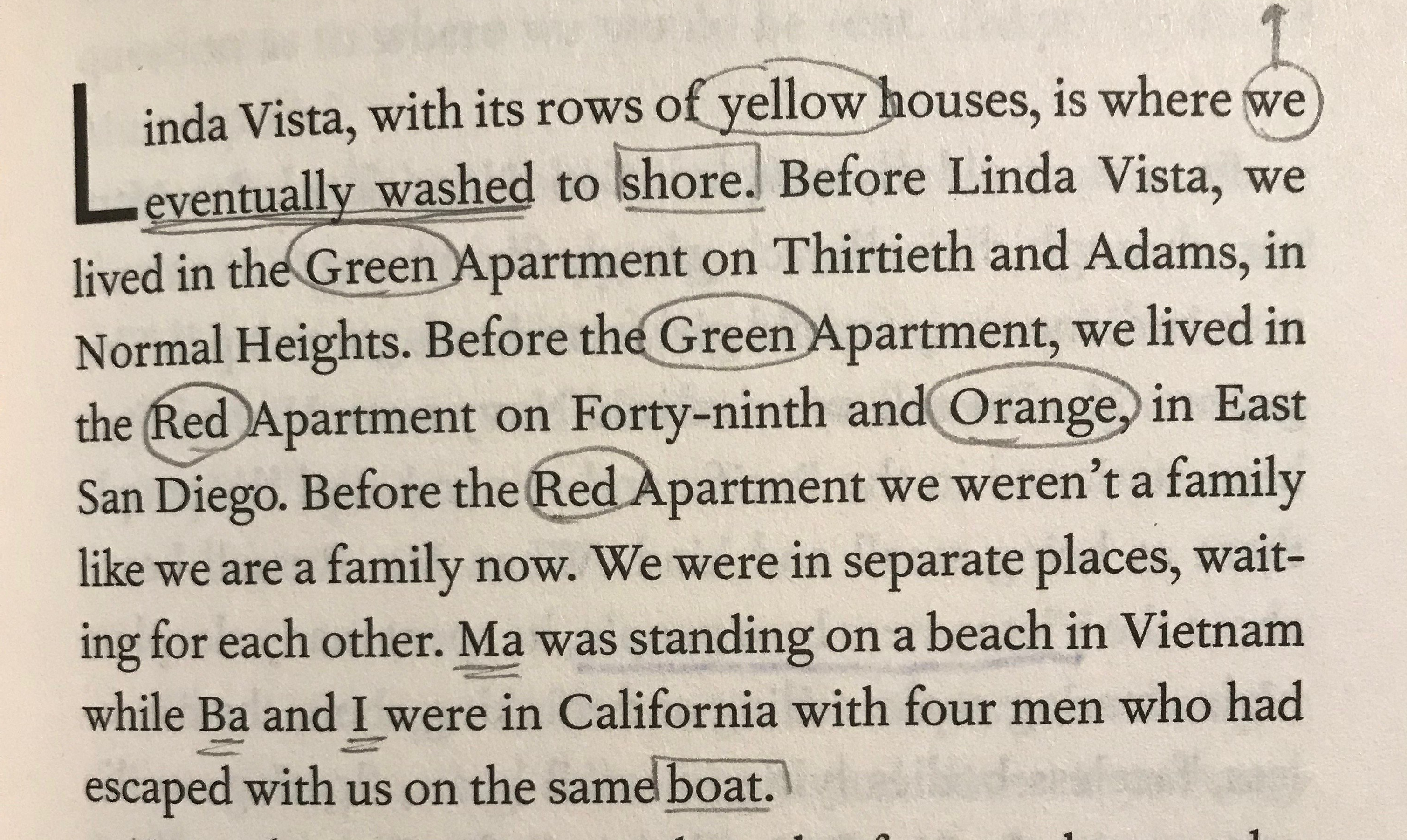
In Le Thi Diem Thuy’s novel The Gangster We Are All Looking For, Thuy begins the book with the following paragraph: (pg. 3)
Reading this text using an affect stylistic reader response, one would notice the repetitious use of colors to describe places, such as “yellow house,” “Green apartment,” “Red Apartment,” and “Forty-ninth and Orange.” This childish way of identifying places and the use of the past tense then leads the reader to believe that our narrator is a child looking back on her past experiences. Time and place are now established, but the textual analysis is needed to grasp what the text wants us to feel. The narrator withholds names, as she only gives pronouns for the first seven lines. The ambiguous “we” sets the reader up to believe that the “we” group was always the same, but “we” never stood for a complete family or group dynamic. Ma was across the water in Vietnam, and the child was with her dad and four men. This observational yet delayed response to her situation gives the reader insight into the narrator’s subconscious and way of processing information. We now know that this novel is going to first overload our senses, like with the colors, and then sneak in a blunt, but profound statement that changes our course of thinking and feeling about the previously mentioned sensory images. This contrast between image and statement speaks to the emotional and intellectual minds of the readers. Also, diction such as “we eventually washed ashore” implies that the journey was tiresome and that they washed up like debris. Using a social reading response, one would understand that immigrating to American from Vietnam was common in the 1970s and that the immigrant experience in America was not simple. The child narrator implies that she washed ashore as if she drifted there—unwanted by the Americans and far from home. Her life as a Vietnam refugee has just begun in this first paragraph, but the reader is keyed into cultural details about the immigrant experience. This reading now gives the readers context for why the child narrator may be describing locations in colors: because everything in this new world seems unreal and strange. Moreover, affect stylistics and social reader response can work well together to identify meaning from the language itself and the cultural context.
Works Cited
Lê Thi Diem Thúy. The Gangster We Are All Looking For. Anchor Books, 2016.
Tyson, Lois. Critical Theory Today. 3rd ed., Routledge, 2015
For this week’s blog post, I am interested in exploring subjective reader-response theory in relation to Gretel Ehrlich’s The Solace of Open Spaces. In the past, I have focused on Ehrlich’s syntax or the organization of her memoir and not so much on how the memoir makes me feel as a reader. Also, my previous responses have focused heavily on the text and structure of the memoir, which is why a literary theory that states that “reader’s responses are the text, both in the sense that there is no literary text beyond the meanings created by readers’ interpretations and in the sense that the text the critic analyzes is not the literary work but the written responses of readers” (Tyson 170) is an interesting way for me to look at Ehrlich’s work. My questions pertaining to subjective reader-response theory have to do with how we, as readers, do not fall into the trap of simply reading for relatability when applying this theory.
As I recall from reading Rebecca Mead’s article on “The Scourge of ‘Relatability,’” readers often use the excuse that they do not see themselves reflected within the text or cannot sympathize or empathize with characters or scenarios. If this subjective reader-response theory relies, according to David Bleich, on “experience oriented” reader responses that “discuss the reader’s reactions to the text, describing exactly how specific passages made the reader feel, think, or associate” (Tyson 171), how does this relate to the esteemed writing academia values so heavily? I believe the escape from just reading for relatability comes in answering the third guideline in creating a response analysis statement, which asks the reader to determine “why these responses [to the text] occurred” (Tyson 172). In thinking about the response a reader has to a particular paragraph or text first, as I will attempt to do in the next paragraph, the reader is able to address a section that appeals to them and then dig into it deeper to understand how specific textual elements result in that response and how it affects the meaning of the text as a whole.
In order to apply the subjective reader-response theory to Ehrlich’s chapter “On Water,” I will construct a response-analysis statement by following Bleich’s three proposed guidelines, which ask the reader to:
Characterize his or her response to the text as a whole
Identify the various responses prompted by different aspects of the text, which, of course, ultimately led to the student’s response to the text as a whole
Determine why these responses occurred
I will be applying these guidelines to the following passage:
“Water can stand for what is unconscious, instinctive, and sexual in us, for the creative swill in which we fish for ideas. It carries, weightlessly, the imponderable things in our lives: death and creation. We can drown in it or else stay buoyant, quench our thirst, stay alive” (Ehrlich 83).
As a former competitive swimmer, I feel most comfortable and most myself when I am a body of water. Thus, I felt drawn to Ehrlich’s chapter of The Solace of Open Spaces titled “On Water.” Without even reading this chapter, I had already made up my mind that I would enjoy the contents of the chapter and could relate to it personally in some way, as water created the direct line that connected my experiences as a reader and to Ehrlich’s experiences as the author. While this predisposition is more explicitly addressed by the social reader-response theory, I think that my interaction with this text can also be addresses by the subjective reader-response theory as I am “describing exactly how specific passages made the reader [me] feel, think, or associate” (Tyson 171). My initial response to this passage is that it makes me feel hopeful and at ease; I feel relief and comfort when I read Ehrlich’s words about water. I then realize that I am responding to the passage in this way because I feel an intimate connection with water, having grown up surrounded by it, whether that be in a swimming pool during practice or fly-fishing on the river with my father. For me, water is the only constant thing in my life: every major life moment for me has some connection with water and my strongest and most emotional memories are of times when I have won swimming races, fell into deep bodies of water, played in the waves with my sister, or spent late evenings tying flies on my father’s drift boat. I completely understand how water can symbolize the boundary between life and death and feel an intense sensation of relief when Ehrlich projects the feeling in my heart into words on a page as I know that at least someone else shares this sentiment and I am not alone.
By analyzing my own response to Ehrlich’s passage about water, I, as a reader, am able to understand why I identify with the text and how that shapes my response to the text as a whole. Yes, I do “relate” to the text, but Bleich’s guidelines help me to understand how and whyI do, undermining the simplicity of a reader liking a text because it is “relatable.” This theory is particularly useful when applied to a memoir (and for me thinking about memoirs for my SCE) because it encourages the reader to understand their complex relationship to the text in regard to their own personal lives, which is exactly at the heart of what makes certain memoirs such successful and compelling texts. I do think it is more serviceable to use this reader-response theory in addition to a close reading of the text, as I think there needs to be more textual weight behind the argument in order for the passage to be considered sufficiently analyzed.
Ehrlich, Gretel. The Solace of Open Spaces. New York, Penguin, 1985.
Finally, the reader. After working our way through New Criticism, structuralism, and the poststructuralist critical theory of deconstruction, we finally take up a key subject in the literary experience heretofore forgotten by analysis of “the text itself”: the reader. As we saw, in a variety of ways, all three previous theories and methods of literary interpretation–from Brooks to Barthes to Derrida–focus so thoroughly on the text as object and linguistic construct that the reader (and also the author, another kind of reader, an embodied subject) seemed to matter not in the least. Even to the point of the critic’s own unimportance in the end: the text, after all, deconstructs itself. If there is no outside the text, there’s also no reader separate from the text, waiting to take it up.
We have thus far considered the apparent loss of the reader and the author for its limitations and constraints. With reader response theory, we perhaps have a way to solve the problem of too much text. Here we still have a text, but the reader’s role in reading, in relating to, and perhaps even creating, the text is given prominence. The reader returns.
Tyson does good work in the chapter summarizing 5 different kinds or categories of reader response theory that are out there, or were out there at an earlier point in the study of English (roughly from the 1970s forward), and might be of use to you as you develop your ideas for a project and the most effective methods of interpretation you would bring to it.
Transactional theory: Rosenblatt; the reader creates the “poem” out of the text.
Affective Stylistics: a good example, Stanley Fish’s Surprised by Sin, his argument for “the reader in Paradise Lost.”
Subjective reader response theory: the readers response are the text–about as far from New Criticism as one could get.
Psychological reader response: the readers interpretations are based in their psychology (defenses, fantasies, etc.)
Social reader response theory: Fish returns, focused here on the idea of an “interpretive community,” the ways that we all read based on assumptions given or expected by the institutions within which we work, read, think.
I’d like to give some further thought to Stanley Fish. We can apply and combine the two approaches he is known for to a broader discussion of how we can read and write the sort of critical thinking and rhetorical knowing we do in English, and will be developing throughout the seminar. In other words: argumentation, the work we do (read, research, write, revise) to put forth a “thesis.”
What is a thesis? It is a name for a dynamic structuring of an argument that has a very basic core, whether that argument is 2 pages or 200 pages. Discovering a good argument (the word I tend to use instead of “thesis”) is as simple (and as complex) as asking the question: what’s the difference if we understand things this way instead of that way, if we rethink the topic, or reread the text in a different way? In other words, an argument is a re-sponse, re-lating and re-vising what is known with what is new, thus developing new ideas by re-thinking existing ones. This is what Kenneth Burke has in mind with the parable of the parlor, and why Burke argues that all thinking, by which he means therefore all rhetoric, is by nature dramatic–or what he called dramatism. Here is a basic dramatic structure for argumentation we will be using and practicing throughout the semester gets at the dynamics of response:
1. Context/Topic/Given/Premise—what’s already known: the conventional view
2. Problem or Question or Challenge to conventional view
3. Response—how the author will resolve the issue or answer the question
or in a variation of this structure (The Craft of Research refers to this as the “elevator speech” for any research project):
I am working on X [Topic, Author, Context]
To learn more about Y [a particular Problem, Question, Issue raised with regard to the topic]
So that my readers can better understand Z [What’s at stake, what’s the difference when we resolve the issue or question, and thus rethink X and understand it differently]
I would call this very basic structure and its variations a kind of Affective Stylistics that our interpretive community (in this department, English majors and English professors) expects to see and hear in an argument. The structure signals what’s at stake in an argument or critical reading. Why do we expect this “stake”? Because we know that this is an effective way to move our readers into and through our argument toward a level of persuasion and understanding we, as writers, want them to reach. It helps the reader understand why our thinking (and by hopeful extension, their thinking) matters, why they should care.
We can think of this combination of rhetorical knowledge and critical reading we bring to our writing in English as “effective stylistics.” We pay attention to the rhetorical matters of our style and syntax and organization not just because our interpretative community (faculty, editors, other readers in the field) expects this from us, but because we can also use this knowledge to move our readers.
Like Milton with Satan in Paradise Lost. To speak metonymically: We can surprise our readers out of the syntax of their conventional views and suggest ways to rewrite and rethink our sentences.
Reader, what would you do with reader response theory in your critical reading and writing? We will continue to think about various projects and the critical theories that best illuminate their problems and issues and the questions we want to pursue. Reader response theory is yet another. But I am also suggesting that whenever we think about and work on our own critical writing, reflect on its effects and think about our audience of readers, we are inevitably engaging in some version of reader response.
Looking at literature
through the lens of structuralism allows the audience to make easy access of
knowledge found in the text through means of categorization. Even without
meaning to, audiences may find themselves naturally sorting out aspects of a
work of literature due to prior knowledge. People may find certain stories to
find the same patterns and steps as they have seen in other cases, such as in
the case of movies for example. Structuring a movie based on what aspects the
plot shares with other movies before it. This in turn can allow the audience to
trace story archetypes back to their origins. Taking something such as The Quest
type of story allows itself to be lent to fictional work ranging in time
periods and intended audience.
Taking a popular story
such as the Harry Potter books create a world in which a hero emerges and
begins a quest to defeat an antagonist. This basic version of the story is in
no way original as it can be found in earlier works of literature such as Star
Wars (The original movie or the Book written by George Lucas). A hero emerges
and crosses a thresh hold. They are then taken in by an elder character with
more experience and go on to defeat the antagonist. Even earlier than that and
perhaps even more closely aligned with the Quest story type is The Lord of the
Rings by Tolkien. Characters are sent out from their home, not in search of an
item, but of a location. They take an object that it of great importance to
another location in order to quell of large-scale conflict by destroying it,
and in the process defeating an antagonist. All of these stories can indeed be
boiled down to fairly similar plot structures that all seem to hit the same beats
in their story type. A villain emerges, a hero emerges, they cross the point of
no return and end with the defeat (at least temporally in some cases) of the
villain.
Many of these simple
stories can be traced back to far older literature such as the story of Beowulf.
In the story of Beowulf there is a clear-cut skip to the antagonist being evil
just because and the hero being the hero because the story said so. Even
further back than this would be the stories present in the Bible. One can take
the story of Moses and fit it into the steps all the other stories mention
before followed. Although, while these are the same type of story being told
multiple times and hit the same beats, they differ in many ways. Structuralism
misses out on the ability to look deeper into a text and therefore misses out
on the individual difference between each of these stories. Each one mentioned
has its roots in the time and place in which it was created. The Bible and its
stories, specifically the story of Moses reflects the values of Jewish and Christian
heritage and relationship with God. On the other hand, the same story being
told in The Lord of the Rings follows similarly but highlights the everyday people
who are caught up in conflicts larger than themselves. While Structuralist thinking
can help to make connections between works of literature, it ignores the deeper
principles of the works covered and therefore misses much of the subjects that
would otherwise be discussed in a close reading of said stories.

 Psychoanalytic literary theory and criticism is by no means limited to the insights and theories developed by Sigmund Freud, the father of psychoanalysis. As Lois Tyson demonstrates, a great deal comes after Freud and the classical psychoanalysis that he establishes in the early 20th century, and much of that challenges while also building upon Freud’s “discovery” of the unconscious: Jung, Lacan, French feminists such as Kristeva and others who build upon Lacan and psychoanalytic theory. It’s complex stuff, and even though I took an entire course in graduate school on psychoanalytic theory, much of it is beyond my limited powers of understanding.
 Finally, the reader. After working our way through New Criticism, structuralism, and the poststructuralist critical theory of deconstruction, we finally take up a key subject in the literary experience heretofore forgotten by analysis of “the text itself”: the reader. As we saw, in a variety of ways, all three previous theories and methods of literary interpretation–from Brooks to Barthes to Derrida–focus so thoroughly on the text as object and linguistic construct that the reader (and also the author, another kind of reader, an embodied subject) seemed to matter not in the least. Even to the point of the critic’s own unimportance in the end: the text, after all, deconstructs itself. If there is no outside the text, there’s also no reader separate from the text, waiting to take it up.
 Creative Reading
You must be logged in to post a comment.