
Attempted Defiance of Structuralism

The most common structuralist practice we partake in as readers and writers would seem to be generic classification—a topic Tyson dedicates an entire subsection to as “The structure of literary genres.” In this section, Tyson largely cites Frye’s “theory of myths,” a framework that sorts texts by narrative pattern and offers four patterns that are presumed to account for the totality of human work. Frye similarly offers the “theory of modes,” which, again, provides only four stations to occupy, this time based on the agency of characters. The specifics of each theory and mode are somewhat unimportant for my argument so long as we understand as methods of classification—methods limited to four categories.

Modern methods are similarly limited and coincidentally rely on quartets as well. We commonly understand the broader modern genres to be fiction, nonfiction, poetry, and drama. It’s safe to say that large fantasy series like Harry Potter and Lord of the Rings are fiction, that a memoir like Cheryl Strayed’s Wild is nonfiction, or that the Broadway-hit Wicked is drama. The elements that classify these texts might not be entirely tangible, but the creation and continued existence of all of these texts was and is undeniably informed by the genres (structures) into which they fall. With little regard for plot or character, this generic classification would likely be the main structuralist concern. What makes Wicked dramatic? In what ways did previous self-discovery memoirs shape Wild? How did Harry Potter redefine teen fantasy novels? The list goes on with nearly every structuralist question coming back to genre.

However, genre isn’t the only thing structuralism seems to rely on so heavily. The desire for systems of classification points to a need for essentialism in order for structuralist criticism to work. We have to first identify a text as nonfiction before we can ask how it being nonfiction has shaped it. The problem comes when not texts don’t fit so neatly into broad genres. Works of historical fiction and speculative memoir hang somewhere between fiction and nonfiction. Prose poems lack the lineation and meter we expect of poetry. How can we discuss the poetic structures of Brigit Pegeen Kelly’s “Iskandariya” when the “poem” doesn’t fit nearly any of the criteria we check when asking if a work is, in fact, a poem?

Surely structuralism fails when a text defies accepted structures; one can’t work without the other. At least, this was my original conception. In the process of writing this blog post, however, I’ve realized it’s not so simple. Defiance of essentialist structures doesn’t free a text from the murkier deep structure Tyson goes on about. “Iskandariya” might not be a typical poem but we can still consider how it’s indebted to schools of imagism or the way invertebrates contrast with biblical allusion. Structuralist questions can still be asked of the text. “How does ‘Iskandariya’ fail as a poem?” is a structuralist criticism in the same way as asking how it succeeds. And so we find the importance of the deep structure. Though structuralist criticism leans heavily on classification and definition, the unknowable/unidentifiable influences that make up a text’s “deep structure” can still be analyzed—even when a text resists being classified.

Structuralism and age categories for thrillers

Structuralists strive to find the deep structure of a work. There seems to be a certain timelessness to many deep structures, such as the Cinderella narrative. Redone a million times in a million different ways, at its root, Cinderella will always consist of a girl with two evil stepsisters, a stepmom, a dead father, a helper (fairy godmother figure), and a male romantic interest. This is due to structuralists seeking “to understand, in a systematic way, the fundamental structures that underlie all human experience” (Tyson 198). Cinderella works hard her whole life and with a little guidance from others, eventually this hard work pays off and she is able to live happily. Society still holds these ideals in regard to working hard and being rewarded for this work. In class, we discussed that genre can be described as a form of structure, so I’m curious to delve deeper into the evolving structures regarding genre, specifically looking at how similar genres are across age categories.

Courtney Summer’s young adult thriller Sadie fulfills the deeper structures required of a thriller. It contains suspense and cliffhangers. The novel centers around the protagonist Sadie seeking justice for her sister Mattie’s death. However, in a form that I’ve never seen used before in a text, every other chapter is narrated by a radio personality in a podcast format. As part of the text itself, I think structuralists would take into consideration that the form of the text switches between being told from first person to being narrated like a podcast. However, I think the deep structures that structuralists look for would take this form to go one step deeper and use it to reveal how the text fits into the structural form of a thriller. Looking specifically at the age category Sadie is placed in, the text is marketed towards young adults because Sadie herself is a young adult. It also deals with more mature content, in part being that Sadie is actively seeking her sister’s murderer for revenge.

Megan Miranda’s All the Missing Girls is an adult thriller that also fulfills the required deeper structure of a thriller. Like Sadie, All the Missing Girls revolves around a dead girl. However, all of the characters are adults and the suspense is driven by them connecting points of the plot with seemingly unconnected and pivotal points of their childhood. Different from Sadie, a portion of All the Missing Girls is told reverse chronologically: from the past to the present. Just like with Sadie’s form though, structuralists would use this reverse chronology to go deeper into the text and look at how it contributes to making this text a thriller.

What is interesting between these two examples is that due to structuralist’s focusing purely on the underlying structures of a text, these two works can be vastly different in approach to content, form, and audience and yet still contain the same underlying structures that drive them to be thrillers. By removing the text to a certain level, we can see that young adults and adults are in essence reading the same content when they approach a thriller. In the example of these two books, it is suspense surrounding the protagonist in the exploration into the death of another character that is present in the text only in memories.

Works Cited

Miranda, Megan. All the Missing Girls. Simon & Schuster, 2017.

Summers, Courtney. Sadie. Wednesday Books, 2019.

Tyson, Lois. Critical Theory Today. 3rd ed., Routledge, 2015

On Beat, Offbeat

When I reviewed my notes on structuralism and deconstruction, I realized that I noted binary opposition under both theories. In structuralism, binary opposition is defined a “two ideas, directly opposed, each of which we understand by means of its opposition to the other” (Tyson 202). In deconstruction, binary opposition is, well, deconstructed; that is, it calls into question why we consider binary pairs the way we do, and it challenges us to look at them differently (Tyson 241). Support and criticism of binary opposition exist in conversation with each other, and I find it difficult to examine one without the other. In fact, longer texts may have this conversation in real time, supporting a binary in one way and breaking down the same binary in a different way a few pages later.

Before I go into examining this within a text, it seems relevant to note Roland Barthes’ concept of plurality. On the subject, Barthes writes, “…[the Text]  accomplishes  the  very  plural of meaning: an  irreducible (and not merely an acceptable) plural.  The Text is not a co-existence of meanings but a passage, an overcrossing…” (159).  To me, this means that each text not only has an infinite number of meanings, but all these meanings intersect with each other. This includes any meaning devised from any theory, even structuralism. There is no one meaning or interpretation. There is a collection of interconnected meanings, mingling together instead of simply standing adjacent to one another.

With that in mind, I return to where I left off at the end of the first paragraph: what is the nature of binary opposition in longer texts? Does it favor a structuralist reading or a deconstructive reading? Or does it turn out to be equally divided? Obviously, the answers to these questions hinge on the text that is under examination, so for the purposes of this further reading, I will look at Leah On the Offbeat.

Leah On the Offbeat is a coming-of-age novel about a teenager growing up, facing the challenges of high school, and falling in love. In this sense, structuralist would probably categorize it as a comedy, if they were going to file it under one of the seven archetypes (Walker). In terms of binary opposition, Leah, the titular character, is a young woman who falls in love with another young woman named Abby. This overarching plotline is quite deconstructive; it is typical for this narrative to be about a boy who falls in love with a girl. Therefore, the marginal female side of the gender binary, as well the queerness on the sexuality binary, are drawn to the forefront. However, Leah has an overwhelming desire to fit in. She tries to fit the typical structure that American society has created for teenage girls. In one of the more poignant moments like this, Leah tries to find a dress for prom. She eventually finds one that she likes, but she laments about how she wishes that she was one of the girls to whom fashion comes easy.

Leah’s attempts to fit into the pre-existing structure are an acknowledgment of their existence and influence, but in the case of this novel, it becomes clear that it is deconstructing their validity. Therefore, a conversation between structuralism and deconstruction needs to exist; it is difficult to unpack something before we know what we’re unpacking.

Works Cited

Albertalli, Becky. Leah on the Offbeat. Balzer & Bray, 2018.

Barthes, Roland. “From Work to Text.” Image Music Text. Translated by Stephen Heath, FontanaPress, 1977.

Tyson, Lois. Critical Theory Today. 3rded., Routledge, 2015.

Walker, Tommy. “The 7 Story Archetypes, and How They Can Dramatically Improve Your Marketing.” Social Media Today. www.socialmediatoday.com/content/7-story-archetypes-and-how-they-can-dramatically-improve-your-marketing. Accessed 13 Sept. 2019.

Wrestling with Suffrage

In “The World of Wrestling,” Roland Barthes argues that wrestlers are very much like characters in a play, and each wrestler has a designated role or “type,” such as “the bastard” or “the underdog.”  It reminded me of an Elizabeth Robins short story I read in my modernist women writers class called “Under His Roof” about the strained relationship between two former friends. Esther is a well-off housewife who takes pride in her house and doesn’t like change.  Miranda intends to join the suffrage movement and break into Parliament, against Esther’s advice.  

It becomes apparent that the characters embody the opposing views of women during the suffrage movement.  On the one hand, there’s Esther, who’s comfortable in her decaying and unsafe house (representing patriarchy) and who fears the suffrage movement (and change).  She marries out of desperation, believing this is the best and safest option. In Miranda’s words, she lives in the past. Miranda, on the other hand, is willing to risk life and limb for the right to vote.  She doesn’t admire the old house, and she points out its flaws. She is unmarried, independent, and determined. By reducing her characters to archetypes, Robins has a clear medium to convey the viewpoints and make an argument about suffrage.  Barthes touches on this idea when he praises wrestling for its clarity and lack of ambiguity.  

This level of simplicity can draw criticism from people who think it’s too heavy-handed.  So how clear is too clear? Robins manages this balance by giving her two archetypal characters a backstory unrelated to suffrage that also connects them.  She also doesn’t bypass the range of emotions both women show. Esther is proud and condescending, but worried for Miranda. Miranda, in turn, struggled with heartbreak in the past, finds a purpose and dignity in the movement, and feels a degree of tenderness toward Esther.  

And if a character type is meant to be unpredictable (as Barthes describes the “bastard”), how can one be unpredictable and yet clear?  I suspect by “unpredictable,” Barthes means “appearing unpredictable,” as the entire wrestling match is an appearance or show. We can have a general idea of what the character will do, even if how he goes about it, and the result, is familiar.  For example, Wile E. Coyote tries all sorts of bizarre methods to catch Road Runner, but someone who’s seen enough episodes knows he’ll always fail.   

Further, at one point, Barthes says at least some of the audience members aren’t within the roles of society.  This suggests that a person who watches a flamboyant display like wrestling becomes a type or role, the same as the wrestlers.  It seems strange that people who normally don’t encourage fighting may egg on fighting and violence in a staged setting—until we consider how humans behave differently in different environments, a deconstructionist outlook on human identity.  The person I am in my dorm, the person I am in band class, and the person I am when I’m at church are not identical. Role playing and archetypes aren’t limited to wrestlers or fictional characters; it’s a life skill for everyday people.  

Structuralism: Diversions and Creations

Structuralism is interested not in the text itself or the history of the author, but solely in the work’s structure and the history of not only that structure, but also all the structures that led to that one. While I think it can be useful to look at the structure of a work and what it means for something to be written in that structure, I also think that it is impossible to get a good critical reading of a piece if your only concern is how the piece is structured and why. For example, in Prof. Rydel’s Women Writers to 1800 class, we were talking about how the form of the lai predated the fairy tale, but Marie de France’s lais still read very much like fairy tales. We then talked very briefly about Frye’s four archetypes of literature before moving on to discuss the content of the lais, which ultimately helped us analyze the lais more than determining how the fairytale and lai structures were similar.

When applying structuralism to a text, I think it becomes most useful when the author is purposefully subverting the structure, or the structure is explicitly important. One example of a structure being purposefully subverted, as we have mentioned in class a few times, is John Milton’s Paradise Lost. In the first few lines of the poem, Milton tells the reader exactly what is going to happen—the poem is an epic retelling of Genesis in which Jesus is the epic hero. Despite this, Milton subverts the reader’s expectations of an epic poem by focusing on Satan, creating the impression that he is in fact the epic hero instead. This subversion of the reader’s expectation creates an interesting dynamic between the author and the structure that I think a structuralist would run with (but I guess we’ll see for sure when we read the article about Paradise Lost).

The other time I think the structuralist criticism would be most interesting is when the structure of a piece is explicitly important. While I realize a structuralist would argue that the structure of a piece is always explicitly important, I am again more interested in what an author chooses to do with a structure. One of the most obvious examples of this is poets who write into a form—sonnet, ghazal, sestina, couplets, etc. Jericho Brown created the duplex, which he describes as, “a combination of the sonnet, the ghazal, and the blues” (jerichobrown.com). An example of a duplex can be found here: https://poets.org/poem/duplex. The structuralist perspective would be interested in the way Brown’s poem is in couplets, it has a rhyme structure, it’s got lyrical qualities, etc. There are infinite possibilities and rabbit holes in which a structuralist could dig to find the “deeper structure” of a duplex, beyond what Brown gives us in his definition of one. A structuralist would not care about Brown’s mention of abuse or him being gay—two things that feel important to the poem—and would only focus on the interconnections of the structures.

Brown, Jericho. “Poet: Jericho Brown.” Jericho Brown, http://www.jerichobrown.com/.

“The Tradition.” The Tradition, by Jericho Brown, Copper Canyon Press, 2019.

The Usefulness of Structuralist Criticism

In our group discussion of structuralist criticism, I raised the question of whether or not one could create a full, developed argument about a literary work based solely on structuralist criticism. The group came to a consensus that structuralism is very limited in its usefulness to analyze the whole of a literary work, but could be more useful if used in conjunction with a different form of criticism. Since structuralist criticism is exclusively limited to the structure of a particular literary genre, one would ultimately be leaving out key details and points in an argument using a structuralist analysis on its own.

Structuralist criticism in terms of literature aims to simplify and categorize texts in an almost scientific way. Structuralist theory does prove to be useful in making sense of the texts we read, but can every text be as simple as boiling it down to a formulaic structure? Many works of literature such as Frankenstein for example, can contain multiple structures and allusions to multiple genres built into the text. When we get into works that are more complex, is it still always possible to break the text down into a single structure, or do other types of criticisms need to come into play?

We as readers tend to find movies, books, television shows, and events more exciting when typical structural norms are broken or reversed to create deeper interest. The same can also be said for things like WWE or television shows such as NCIS where each match or episode is based around the same structure and we as the audience know what’s basically going to happen. So what is it really then that captures our interest when it comes to the structure of a work of literature? Paradise Lost is a good example of a text that is aware of its own structure but still attempts to subvert it.

Everything must have some type of structure even if it attempts to destabilize it. In writing Paradise Lost, John Milton was aware that he was going to follow the structure of an epic poem, but also subvert it by taking the trope of the epic hero and flipping it on its head. Milton uses Satan as a character that resembles many of the same characteristics as an epic hero, but is ultimately still the villain of the story. Readers find the character to be extremely interesting because of the parts of the structure that stay intact and the component of evil tied into it are at odds with each other. Structuralist criticism is certainly limited when it comes to fully analyzing a work of literature, but can provide important uses in its simplification and categorization of genre, structural components, and sign systems. A work can ultimately not succeed unless it follows a certain structure and sequence of events, but that doesn’t mean it can’t still challenge those structures.

Further Reading – Structuralism and the 4 chords

            In today’s discussion on structuralist theory, I began thinking about how it could be applied to music.  Many people know that the top 40 pop songs tend to sound very similar, but most don’t know just how similar.  The majority of popular songs in the past few decades have only used the same four chords played in various arrangements and time signatures.  Those chords are C, G, A minor, and F, which are all actually just variations on the C scale.  So many songs use these chords that these are typically the first ones any musician learns when learning to play a new instrument.  These four chords allow a musician to play so many songs and so many simplified versions that many people don’t go far past learning these four if they are only interested in casual mastery of their instrument.

            The fact that so many songs use the same four chords has led to many people creating their own songs, tutorials, and videos based around this phenomenon.  You can find many different mash ups on YouTube that provide an example for how many songs use the four-chord formula, but the best one I’ve found is from the spoof band The Axis of Awesome.  Their song, literally called “4 Chords”, is approximately 6 minutes long and includes 47 snippets of different songs.  The video starts off with one of the three members playing the opening melody to Journey’s “Don’t Stop Believing” while the other two walk up.  The man at the piano asks the other two if they recognize the song, they answer yes, and the man at the piano says, “Well, there’s a few more songs with the same chords, check it out.” (The Axis of Awesome)  The man at the piano then slips into a simple melody that is used for the rest of the song.  The three men then proceed to sing the snippets of other songs over this melody line, showing how all those other songs follow the same formula with the same four chords.  The never changing melody line, but ever-changing lyrics and beat at which the men sing forms their structuralist criticism.  It shows how many popular artists use the same framework to construct their songs.  The song ends with the lyrics,

Doesn’t that sound familiar?

Doesn’t that hit too close to home?

Doesn’t that make you shiver?

The way that things have gone? …

It’s something I do remember

To never go this far

That’s all it takes to be a star.  (The Axis of Awesome)

The criticism here is how simplistic most songs are and how simple it is to construct a top hit song.  The Axis of Awesome is using structuralism to form their argument by showing just how many songs they can throw together into one piece with the same melody line, which shows how all the songs are using the same frame work.

If you’re interested in the video, you can watch it here.

The Axis of Awesome, director. 4 Chords | Music Videos | The Axis Of Awesome. YouTube, YouTube, 20 July 2011, http://www.youtube.com/watch?v=oOlDewpCfZQ.

Deconstruction and the Beauty of Being Meaningless

When considering the deconstructive method of literary criticism, I immediately imagine a never-ending food chain in which a string of organisms (both micro and macro-sized) evolve as life goes on. I think that deconstructive theory relates to an ever-growing ecosystem in the sense that language, meaning, and semantic codes are always tumbling forward, building off one another, and leading to new life or interpretation. In Tyson’s chapter on deconstruction, she uses terms such as undecidability, dissemination, and plurality to describe how language is always changing. I find it helpful how Tyson defines undecidability as meaning “that reader and text alike are inextricably bound within the language’s dissemination of meanings” (Tyson, 245). Dissemination is defined as the action of spreading, diffusing, or distributing, and I believe that a deconstructive outlook on language would view the text as constantly diffusing and expanding across the page and the world. In analyzing a text with a deconstructive lens, one must accept that “the ‘meaning’ of the text is really an indefinite, undecidable, plural, conflicting array of possible meanings and that the text, therefore, has no meaning” (Tyson, 245). Once we can accept that language is a messy, slippery form of expression, we can allow the text to unfold in an unforced and organic way. This natural progression of a text, or dissemination, can also be applied to one’s mental and spiritual state. For example, Tyson writes that “our mental life consists not of concepts — not of solid, stable meanings — but a fleeting, continually changing play of signifiers” (Tyson, 238). Moreover, I am interested in how a deconstructive lens can be applied to both literature and a state of mind, and how this affects the structural unfolding of a text. Also, I want to explore texts that use deconstruction, rather than a formal and “meaningful” structure, to celebrate words and breath life into the beautiful, ambiguous mess of linguistics. 

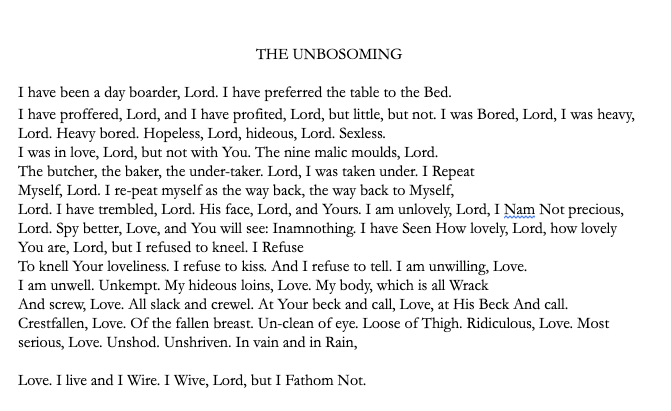
Roland Barthes writes in her essay “From Work to Text” that “the work is a fragment of a substance” (Barthes, 156). This ambiguous and abstract concept works so well to describe the deconstructive theory. Each word is a fragment of an essence, and this essence is neither absolute or tangible. Therefore, language is simply an organism that has feasted on the previous organism to gain depth and movement (going back to my food chain analogy). A work of art does not have to have a concrete meaning. This is especially present in Olena Kalytiak Davis’ poem “The Unbosoming.” Davis creates a long, associative string of nonsensical words that all recall auditory connections with previous words. Her poem is highly musical and contains so much consonance and assonance that the language simple takes over any possible meaning. I would argue that her poem completely deconstructs language. Her use of sonic wordplay propels the poem forward. Her reliance on language’s instability also highlights the tension between language and expected meaning. Deconstruction aims to sustain tension by leaving the text unresolved, and Davis defers inherent meaning by stringing together impressionistic and musical words. The poem unfolds like a stream-of-consciousness that is free from any critical or structural judgment. The words and images work as associative sequences that debunk the poet’s illusion of control over the poem. She truly embraces the messy and decentralizing nature of deconstructionism by creating “nonsense” words. 

Overall, her poem would be celebrated by deconstruction critics because they would argue that her nonsensical diction and lack of narrative control is a testament to literature’s continuous journey towards nothingness. Davis writes: “Lord, I was taken under. I Repeat /Myself, Lord. I re-peat myself as the way back, the way back to Myself” (5-6). She is taken under by the power of language. The limits of language and self-expression are materialized by her poem. The narrator swallows sounds and images as if they have agency over us as if they will keep moving regardless of whether humans find meaning in them. After applying deconstructionism to “The Unbosoming” I understand how existentialists are constantly questioning whether there is a fixed existence. In reading Davis’ poem, which is a great manifestation of deconstructionist thinking, I was able to forget about authorial intention, structural form, and thematic meaning to simply follow the words and they grow and change. 

Screen Shot 2019-09-12 at 10.07.38 PM.png


Works Cited

Barthes, Roland. “From Work to Text.” Image Music Text. Translated by Stephan Heath. Fontana Press, 1977.

Davis, Olena Kalytiak “The Unbosoming” 

Tyson, Lois. Critical Theory Today. 3rd ed., Routledge, 2015


The Deep Structure of Feminine Temptation and its Consequences

Structuralist criticism teaches the scholar of literature to look for recurring deep patterns in the framework of the composition of many texts. These comment elements or themes give us insight into the conscious or subconscious themes that are repeated time and time again throughout history.

One such deep structural pattern is the recurring concept of a virginal female character being tempted into sin by an evil male influence. The innocent pays dearly for her transgression, nearly loses her life, and is saved by the positive influence of another, more virtuous woman.

In “Goblin Market” by Christina Rossetti, two seemingly parentless young maiden sisters are called to by the evil, masculine goblins who offer them their fruits. Each day, the sisters endure the increasingly confrontational calls from the goblins hawking their wares. When one of the sisters, Laura, is tempted beyond reason, she must give a golden curl of hair to the goblins in exchange for the fruits they offer. She gorges on the sensuous feast of fruits and returns to her sister with tales of the pleasures she’s enjoyed. Her sister Lizzie scolds her and reminds her of another maiden who once dealt with goblin men and withered away. Laura reassures Lizzie that she’ll be fine, but when she realized she can no longer see or hear the goblin men, she begins to pine for the fruits they offered. She wastes away until her virtuous sister goes to the goblin men and purchases fruits and rubs the juices upon her face without enjoying the sensual pleasure of them herself. She returns to Laura who kisses the juices from her sisters face and is restored to health, grateful and chastened by her experience with the goblin men. Laura then expresses gratitude for the intervention of Lizzie and her sister’s virtuous nature.

Fifty years prior, Marianne and her sister Elinor in Jane Austen’s tale, “Sense and Sensibility” have a similar relationship. When Marianne falls for the dashing Willoughby, she lets all propriety go by the wayside. She spends scandalously unchaperoned time with him and provides him with a lock of her hair as if they were engaged to be married. After she’s risked her reputation and social standing on him, he abandons her for a more advantageous match with a wealthier woman. Devastated, Marianne jeopardizes her health and catches a fever that nearly kills her. Elinor saves the day enlisting Colonel Brandon to fetch their mother to nurse Marianne back to health. Marianne realizes the error of her ways and begins to take her sister’s advice and settles down.

126 years later, a popular movie (based on the novel by the same name) “Practical Magic” follows the structure. Sister Sally marries and settles down with a family. Her sister Gillian chases her impulses across the country and ends up linked with an evil man. Only the intervention of her sister Sally can rescue her from the consequences of her misdeeds. Gillian nearly dies in the process and decides to emulate her sister for her own well-being once she’s recovered.

Time and time again, young woman in literature and film fall victim to the evil influence of tempting male figures. They suffer gravely for the mistake, and rely upon a woman, often her sister, of better character to pull them back to the right path. This deep structure is used a cautionary tale to young women and reflects our society’s fear of sexually empowered young women.

Works Cited

Austen, Jane. Sense and Sensibility. Edited by Peter Conrad, D. Campbell, 1992.

Dunne, Griffin, director. Practical Magic. Village Roadshow Pictures, 1998.

Rossetti, Christina. “Goblin Market by Christina Rossetti.” Poetry Foundation, Poetry Foundation, https://www.poetryfoundation.org/poems/44996/goblin-market.

Into the Narrative: A Structuralist Look at Gretel Ehrlich’s Memoir

A critical concept that particularly interested me in the reading is the structure of narrative. In the context that I want to interrogate this concept, I am working with the definition that narrative structure deals with the “inner ‘workings’ of literary texts in order to discover the fundamental structural units . . . or functions . . . that govern texts’ narrative operations” (Tyson 212). In terms of structuralism as a whole, the structure of narrative is concerned with characterization and plot formulation in relation to language structures within the text. Ultimately, the structure of narrative is useful in that it gives the structuralist critic a way to examine the how the narrative operates within the text and to what end. One thing I realized when reading this section was the specific use of this concept with fiction; therefore, I wonder how applicable this concept is to nonfiction texts. How does structuralist narratology work with a nonfiction text such as a memoir, which does not include the same plot formula as a fiction work?

The best way I can think of to delve into this question is to think about the “units of narrative progression” (Tyson 212) in both fiction and nonfiction. In fiction, the narrative progression takes the structural form of a plot mountain, with the conflicts, tensions, climaxes, and resolutions clearly labelled. In a memoir, I believe the narrative progression is not as easy to map out, mostly because the progression depends upon the order that the events are told in, such as in chronological order. Even if we cannot apply a plot map to a memoir in the same way we can with a fictional novel, I do think that the narrative structure of a memoir can be analyzed in the same or similar way if we look at the text in the way that Gérard Genette does: by observing the tense of the text in regard to order, duration, and frequency (Tyson 216). 

In Gretel Ehrlich’s The Solace of Open Spaces, she says in the preface that this memoir was “originally conceived as a straight-through narrative,” but was instead “written in fits and starts and later arranged chronologically” (ix). If we think about this memoir in terms of the order of the narrative structure, the relationship between the chronology of the story and the chronology of the narrative is technically the same, as the stories are told in the same order as they happened in real life. However, due to Ehrlich’s note in the preface, the reader knows that the writing process did not happen chronologically. With structuralism, this note about how the memoir was written does not really matter in terms of narrative structure. This moment of authorial intention is irrelevant because the critic aims to analyze the text alone, and the only thing that matters in analyzing this memoir is that the chapters or sections are arranged in chronological order. 

In terms of duration, The Solace of Open Spacesis 131 pages and covers roughly ten years of Ehrlich’s life in Wyoming. Individual stories may tell a few months in as little as 10 pages, but the relationship between the length of time of a certain event and the number of pages the narrative occupies is fairly even. Just as in a fictional novel, the speaker can stretch or condense events to fit however many pages she sees fit. The main difference here is that the speaker in a memoir uses the whole book to tell of one portion of her life, making that the main event that occupies all of the pages. In Genette’s last section about frequency, one might note the number of times Ehrlich describes the sky in her memoir, or the recurring trips she takes as a ranch hand and how the experiences differ. In this way, the events repeated in a memoir have much of the same effects as repeated events in fictional novels. 

Circling back to my original question, a critic is definitely able to analyze a memoir in terms of narrative structure in the same way that a fictional novel can be analyzed. Though characterization may not be as much of a focus, the plot of a memoir and the order of events in the memoir give the critic an insight as to what deeper structures are at work within the text. For example, after noticing that the events in a 10-year timespan occur chronologically over a good amount of pages, perhaps the critic would realize that the recurrence of specific events, descriptions, and syntax are additional structural functions at work that allow the reader to understand the landscape and atmosphere of Wyoming and how the land itself can affect a person. 

Ehrlich, Gretel. The Solace of Open Spaces. New York, Penguin, 1985.

Tyson, Lois. Critical Theory Today. 3rd ed., Routledge, 2015. 

The Death of the Author and the Birth of the Text

That ominous phrase and concept, “the death of the author,” has long been attached to deconstruction, or deconstructive criticism. Deconstruction is a leading critical theory of a larger grouping of literary and critical theory that emerges in the 1960s and 1970s in Europe, and thrives in American academic institutions (mostly) in the 1980s and 90s. That larger grouping is known as “poststructuralism,” a phrase which in some ways overlaps with the term “postmodernism,” but not entirely.

“Poststructuralism” (as an umbrella term for theories like deconstruction) is useful for our purposes this week since the phrase reminds us that deconstructive criticism follows and replaces structuralism, but does so by way of relation. Both focus on an understanding of language and writing as the foundation of any text–not the author, not the reader, not the historical era in which that text was composed or published.

To some extent, we are still talking about “text without contexts,” as we encountered in our readings of the New Criticism. But structuralism and then deconstruction take things a step further. In New Criticism, we had an author’s work (Brooks consistently refers to Keats and Eliot to “the individual talent”), but we understood that what mattered was interpretation of the poem/poetry, not the poet. Now, with structuralism and deconstruction, that individual author and work disappear into the writing of the text. Now, the text is all context–or as Derrida, leading proponent of deconstruction famously  put it: “there is no outside the text.” We move, as Roland Barthes phrases it, “From Work to Text.”  We will read that essay for Thursday, from a collection (Image/Music/Text) that includes his essay “The Death of the Author.” Barthes is a useful guide for us this week since his earlier work such as “The World of Wrestling” (from Mythologies) is a good example of a structuralist interpretation.

As a way to distinguish structuralism from what comes after it, poststructuralism, I think it is particularly helpful to focus on the linguistic “structure” that both emphasize in understanding the birth of the text and the death of the literary work grounded in the authority of the author. Structuralism would have us think in metaphors and analogies of surface and depth, the structures we can see and the deep structure we can’t. Here are some relevant surface/deep structure relations:

structural linguistics:

parole (individual speech) / langue (the underlying language, grammar, syntactic structures

cultural (also called structural) anthropology: culture (individual practices or rituals) or myths (individual stories, mythemes) / underlying kinship rules or archetypal mythology across groups, cultures [Levi-Strauss: “incest is bad grammar”]

psychoanalytic theory: conscious/unconscious

Marxism: superstructure/substructure or base

New Criticism: Denotation/Connotation or Tension/Opposition/Paradox in the poem/organic wholeness underlying the poetry


Poststructuralist theory, most especially deconstruction, learns from the structuralist insights on language (Saussure is a key figure for both) and what is called semiotics (the science of signs, the understanding the a sign is comprised of something signified but also its signifier). But rather than believing, as strucutralism does, that the acts of signification are contained or closed off by the signified, deconstruction argues that one signifier suggests another signifier. The process of signification continues without end. Instead of a surface/depth metaphor where the signifier is grounded by the signified, deconstruction shifts attention to the metonymy of signifying: one sign leads to the next sign that is near it or in part related, which leads to the next sign, and so on. From the deconstructive perspective, there is no underlying deep structure in language that somehow stands apart from language. The very idea of a deep structure, and the very act of interpreting or perceiving a deep structure in anything, exists only in the thinking we do with language and signs.

deconstruction: sign–>sign–>sign / signification (but: signification is itself more signs)

mise en abyme: a phrase from French used by Derrida and others: “placed into the abyss.” Think of a mirror held up to a mirror–where does it stop? Or a play within a play (which also has a play within it, and so on). This is where “undecidability” comes into play.

In other words, from the perspective of deconstructive theory, there is no end to the signifying process, since there is no one or no thing outside the process of signification. (The sign tells us there is another sign ahead; but when we get up to that sign, we are still looking at a sign.) There is no “transcendental signified” that can stand apart from the language we use to think. According to deconstruction, traditional names for some transcendental signifieds used to (falsely) suggest a stable ground apart from the process of signification: Author, God, Nature, Being.

Last week we suggested that Brooks’ new critical perspective on Keats’s “Ode” is on to something valuable. The poem is contradictory, paradoxical, maybe even noisy–and close reading of the symbols and language help us to hear the noise more clearly. That makes it interesting to both the new critic and the deconstructionist. But Brooks in the end has to sweep the mess (all the stuff he can’t account for) under the rug, saying the paradox is resolved by Paradox (his transcendental signified). It’s circular (just as the statement made by the Urn: this poem is art because true art is poetic). Deconstruction calls out that circularity as a lie, but says it’s a lie that all texts, all poets and critics, can’t escape, due to the nature of language. Instead of sweeping the mess under the rug, deconstruction suggests that the rug is indistinguishable from the mess.

But does that mean we should stop caring about cleaning up the room, stop sweeping the floor since the rug in the end isn’t separate from the floor or the mess? And are we, in fact, separate from that mess? Doesn’t contemporary physics suggest that we–the stuff that really makes us–can’t be decidable or certain in the ways we used to think of nature (Descartes, Newton) before Einstein and Heisenberg? I fear that the metaphor of my analogy is slipping away from me into quantum physics, sliding into the abyme of my thinking of thinking, my language about the nature of language.

For some further reading and thinking about structuralist principles in the real world, for example the idea of “archetypes”:  The 7 Story Archetypes, suggesting that any story  or narrative (including film) can be read at a deep structural level.

And for more on Derrida and deconstruction, you can’t go wrong with YouTube.

To hear Robert Frost reading “Mending Wall” (the poem used as an example in the Deconstruction chapter). Consider what a structuralist reading of this poem would do compare to what a deconstructive reading would do.

T.S. Eliot’s Tradition & Individual Talent Theory and New Criticism applied to Paradise Lost

In T.S. Eliot’s essay: Tradition and Individual Talent, Eliot formulates several interesting theories about writers and how their talent is connected to tradition. Eliot points out the fact that when we criticize a literary work, we praise the writer for the aspects of their work that stand out or least resemble anyone else. In other words, we praise the parts of a writer’s work that sets them a part as an individual and gives them their own unique identity. Eliot’s argument is that these parts of the writer’s work that gives them their individual identity is developed and is a result of writers from the past and their works that have influenced the present writer’s work. In this way, tradition and what we praise as individual talent are directly tied together. In Eliot’s words, “What is to be insisted upon is that the poet must develop or procure the consciousness of the past and that he should continue to develop this consciousness throughout his career” (Eliot). This also relates to our discussion in class of the parlor conversation and how any argument or idea that someone can come up with is always a continuation of some previous discussion or argument. We can come up with new angles and ways to argue a topic, but it is always building off of someone’s previous discussion.
While Eliot makes it clear that it is important to note the tradition and historical context preceding and influencing a text, he does also resemble several elements of new criticism theory in his essay. For one, Eliot believes “Honest criticism and sensitive appreciation are directed not upon the poet but upon the poetry” (Eliot). Eliot also believes in looking at a text through a scientific point of view or formulaically, something else that seems to be very new criticism-esque.
It would be very hard to examine Paradise Lost through a lens of new criticism because the text is designed to work in parallel with its’ historical context. Milton is trying to make an argument against government censorship through his writing, so how is it possible to not bring in the historical context in an analysis of the text? My SCE project analyzes Paradise Lost by John Milton and discusses the arguments that Milton is trying to make underneath his intriguing layer of prose. Milton himself realized and understood in his creation of Paradise Lost that he was using the same conventions of a typical epic poem as many writers before him such as Homer and Virgil had done before. What made Milton an individual and what we praise in Paradise Lost is Milton’s unique reversal of epic poem conventions. Milton creates his own identity by using ideas from previous writers and their works, and builds something new off of it. For example, in most if not all epic poems up until Paradise Lost, there was the typical “epic hero” who goes on a quest, faces challenges, and ultimately succeeds in a task. The epic hero typically has traits of righteousness and virtue. Milton takes this convention and flips it on its head with the character of Satan who resembles certain traits of an epic hero, but is also the villain of the story.

Works Cited:
Eliot, T. S. “Tradition and the Individual Talent.” Perspecta, vol. 19, 1982, p. 36., doi:10.2307/1567048.

Content vs Context

When applying New Criticism to a text, the analyzer is only supposed to take into consideration what is in the text. New Critics value content over context, ignoring anything that isn’t explicitly stated by the writer in that particular work. While I appreciate the heavy reliance on analyzing the text, I find it counterproductive to the project of the piece not to contextualize it—not to think about what was happening at the time the text was written, who the writer was, and what they were interested in forces the reader to ignore certain aspects of the text (or completely miss references) does the work a disservice.

Because of the intense focus on the text, New Critics are able to deeply analyze a text, which I think is fundamental when it comes to analysis of any kind—you have to be able to articulate what the text is doing before you can begin to unpack how it’s doing that. However, I think New Criticism falls short in ignoring outside aspects and influences of the work. As we began to talk about in class today, when artists or critics or curators or whomever are analyzing work they look at the piece itself, but then they look at the piece in relation to the other pieces made by that artist or made in the same time period or during the same movement in order to create the most compelling, thorough analysis of the work.

One poet whose work I am really interested in right now is Jericho Brown, whose latest book, The Tradition, deals with a lot of heavy topics including race, queerness, and trauma. If we were to look at Brown’s poems as New Critics and analyze only the content of the poems, we would still be reading amazing poems, but we would lose so much of their nuances. Brown’s personal history plays a huge role in the emotion of these poems—he is an African American, queer man who has undergone some intense traumas in his life, and to separate that context from the content of his poems would mean losing the value of them.

In the titular poem for Brown’s book (which can be found here: https://poets.org/poem/tradition), New Critics would lose so much of the historical implications of the poem, which deals with slavery and police brutality without ever naming those things. To separate Brown from the poem would mean that lines like, “our dead fathers/Wiped sweat from their necks” wouldn’t have the implications of slavery because a New Critic would not consider Brown’s race when analyzing the poem. And a New Critic would completely lose the meaning behind the end of the poem because they wouldn’t be able to understand who John Crawford, Eric Garner, and Mike Brown are or why the ending of the poem is not only intelligent, but also extremely emotional. When Brown says, “Men like me and my brothers filmed what we/ Planted for proof we existed before/ Too late, sped the video to see blossoms/Brought in seconds, colors you expect in poems/Where the world ends, everything cut down./John Crawford. Eric Garner. Mike Brown.” he is equating black men who have been murdered by police officers to flowers that have been plucked and cut down. Without the context of Brown’s background or the current political climate surrounding police brutality, New Critics wouldn’t be able to fully grasp what Brown was doing in the poem.

“The Tradition.” The Tradition, by Jericho Brown, Copper Canyon Press, 2019.

The Importance of Context

After reading Critical Theory Today by Lois Tyson, I am intrigued by how new critics believed that the interpretive work they were doing could lead to one single best objective interpretation of a text. By only looking at the text itself, new critics believed the text “would itself dictate how it would be interpreted” (Tyson 142). However, there is no objective way to evaluate what constitutes “the best interpretation” of a text. Clearly the creators of new criticism were rejecting the idea that every reader brings to the text their own backgrounds and bias, while at the same time evaluating a text based on their perception of what is “best.” Did new critics genuinely not believe that context influences works or were they choosing to neglect this contextual influence?

By focusing solely on the text of a work without regard to any context, the new critic could easily be overlooking a major creative element of a text. If a major element of the text is being overlooked than how can they say that they have formed the best interpretation of the work? And if there were one single best interpretation of a text, then why is it necessary to argue for your interpretation? Wouldn’t everyone in the literary community agree with your view, as they have come to the same single interpretation that you have?

New critics have to evaluate which form of a word best fits with their perceived “best interpretation,” which means they have to be aware in some way, shape, or form that others can argue differently for the interpretation of the text. There are definite limitations to how objective their criticism becomes once they have to make these choices rooted in personal opinion of the text and its meaning. If there are multiple different definitions for the words, then how objective can new critics actually be in interpreting the text when they must only pick one definition as correct?

To new critics, “[a text’s] meaning is as objective as its physical existence on the page” (Tyson 131). However, in “Caged Bird” by Maya Angelou, without context the text loses a lot of its importance. Through a new critic’s eye, “Caged Bird” is taken very literally to present the dichotomy between freedom and imprisonment. In Angelou’s poem the free bird “floats downstream” (3) and “names the sky his own” (26) because his normal bodily functions have not been hindered in any way. In opposition to the free bird, there is not only a cage around the imprisoned bird, but also “his wings are clipped and / his feet are tied” (Angelou 12-13). The voice of this bird is all that it has left to use in protest of its current and potentially never-ending conditions. The poem opens with the free bird and the freedom that the caged bird at the end of the poem is still singing and longing for.  

Though this interpretation is able to address important aspects of the poem, by removing the broader social and historical contexts of the poem from consideration into its meaning, the poem loses part of its significance. The fact that this poem was written by an African American poet during the Civil Rights Movement is important in knowing that the birds are symbols representing the white man and the enslaved African American. New critics are in part only able to scratch the surface of literary analysis of a text due primarily to the fact that context often and almost always plays an important role in the creation and meaning behind a text.

Works Cited

Angelou, Maya. “Caged Bird.” Poetry Foundation, Poetry Foundation, http://www.poetryfoundation.org/poems/48989/caged-bird.

Tyson, Lois. Critical Theory Today: a User-Friendly Guide. Routledge, 2015.

Limiting Genius with the New Criticism Method

The New Criticism model of literature evaluation forces us to compare a text against itself. It constrains us to what has been provided for us by the author. All arguments must stem from what is on the page, all evidence to support those arguments must come from that same page. We are asked not to consider the author’s background, their intent in writing the text, or the impact the artifact has had upon the reader.

The effect of this model of criticism is to limit the brilliance of some pieces of literature, by removing from their merit the huge emotional response a reader may have to the piece to avoid the “affective fallacy” (Tyson, 131). Removing the author’s background or purpose in writing to avoid the “intentional fallacy” (130) can also hobble appreciation of the piece; by not including their experiences or lack of experiences, we don’t fully appreciate what they’ve accomplished with the text.

The piece “Incarnations of Burned Children” by David Foster Wallace is a piece that suffers from the avoidance of the two fallacies Tyson describes. The text is a visceral stream of consciousness narrative from the internal dialogue of a father whose child has just been critically injured. The text itself does not follow many of the traditions that Eliot espouses authors building upon. Wallace’s concept is not a new one. The words he chooses, while well chosen, aren’t especially academic or inventive. What is new, or “temporal” (Eliot) about the piece is the effect the structure and words chosen have upon the reader.

If the reader is limited solely to the text, they will find little formal structure here. Even punctuation often goes by the wayside to accomplish the frantic, pell-mell feeling of the text. The piece is so appallingly real that many parents struggle to read the piece or listen to the work being read. When reading this piece, the reader fights to get through the piece quickly, desperately seeking resolution to the horrors unfolding before them, much as the father himself is trying to remedy his child’s distress. Wallace forces the reader to become the parent. The reader’s urgency is evidence of the brilliance of the piece. If we remove their response to the piece, we miss out entirely on the genius of the structure.

Where Wallace’s work might please Eliot is in his depersonalization. Eliot describes depersonalization as “a continual surrender of himself as he is at the moment to something which is more valuable” (Eliot). Wallace, who had no children of his own, steps into the shoes of a parent on the worst day of their lives. He surrenders himself to the experience that many parents have experienced to varying degrees. He fully explores the helplessness and rage and frustration a parent cast into those circumstances feels, with little personal experience to draw from.

To remove the reader’s response to “Incarnations of Burned Children” and to remove the incredibly real way Wallace explored a situation he had no experience in is to detract from the genius of the piece. Wallace’s ability to cast the reader into the same emotional crisis as the protagonist of his work using commonplace words arranged and paced in a deliberate way detracts from the piece’s value. His ability to conceptualize the emotional state of the man without having experienced it himself is remarkable.

For these reasons, the New Criticism model of evaluating literature cannot effectively assess the merits of some works. In works such as this, the New Criticism model becomes merely a starting point to look at the structure of the piece, its patterns, and overall tone. We as scholars must then step outside the model to truly evaluate the whole of the piece.

https://www.esquire.com/entertainment/books/a500/incarnations-burned-children-david-foster-wallace-0900/

Works Cited

Eliot, T. S. “Tradition and the Individual Talent by T. S. Eliot.” Poetry Foundation, Poetry Foundation, 13 Oct. 2009, https://www.poetryfoundation.org/articles/69400/tradition-and-the-individual-talent.

Tyson, Lois. Critical Theory Today: a User-Friendly Guide. Routledge, 2015.

Wallace, David Foster. “Incarnations of Burned Children.” Esquire, Hearst Magazine Media Inc., 11 Oct. 2017, https://www.esquire.com/entertainment/books/a500/incarnations-burned-children-david-foster-wallace-0900/.