Originality and the Historical Sense

Eliot describes a poet’s originality as the places where “the dead poets, his ancestors, assert their immortality most vigorously.”  In other words, everything in art has been done, no matter how original it seems, and this isn’t something to be ashamed of. (I get this a lot as a writer.)  He emphasizes the “historical sense,” an understanding of how the past is present today (clever pun). But a historical sense cannot be passively absorbed. It must be obtained by “great labor.”  

I agree with much of what Eliot said.  His argument on dead poets asserting their immortality in living poets’ work reminded me of a surprising discovery I made while revising a YA mystery.  I considered my protagonist Silas pretty original—he’s a seventeen-year-old butler—but I realized he has things in common with a much older protagonist: Jesus.  Silas is conceived out of wedlock to a low-class couple. He lives a life of service and obedience. He walks on (frozen) water and serves at the story’s last supper.  He puts the lives of others before his own to confront great evil (the killer), who drags him to a graveyard. There, he’s wounded in the hand and side but (miraculously?) walks out of the graveyard alive.  

Contrary to Eliot’s argument, I wasn’t aware of all this when I wrote the story.  Not all echoes of past literature are consciously inserted by the writer through great labor.  First, we’re born into cultures that carry assumptions, stories, and ideals, which influence our thinking.  Second, the story (or other art) always has connections, references, and ideas the writer isn’t immediately aware of.  However, I doubt it’s a coincidence that I, a Roman Catholic author who read various stories with Christ figures and Biblical allusions, wrote a story about a boy with Christ figure characteristics.  

At the same time, becoming aware of our culture’s assumptions, stories, and ideals that we absorb is important not just for writers but also for thinkers.  This is the “great labor” to acquire a “historical sense.” It helps us understand why we believe what we believe and gives us room to consider other cultures’ assumptions, stories, and ideals.  

The historical sense and the “immortality” of dead writers puts a wrinkle in new criticism, though.  New criticism cuts out any context a writer is born into and the influence of previous writers, but Eliot claims both of these must be considered by a writer with the historical sense.  A new critic could get around this by pointing out that historical sense is directed at writers, not readers, and new criticism is a way of reading, not writing. Arguably, a writer doesn’t have to think about new criticism and can consider all the context they want when writing.  A new critical reader just won’t factor any of that in. But ignoring the historical sense means ignoring influences that guide the work. Those influences may give a new way to see the work as a whole. For example, if I think of Silas as a Christ figure, that suggests the killer embodies Satan and human wickedness, or Silas’s friends represent disciples, which opens a new line of analysis into their roles in the story.  

Reference

Eliot, T. S. “Tradition and the Individual Talent.”  The Sacred Wood: Essays on Poetry and Criticism, 1920.  

Far From Close Reading

Megan Walsh

The critical concept that interested me most was one that I was not unfamiliar with. In high school, close reading was emphasized as part of a New Criticism-leaning curriculum. However, I have never questioned or considered the potential limitations or relevancy of close reading, nor its connection to New Criticism. Lois Tyson explains New Criticism as a movement characterized by a dedication to the text as a singular entity (130). It moves away from the earlier method of analysis, focus on authorial intent and historical context, and focuses singularly on the work itself (Tyson 130). New Critics emphasize a strict focus on the work in question with no outside knowledge or contextualization; they believe that the text speaks for itself and all other information is irrelevant.

New Criticism holds that in order to analyze and understand a work’s underlying meaning, one must only look for the answers in the text itself by reading closely. Close reading can also mean slow reading, or deliberately and carefully looking for deeper meaning and connections in a text. Even individual words can be analyzed within a text and change the meaning of the overall piece through connotation. Close reading recognizes this and, as a strategy, aims to reach a broader understanding of a text and its relevancy to humanity and overarching themes by analyzing details within the text. The strategy of close reading aims to examine “all the evidence provided by the language of the text itself: its images, symbols, metaphors, rhyme, meter, point of view, setting, characterization, plot, and so forth, which, because they form, or shape, the literary work are called its formal elements” (Tyson 131). I found that although new criticism has waned in popularity, close reading is still a key part of current literary practice.

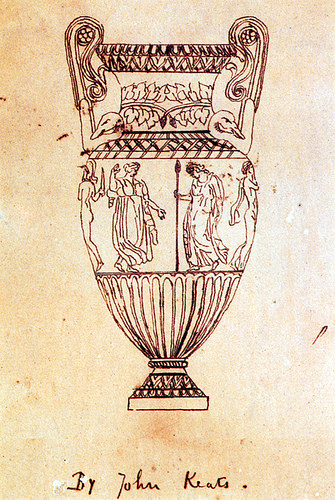
However, form does dictate close reading’s relevancy to a certain extent. There may be limitations to close reading that I had not previously thought possible. I realized this while reading Cleanth Brooks’ “An Account of Keats’ Urn”, a close reading analysis of “Ode on a Grecian Urn”. Brooks draws evidence stanza by stanza to support his claim of a larger connection that justifies the final paradox of the poem as “in character”: “But to return to the larger pattern of the poem: Keats does something in this fourth stanza which is highly interesting in itself and thoroughly relevant to the sense in which the urn is a historian” (Brooks 9). I agree with Brooks in that I believe formally close reading may be necessary to ascertain the overlying meaning of this poem or justify the last few lines. Poetry lends itself to close reading on a formal level. However, Brooks’ writing points out a glaring flaw of the strategy; the double bind of close reading is revealed.

Brooks close reads in order to pick out evidence for his argument, glossing over lines that do not support his claim. It is nearly impossible to close read everything in the poem, but entirely necessary to do so in order to create the unity and wholeness desired by those who uphold close reading. In order to look at the whole text and nothing but the text, and to achieve a singular effect, close reading must be applied to every stanza in order to not miss any chance for analysis that might change the poem’s meaning. After all, if every word counts, doesn’t glossing over lines leave potential analysis out? This is the paradox that created the biggest limitation of close reading for me. I decided to apply this to another work that differed in form, The Great Gatsby, in order to look at Tyson’s example in a different light. To look at The Great Gatsby from a New Criticism lens is to risk close reading for the wrong reasons. To decontextualize Gatsby from the American Dream and the time period is to miss greater themes that characterize the novel. Also, depending on which parts of the novel one close reads, very different types of criticism become necessary. For instance, one could hypothetically perform a close reading of The Great Gatsby which focuses only on Nick’s interactions with Gatsby, thus leading to an analysis centered around themes of hero worship and even homosocial bonding, missing the larger themes Daisy represents in the text and Gatsby’s real motivations.

To go further with this idea, I wondered if it were possible to close read a text in a way that goes completely against its purpose as a work, and I believe that by picking and choosing which passages one reads from, this is a legitimate problem. How much of a given text are we missing by close reading? Is it possible to apply close reading wholly to longer texts, such as Moby Dick, without skipping over parts of the novel? I wondered if close reading could get too close and miss the point of a text. I think that sometimes it may be necessary to get further away from close reading, to contextualize a text and look for broader themes in the novel by looking at a text without a (potentially too narrow) New Criticism lens.

Works Cited:

Brooks, Cleanth. “History without Footnotes: An Account of Keats’ Urn.” The Sewanee Review, vol. 52, no. 1, 1944, pp. 89–101.

 Fitzgerald, F. Scott. The Great Gatsby. New York: Scribner, 2004.


Tyson, Lois. Critical Theory Today. 3rded., Routledge, 2015. 

Poetryfoundation.org. (2019). Ode on a Grecian Urn by John Keats: The Poetry Foundation. [online] Available at: http://www.poetryfoundation.org/poem/173742

The Cost of Cutting the Context

I find many aspects of New Criticism contradictory and un-objective, but what created the most conflict for me is the New Critic perspective on psychological, sociological, and philosophical parts of works. In Critical Theory Today, Lois Tyson describes this perspective: “…New Critics addressed these elements, but they did so for the purpose of examining how such elements operate to establish the texts’ theme… they aestheticized them” (142). To look at psychological, sociological, and philosophical parts of a work and disregard them or only look at them aesthetically seems disingenuous. True distance from those three areas is impossible for a human, who is made of subjectivity and bias, and more so for the specific group of humans – rich, white, educated, abled, cisgender, heterosexual men – who dominated this theory in its heyday.

T.S Eliot writes in “Tradition and the Individual Talent” that “the emotion of art is impersonal.” This ties into his commentary on the separation of the of the “personality” of the author, as he describes it, and the medium. This implies a vast distance between a poet and their writing. I understand him to mean that emotional distance is required to produce effective poetry, and I agree that some is useful. However, his description of the distance is too extreme. It is as if the poet is merely a robot that has no experiences, feelings, or thoughts that can – intentionally or unintentionally – influence the resulting poem. Or, those influences are irrelevant to the quality of the poem.

The New Critics reduce writing to the formal qualities, and Eliot furthers this notion of intratextual examination when he distances the author. Neither, however, are the problem inherit with this theory. Its claims of ‘single best interpretation’ and ‘objectivity’ create the issue. As I have touched above, there are alternatives to the rigidness of New Criticism, which can hold more weight based on the work.

Consider “On Being Brought from Africa to America” by Phillis Wheatley:

‘Twas mercy brought me from my Pagan land,

Taught my benighted soul to understand

That there’s a God, that there’s a Saviour too:

Once I redemption neither sought nor knew.

Some view our sable race with scornful eye,

“Their colour is a diabolic die.”

Remember, Christians, Negros, black as Cain,

May be refin’d, and join th’ angelic train.

A New Critic would talk about the organic unity in certain aspects in this poem (“Pagan” balancing “Saviour,” the contrast of a physical land and a soul). But they would be missing what I find of the utmost relevance, because context is required. It was written by an enslaved African woman in the United States at the beginning of the 19th century. Phillis Wheatley was published by white people for white people, and her master encouraged her to write. She could neither cut herself off completely, because she had things she needed to say, nor directly convey what she needed to tell them. New Critics may say, “Well, we can aestheticize some of that from within the poem.” And to that, I say, if we do, we miss the integral part of this poem. This poem does not exist simply to be art. It is a message. In an elegant and poetic form, but the purpose is to convey a specific message in a non-threatening yet impactful way that comes directly from her personal circumstances. It is openly as Phillis Wheatley can say to that her enslavement is wrong: “Remember, Christians, Negros, black as Cain / May be refin’d, and join th’ angelic train.”

This portrait comes from one of Phillis Wheatley’s poetry books.

Works Cited

Eliot, T. S. “Tradition and the Individual Talent.” Poetry Foundation. 13 Oct. 2009. www.poetryfoundation.org/articles/69400/tradition-and-the-individual-talent. Accessed 6 Sept. 2019.

Moorhead, Scipio, Engraver. Phillis Wheatley, Negro servant to Mr. John Wheatley, of Boston. Retrieved from the Library of Congress. http://www.loc.gov/item/2002712199/. Accessed 6 Sept. 2019.

Tyson, Lois. Critical Theory Today. 3rded., Routledge, 2015.

Wheatley, Phillis. “On Being Brought from Africa to America.” Poetry Foundation. www.poetryfoundation.org/poems/45465/on-being-brought-from-africa-to-america. Accessed 6 Sept. 2019.

Loss of Satire

When going through the concept of New Criticism and its replacement of Biographical-historical criticism, it mainly sets the common rule of interpreting only the text itself. This rule is put in place to view literature through a purer lens, looking only at the literature, thus cutting off connected subjects such as history. This intends for scholars to deeply think about the words on the paper without being distracted by all manner of related content. This unfortunately does not allow for all works of literature to be analyzed in a proper manner as some simply do not fit well into this form of literary theory, as shown in Brooks’ History without Footnotes, where even the title implies a lack of context. In the essay he quickly addresses the problem of some of the poem’s last few lines, “Beauty is truth, truth beauty”. The line creates a paradox that doesn’t fit well into New Criticism not only for the fact that it is a self defining definition with no end but also that it leaves the poem in a state of ambiguity despite leading up to such an end.

This type of breaking of the system brought to mind other works of literature that would achieve something similar, one such work being A Modest Proposal by Jonathan Swift. Since New Criticism strictly deals with the text and chooses to cut out all accompanying context, the main focus of this essay is lost in translation. Swift writes about the problem of “beggars of the female sex, followed by three, four, or six children, all in rags, and importuning every passenger for an alms” (Swift). Swift states how poverty is the overall problem which is leading to many mouths to feed but no food to do it with. Swift follows that up with a proposed solution to such a problem saying “[Children], instead of being a charge upon their parents, or the parish, or wanting food and raiment for the rest of their lives, they shall, on the contrary, contribute to the feeding, and partly to the cloathing of many thousands” (Swift). Swift’s proposal ends up being exactly as he describes, eat the children and make clothes from them and while this is sickening it is easily explained through biographical-historical context. Swift was known for his satirical essays and therefore was not serious at all about his proposed solution. The entire essay is meant to be a longwinded effort to poke fun at the standing government’s treatment yet responses to the growing problem of Irish poverty in the early eighteenth century. Without the context of what Swift is known for writing and the history behind the situation he writes about the essay loses much of its meaning.

Looking through the essay using New Criticism will still allow a scholar to study the literary techniques used and the many complexities of the work, sure, but lacks its main points. Satire becomes far more difficult to detect using New Criticism as nothing plainly states its use in the essay and leaves the reader to a more surface view of the work. Works may be taken literally that were not intended to be and to bring in the intentions of the author to find such a singular meaning would break a core rule of New Criticism.

Brooks, Cleanth. “History without Footnotes: An Account of Keats’ Urn.” The Sewanee Review, vol. 52, no. 1, 1944, pp. 89–101.

Bruggink, Eric. “A Modest Proposal.” Public Contract Law Journal, vol. 28, no. 4, 1999, pp. 529–543.

John Keats, “Ode on a Grecian Urn,” Bartleby.com, http://www.bartleby.com/101/625.html , Accessed 5 November 2009.

There’s No Memoir without Me

From our in-class discussions and supplemental readings, one concept that has interested me is the idea of intentional fallacy and the isolation of “the text itself” (Tyson 130). In Critical Theory Today, Lois Tyson provides the definition of intentional fallacy as the “mistaken belief that the author’s intention is the same as the text’s meaning” (130). New Criticism does not find value in authorial intention but looks at the text alone to determine and identify meaning. While there is value in isolating the text and looking at sentence structure, diction, etc., when determining a piece’s true meaning in the grand scheme, there is certainly some importance in knowing background about authorial intention or the author’s backstory. 

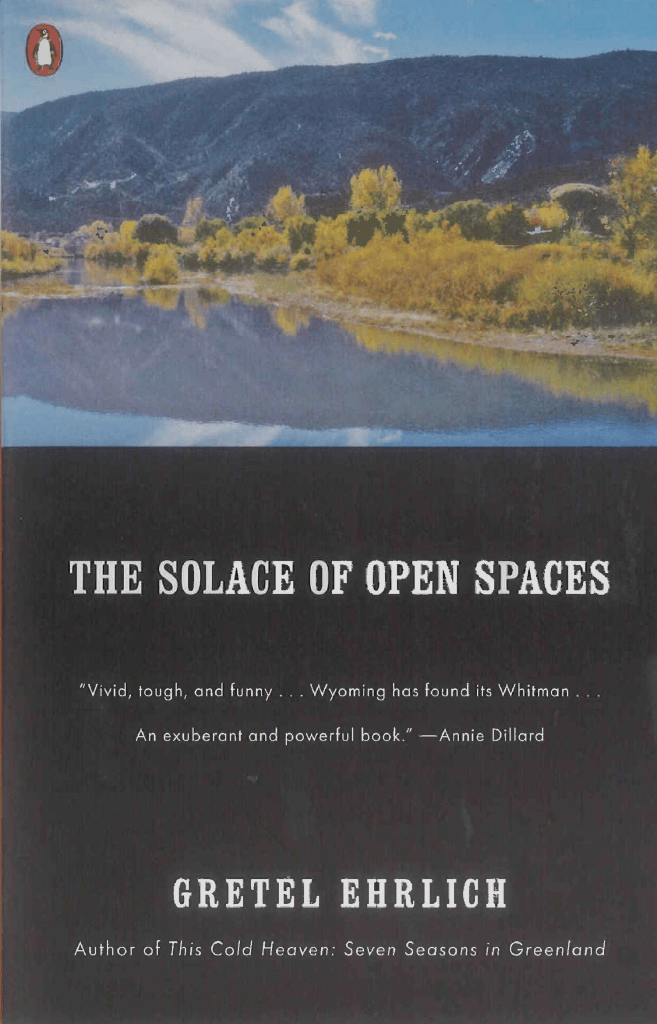
Thus, this sparked my interest to apply the concept of isolation and omission of author intention in New Criticism and see how an interpretation of Gretel Ehrlich’s The Solace of Open Spaces would differ depending on the lens it is seen through. Starting with the genre, the memoir has information about the author’s life included within the text, so New Criticism lends itself well for analysis as the outside information and authorial perspective is. However, The Solace of Open Spacesconflicts with New Criticism because of its lack of separation between the author and the author’s work. In a memoir, the two cannot be separated like poem and poet can be, as the reader is already aware that they are reading about some part of the author’s life. As readers, we are forced to engage with Gretel Ehrlich in relation to her work because the memoir is told directly from her perspective. Following the guidelines of New Criticism, we can look at The Solace of Open Spaceswith more of a focus on form, language, and the text itself, but the first person point of view introduces inherent authorial intention and rules out the isolation of author and text to some extent. 

Specifically with applying New Criticism’s focus on isolation of the text and the text alone, The Solace of Open Spacesexists within its own space and the author’s world, but fails to reach outside of that and have a broader meaning. The entire purpose of the memoir cannot be assessed under New Criticism because it deals with author intention. We cannot interpret what Gretel might mean or want to convey by only talking about certain moments in her life—or including chapter titles such as “To Live in Two Worlds” or “Other Lives”—for that would be intentional fallacy. She focuses on her time as a ranch hand and on the landscape of Wyoming, but we cannot assess why that is important to others reading her memoir. We can only take Ehrlich’s life story at surface level with New Criticism, because any further analysis would have to include why she is telling her story in global context and why the world is listening, which is then affective fallacy. 

Rhetorically, New Criticism allows the reader to see what devices Ehrlich puts into play, and the reader can appreciate her use of metaphor and simile as well as acknowledge her sentence structure and literary devices. Ehrlich’s use of metaphor paints a beautiful picture, where “dust rises like an evening gown behind his truck. It flies free for a moment, then returns, leisurely, to the habitual road—that bruised string which leads to and from my heart” (61), but the picture is all the reader can see with New Criticism, not the meaning behind it. I think applying New Criticism to a memoir is almost ironic: using a theory that does not look at the author or outside the text being used to analyze a piece that focuses specifically on authorial intentional and its implication with the outside world. Ultimately, I do not think using New Criticism to analyze a memoir is really fruitful because it dead-ends the reader into just looking at the text and not the surrounding environment, which is what truly gives purpose to the memoir as a genre. 

Ehrlich, Gretel. The Solace of Open Spaces. New York, Penguin, 1985.

Tyson, Lois. Critical Theory Today. 3rded., Routledge, 2015. 

Certified “Organic”

After reading Critical Theory chapter 5 “New Criticism” and T.S. Eliot’s “Traditional and the Individual Talent” I considered the complicated relationship between art and the individual, specifically whether or not they can be separated. I think that it is impossible to completely depersonalize a piece of creative art. Therefore, I struggle to completely accept the New Criticism theory. I think that the new critic’s fascination with paradox, irony, ambiguity, and tension results in compelling and complex arguments. However, I prefer to contextualize these abstract contradictions using more concrete methods. As an English major, I have struggled to imagine the real-life effects that literature has on the world, often leading me to wonder whether all of literature’s great questioning is done in vain. And while the new critics would argue that close reading stylistic and imagistic choices help us gain a better understanding of the representative truth or greater theme, I think one must balance both an affective fallacy and intentional fallacy to create a meaningful, and well-judged interpretation. Because as much as new critics want to believe that art can stand on its own, there will always be the authors’ and readers’ intrinsic biases. Therefore, I struggle to agree on the new critic’s idea of organic unity, because the new critic also believes that the art is unchanging and that each interpretation should have closure. Despite using organic unity to show harmony within a piece, the new critic still adheres to strict structures, such as analyzing form, language, and objects, instead of focusing on the natural movement or ever-changing essence of a piece. The new critic idealistically categorizes everything as a meaningful paradox that points towards greater meaning, but this alienates the reader and makes art less personal, and therefore (in my opinion) less meaningful. Art and literature are like a mirror, and in the end, everyone yearns to learn something about themselves. This is often accomplished when great art causes the audience to experience a metaphysical or artistic self-projection. I would like to further investigate the particular idea of organic unity and how the connotation of “organic” pushes against the new criticism theory. 

I analyzed Cecily Brown’s abstract painting “The River’s Tent Is Broken” using the new criticism lens, but then I also approached the painting in a more organic way. In order to show how new criticism could be improved upon by considering the natural connotation of the word “organic,” such as how organic matter often decomposes or grows as time progresses, I will address the interpretative possibilities of this painting when freed from the constraints of being a new critic. 

  • New critic analysis: The painter chose the symbolic colors blue and beige to allude to the unattainable and surreal connection between heaven and humans. The heavens being the blue, sky-like color and the humans being the abstract, beige shapes. The warm and cool tones of the painting juxtapose the tangible and intangible creations in our world. This painting uses the malleable medium of oil paints in order to tie all these themes together and illustrate the interconnectedness of man, nature, and the uncontrollable. 
  • Alternative, “organic” analysis: The painter, Brown, has created an oil painting in which the observer is bound to see a reflection of herself in the painting. Even though the shapes are abstract and ambiguous, our brains recognize the human shapes in the painting and immediately make personal, bodily connections. Therefore, the reader is automatically placed into the painting—going against the new critic theory of objectification. In addition, the painting is always changing because it embodies different stories depending on how you piece each part together. Abstract art is meant to change based on someone’s personal perspectives. Brown describes her work as taking from the classical expressionism but creating a “new aesthetic reality.” In this way, she conforms to T.S. Elliot’s idea that there is perhaps no individuality, but there are moments of reinventing the past in fresh, and timeless ways. Both artists embrace history and use it as a springboard to create new ideas that mesh with the past in order to create a dynamic present.

Screen Shot 2019-09-04 at 7.21.40 AM.png

https://gagosian.com/artists/cecily-brown/

“The River’s Tent Is Broken” 

Works Cited

Eliot, T. S. “Tradition and the Individual Talent by T. S. Eliot.” Poetry Foundation, Poetry Foundation, 13 Oct. 2009

Tyson, Lois. Critical Theory Today. 3rd ed., Routledge, 2015

Further Reading – T. S. Eliot

In his essay, T. S. Eliot takes a very New Critical stance by insisting that one must focus on the technical prowess of the text alone to find value in a work of literature.  He made the case that the value of poetry can only be found in the text and not anything around it.  This excludes a lot of context, history, and biographical information that could help lead a reader to a better understanding of the text and to gain a better appreciation for the work.  New Criticism limits the ways one can look at a text and excludes many different lenses that can help contribute to an analysis of why a text is written the way it is.  I don’t agree with Eliot’s insistence that background and history don’t matter.  I think that they provide valuable insight or context to an author’s decisions in their writing.  Authors are a product of their time, just like anyone else.  Many things that they include in their writing are influenced by the time period they live in, the societal expectations, and the events happening around them.  It is impossible to separate a work from its time because you loose so much valuable context.

The Odyssey is one such text that does benefit from having contextual information.  Throughout the epic poem, many lines, phrases, or images are repeated.  From a purely textual basis, this would make these repetitions seem unnecessary, drawing attention to things that don’t have much of an impact on the story at large.  Most of these repetitions refer to the changing of time or already established details about the characters.  Homer’s famous epithets do the famous faux pas of telling instead of showing.  Yet the Odyssey is still treated as a prevailing classic across centuries despite these textual flaws.  The important context here is that the Odyssey used to be memorized and performed aloud more than the actual text was sat down with and read or studied.  The repeating lines, phrases, and images made the poem easier to memorize and to be listened to.  The Odyssey was not even conceived by Homer himself.  The Odyssey began as an oral tradition that Homer recorded, and that record was used as the basis for the oral retellings from there on out.  The Odyssey also takes place just after the Trojan War, which holds valuable context for why Odysseus is in the predicament he is in.  Without studying the background of the Trojan War or the events of the Iliad, which is almost like a prequel for the Odyssey, a lot of the background for the text would be lost and the events of the narrative, both past and present, would be confusing.  In the case of the Odyssey, it is beneficial to study the history and background of the text as well as analyzing it.  Many of the important details of this text would be lost without studying them.
-Lauren Souder

Texts Without Contexts

Keats_urnIs there a text in this class? That’s a famous line (and title) from reader-response literary theory, coming later in the semester. For the first two weeks of our exploration of critical theory, the answer to that question is decidedly: “yes, there is only text in this class.” Beginning with the New Criticism, one of the oldest of the critical/literary theories we will study, and then continuing into structuralism and deconstruction, scholars and critical readers focus thoroughly and rigorously and entirely on texts. Although those texts are produced by authors who live in various historical contexts and bodies, and are read by readers who also live in various and different historical contexts and bodies, New Critics, structuralists, and deconstructionists will exclude those other contexts and focus on (a refrain) “the text itself.”

You and I, as English majors, are particularly familiar with this commitment to the text from New Criticism. Its primary strategy, still with us, is close reading. We have been trained to focus on what’s in front of us, the language and its complexities, recognizing that literary texts, and maybe any text at all, if they are worth our attention and interpretation, are highly connotative, not merely denotative. Such texts say what they mean, but they don’t necessarily mean what they say. That’s where the critic comes in.

As we make our way through the various critical theories and strategies, I will continually ask you to consider the uses and limits of each approach. Another phrasing I would use, borrowed from media and design studies: what are the affordances and constraints of the theory? What does it allow us to do and understand and see (theory comes from a Greek word related to vision)? What does it keep us from doing and seeing? This is where critical theory and rhetoric meet up. The rhetorician Kenneth Burke characterized rhetoric as the understanding that “every way of seeing is a way of not seeing.” I think Spivak has this in mind with her understanding of the “double bind.”

And so, with the New Criticism, close reading, close, careful, thoughtful attention to the text and the complexities that attend language and its symbolic uses (“language as symbolic action,” another phrase from Burke)–this legacy of close reading remains a rich and useful legacy of the tradition. We will continue it. Think, for a moment, about your encounters with close reading in the classroom, or in your scholarship. What have you done with this fundamental strategy of literary and textual interpretation? What did it enable you to do?

But also, think for a moment about being limited only to the text and its close reading. Have you had that experience as well? I am thinking of the student who brings into discussion of a text an idea not directly evident in the text, or maybe deliberately brought from outside the text. Something like: that image reminds me of X, where X might be something historical, or personal, or biographical. In the tradition of New Criticism, that student’s contribution would be knocked down by the teacher as “heretical” because it is external to the text. These are the terms used in the critical tradition: “The Intentional Fallacy,” “The Heresy of Paraphrase,” and “the extinction of personality” (Eliot).

Are these, in your view, legitimate and necessary constraints? Should we only focus on the text in our interpretation–and exclude, for example, what the text might mean to us (a kind of paraphrase), or what we think it meant to the author (intention), or where the text comes from (context)? These are matters for further interrogation and application this week as you begin your first “Further Reading.”

One insight to consider. New Criticism was particularly effective with poetry. This made it highly useful in the college classroom, where a poem could be approached within one class period and (perhaps) brought to resolution. This is a key to New Criticism: all the complexities and paradoxes and ironies and tensions so crucial to literary language–what makes it worth interpreting–must be resolved in the end if the work is to be literary art. We will be testing this out with a famous poem about art, Keats’s “Ode on a Grecian Urn.”

But does every poem necessarily resolve its contradictions and tensions? Does a poem need to be art in order to be a poem? And, what about reaching beyond poetry? You might begin to test out the limits of New Criticism by applying it to a novel. What about other kinds of texts and uses of language that Spivak and Emerson have in mind: speeches, film, the “philosophy of the street”? Should New Critical perspectives and interpretive strategies also be of use to us beyond the classroom?


Slowly Reading Spivak, Thinking of Emerson

We will return to Gayatri Spivak later in the semester when we explore postcolonial criticism and theory. She is a leading figure from that school of critical theory. But in reading “Thinking about the Humanities,” we listen in on more general views she has about what it means to be a reader, to be a scholar in the humanities, regardless of the critical methods and theories one develops and uses to do that work. We hear an argument for the relevance of the humanities positioned against the presumption that they–and we English majors–are no longer relevant. (“English? Humanities? What are you going to do with that?”)

Spivak, one could easily argue, has little to do with Emerson. And yet, her definition of the humanities and her emphasis, in particular, on “patience” and “the slow curricular process of the humanities” evokes, at least to my ears, concerns also echoed in Emerson’s “American Scholar.” You might recall that Emerson worries there about a culture too busy and too distracted for letters and he counsels in the end: “Patience,–patience.” Emerson writes of the scholar’s task of observation as “slow, unhonored, and unpaid,” while Spivak refers to the “untimely” aspect of humanistic study. I can’t help but also hear in Spivak’s concerns resonance with another essay I teach at the beginning of my English 101 course: “In Defense of Literacy” by Wendell Berry. Berry argues for a more traditional purpose and focus for English and literary study, one that would make it, as Berry knows, highly unfashionable in the specialized university. And Spivak’s notion of the “double bind” also brings to mind a famous phrase and concept from Emersons’ essay “Fate,” “double consciousness,” a phrase later made more famous by W.E.B. DuBois.

If we read and pursue humanistic scholarship, inspired by these two scholars, Spivak and Emerson, what should or might we do? What does Spivak add to Emerson’s notion of “creative reading”? How does her vision of slowly reading and studying extend Emerson’s? How does Spivak’s vision challenge or complicate it?

If you, today, were to begin the “slow curricular process” of a project, later to develop into your seminar project, or your SCE, or your dissertation or first published essay or book, what might that project do? And how would you do it?

One way I might apply Spivak’s thinking to my own area of scholarship and research (Emerson, 19th c. American literature and culture): take her concluding focus on globalization, and its contradictory, double-blind relation to the humanities, and apply back to Emerson. One could align Emerson, or certain readings of Emerson, with the sort of isolationist and solipsistic “American humanism” Spivak decries. I share her concerns with that pedagogical tradition. But as she notes, that tradition is also for her a double bind, more complicated and contradictory than we might think. And I think this can apply to Emerson’s place in that tradition. Emerson, also, is more global than we think. This is a point of interest in more recent Emerson scholarship. And, if you think about, it’s there already in “American Scholar.” Emerson urges the scholars away from the European muses, but note all his references and points of inspiration from the past are global, not parochial. That’s a contradiction, a double bind that’s worth further study in Emerson. Spivak, unbeknownst to her, and to Emerson, could help me do that. That’s how humanistic reading and critical thinking work.


On the Art of Creative Reading

The phrase in the title of this digital home for the Junior Seminar comes from Ralph Waldo Emerson. The action, “creative reading” is set in some sort of relation (is it also opposition?) to the phrase most people, certainly English majors, are more familiar with, “creative writing.” In his “American Scholar” address to the Phi Beta Kappa Society at Harvard in 1837 (as it turns out, Henry David Thoreau’s graduating class), Emerson says the following:

One must be an inventor to read well. As the proverb says, “He that would bring home the wealth of the Indies, must carry out the wealth of the Indies.” There is then creative reading as well as creative writing. When the mind is braced by labor and invention, the page of whatever book we read becomes luminous with manifold allusion. Every sentence is doubly significant, and the sense of our author is as broad as the world. We then see, what is always true, that, as the seer’s hour of vision is short and rare among heavy days and months, so is its record, perchance, the least part of his volume. The discerning will read, in his Plato or Shakspeare [sic], only that least part, — only the authentic utterances of the oracle; — all the rest he rejects, were it never so many times Plato’s and Shakspeare’s.

Let’s begin to think about what “creative reading” could mean for us and what we will be doing in our Junior Seminar for English majors–we, scholars engaged in the critical study of literature. (A brief note on terminology: in Emerson’s day, “literature” included the study of what we now call English, as well as rhetoric, as well as philosophy, as well as the sciences. That’s an interest area in my scholarship; more later). We know what “creative writing” means and why we need to distinguish that act from what scholars do when they read Plato or Shakespeare. Or, I assume we know that, given the staying power of the phrase “creative writing.” However, I’m not sure that Emerson necessarily views “creative” the way we have come to understand the adjective. I get that sense from his attempt to define “creative reading” on the analogy of what he calls creative writing.

What’s the difference? What’s the relation or correlation between creative writing and reading? Whatever the answers are, I’d like to suggest that we will be exploring the relations and differences in this seminar. Our language, informed by our primary guide, Critical Theory Today, will be more recent than Emerson’s. But it will be similarly theoretical  and critical. Indeed, Emerson argues against the assumption that theory or speculation is a bad thing. We will be using words to think about, reflect on, interrogate, and better understand how words are used in the books we read and the texts we study.

Let’s start with a kind of pre-test, before we know what we think and before we recognize the keywords and concepts you will have in hand by the end of the course and the culmination of your seminar project. 

Question 1: How would you characterize Emerson’s critical approach to literature? What assumptions motivate his assertion of “creative reading”? What terms or critical methods (perhaps ones you have already encountered in your studies to this point) would you apply to Emerson, as similar as well as different from what he envisions for reading? In other words, how would you as a scholar (today) describe how Emerson conceived the work and character of the scholar?

Question 2: If we were to pursue a critical reading of the text that serves as the header image for our syllabus, the image of Marilyn Monroe reading Walt Whitman (a real image, as it happens; favorite authors included Whitman, Joyce, and Ellison), what could we do with it and what could we say about it? What critical/theoretical approaches might this text invite?

cropped-marilyn-reads-walt.jpg

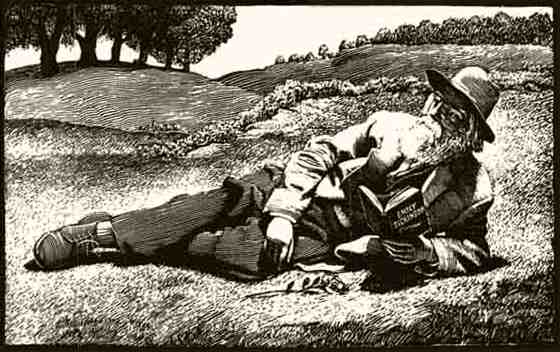
Consider another image which imagines Whitman reading Emily Dickinson. What kinds of critical and theoretical ideas do these images assume or embody? What does that question mean? Stay tuned.

walt