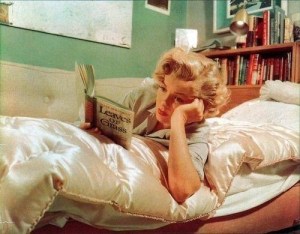
The critical concept I chose to focus on from this week’s reading was affective stylistics. Tyson writes that affective stylistics involves the piece of writing being “examined closely, often line by line…in order to understand how (stylistics) it affects (affective) the reader in the process of reading (167). In order to experiment with applying reader response criticism to a text, I reread “The Philosophy of Composition” by Edgar Allan Poe. Poe’s essay examines his own writing of “The Raven”, a poem which he himself deems “most generally known” (1). Poe says about “The Raven” that “it is my design to render it manifest that no one point in its composition is referable either to accident or intuition—that the work proceeded step by step, to its completion, with the precision and rigid consequence of a mathematical problem “ (Poe 1). Poe talks in this essay about a “unity of effect” that he strives for in his poems. Reader response criticism values the reader’s interpretation of the text, but this seems to be inherently tied to authorial intent. For example, in “The Philosophy of Composition”, Edgar Allan Poe writes about his thought process in planning “The Raven” not only in order to draw appreciation to his genius in method. He also writes it in order to but also more acclaim to an already highly acclaimed poem. He explains and analyzes his own poem, highlighting the same affects that a reader might point out in order to play off the reader-response mindset to his benefit.
Poe attempts to manipulate the reader’s response to his essay through his critique of other writers and thorough analysis of his own text. This text serves to deliver more attention to writing methodology as well as to the product. I believe Poe would agree with those who practice the criticism of affective stylistics because they believe that “the text consists of the results it produces, and those results occur within the reader” (167). I attempted to apply affective stylistics to “The Philosophy of Composition”, thinking about this essay as “an event that occurs in time” (Tyson 167). I took a small portion to focus on specifically, hoping to follow Tyson’s advice in describing this style of criticism. I looked at the “textual cues” from Poe’s introduction (169). Poe writes, “I have often thought how interesting a magazine paper might be written by any author who would—that is to say, who could—detail, step by step, the processes by which any one of his compositions attained its ultimate point of completion. Why such a paper has never been given to the world, I am much at a loss to say—but, perhaps, the autorial vanity has had more to do with the omission than any one other cause” (Poe 1).
To examine this sentence from a reader response standpoint, I believe it is possible to see how a writer consciously thinks about and can attempt to manipulate reader response. Poe writes at first in the hypothetical: “How interesting a magazine paper might be written” (Poe 1). The irony in this statement lies in the fact that he is essentially calling his own paper interesting. Poe then implies that he is one of the only authors capable of attempting such a feat: “by any author who would—that is to say, who could—” Poe draws a (1). Poe’s language differentiates himself from other writers, giving the cause for the lack of papers like his own as “autorial vanity” (1). This is an ironic statement, given that Poe has been patting himself on the back for the last few sentences, but it shows the conscious effort on Poe’s part to manipulate the opinion of the public in his favor. The result that this text produces, to borrow Tyson’s phrasing, is an essay that builds up Poe’s reputation as a writer of both poetry and analysis. I believe that the limit of affective stylistics is that it does not give as much credit to authors who also think of the text from a reader-response standpoint.
Works Cited:
Poe, Edgar Allan. “The Philosophy of Composition.” Poetry Foundation, Poetry Foundation, 13 Oct. 2009, http://www.poetryfoundation.org/articles/69390/the-philosophy-of-composition.
Tyson, Lois. Critical Theory Today. 3rd ed., Routledge, 2015
 Creative Reading