
Applying African American Critical Theory to Faulkner’s “A Rose for Emily”

William Faulkner’s story “A Rose for Emily” is written from the perspective of the people of her small town. They wonder and marvel at her odd behavior, reclusive existence, and eventually at the horror of the corpse in her bed. The story’s setting of post-Reconstruction Mississippi, the mention of Miss Emily Grierson’s ancestral claim to Antebellum aristocracy, and her romance with a northern carpetbagger could call for a close African American Critical Theory reading of the story in and of themselves. But where this critical theory could best be applied in this story is to the oft-overlooked character of Tobe.

Tobe is described as Miss Emily’s servant who does her shopping, her gardening, and the housework. He is also her intermediary at times with the curious townsfolk when they dare not approach the imperious woman directly. Where Tobe is the most compelling is in his role as Miss Emily’s secret keeper. When Emily poisons Homer Barron and keeps his body in her own bed to lay beside until her own dying day, Tobe does not call the authorities. In fact, Tobe himself may have played a role in the man’s demise. Faulkner tells us, “A neighbor saw the Negro man admit him at the kitchen door at dusk one evening” (“A Rose for Emily”). When Emily dies, Tobe admits the authorities to the house and quietly flees, never to be seen again.

Some scholars have suggested that perhaps Tobe didn’t like Miss Emily enough to stick around for her funeral. They overlook some of the crucial factors that African American Critical Theory asks us to examine. The politics of the era in which this story is set are complex.

After the Emancipation Proclamation, southern slaves found themselves “freed” in a south where the war had ravaged the economy and families. With few viable options for employment, some remained with their prior owners in the homes and on the land that may have been the only they had ever known. Tobe is described in the story as being elderly, so not many avenues of employment would be available to him. He may have been the Grierson family’s slave and was likely the child of slaves. Tobe’s options for other places to go were extremely limited, as no mention is made of him having family. He also may have wisely feared repercussions for his role in Homer Barron’s death.

It is telling, too, that it doesn’t seem to have occurred to scholars or the townspeople in the story that it was possible that Tobe and Miss Emily were more than boss and servant, or murderer and accomplice, or co-conspirators. The fact that it does not occur to many that Tobe and Miss Emily may have been lovers is also a reflection of the politics of the time in which the story is set and even the biases of the time in which we now live. Tobe’s steadfast loyalty, refusal to divulge secrets to the townspeople, and disappearance upon her death could certainly be interpreted as the actions of a man who loved her.

“Fringe” characters like Tobe, without whose participation the events of stories like this could never happen are too often overlooked. Scholars have a responsibility to reexamine texts like these through the lens of African American Critical Theory. Because without characters like Tobe, there is no story.

Works Cited

Faulkner, William. “A Rose for Emily.” A Rose for Emily, American Studies

at the University of Virginia,
http://xroads.virginia.edu/~drbr/wf_rose.html.

African American Criticism: Within the Circle

African American literature has been around a long time. The critical study of African American literature, or African American criticism, emerged more recently, shaped in part by social and political changes, and guided in part by critical theories such as deconstruction and new historicism. If African American literature was largely excluded from American literary history until the twentieth century, we can now say (as budding new historicists) that the exclusion was a discursive formation. It was not a matter of objective history, but the inherent subjectivity of history as discourse. Knowledge is power, and the powers that be determine what counts as knowledge.

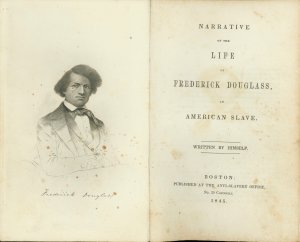
Frederick Douglass knew a thing or two about this overlap of power and knowledge. Here is the beginnings of an important text in the African American literary tradition, Frederick Douglass’ first autobiography, the Narrative of the Life of Frederick Douglass, an American Slave: Written by Himself (1845). The frontispiece and the title page.

First, review: How might we read this text, or begin to read its beginnings, informed by new historicism and cultural criticism? [What would Foucault say?] Or further back: Structuralism and Deconstruction? Reader Response? Psychoanalytic? New Criticism?

Next, interrogation: How can we read this text through the lenses of African American criticism and theory? What do we see that we might not have seen or considered previously? [What would Toni Morrison or Henry Louis Gates, Jr., say?] What are the complications that this text presents us with, and that these critical theories help us to address? As always, what are the uses and limits? To take up a complicated passage, there is this moment from the end of Doulgass’ second chapter.

 I did not, when a slave, understand the deep meaning of those rude and apparently incoherent songs. I was myself within the circle; so that I neither saw nor heard as those without might see and hear. They told a tale of woe which was then altogether beyond my feeble comprehension; they were tones loud, long, and deep; they breathed the prayer and complaint of souls boiling over with the bitterest anguish. Every tone was a testimony against slavery, and a prayer to God for deliverance from chains. The hearing of those wild notes always depressed my spirit, and filled me with ineffable sadness. I have frequently found myself in tears while hearing them. The mere recurrence to those songs, even now, afflicts me; and while I am writing these lines, an expression of feeling has already found its way down my cheek. To those songs I trace my first glimmering conception of the dehumanizing character of slavery. I can never get rid of that conception. Those songs still follow me, to deepen my hatred of slavery, and quicken my sympathies for my brethren in bonds. If any one wishes to be impressed with the soul-killing effects of slavery, let him go to Colonel Lloyd’s plantation, and, on allowance-day, place himself in the deep pine woods, and there let him, in silence, analyze the sounds that shall pass through the chambers of his soul,–and if he is not thus impressed, it will only be because “there is no flesh in his obdurate heart.”

I have often been utterly astonished, since I came to the north, to find persons who could speak of the singing, among slaves, as evidence of their contentment and happiness. It is impossible to conceive of a greater mistake. Slaves sing most when they are most unhappy. The songs of the slave represent the sorrows of his heart; and he is relieved by them, only as an aching heart is relieved by its tears. At least, such is my experience. I have often sung to drown my sorrow, but seldom to express my happiness. Crying for joy, and singing for joy, were alike uncommon to me while in the jaws of slavery. The singing of a man cast away upon a desolate island might be as appropriately considered as evidence of contentment and happiness, as the singing of a slave; the songs of the one and of the other are prompted by the same emotion.

Finally, some applied thinking: How might you apply aspects of this criticism to your studies, to your emerging seminar project? What if you are not focusing on a text by an African American author–what then? Consider borrowing theoretical insights from Toni Morrison and her argument (in Playing in the Dark: Whiteness and the Literary Imagination) for the Africanist presence in American literature by white authors.