Elevator Speech: The Impact of Gretel Ehrlich’s Memoir

I am looking at Gretel Ehrlich’s depictions and interactions with the West in her memoir The Solace of Open Spaces in order to analyze the ways in which she uses this platform to transform personal experiences into universal concepts so that my readers can better understand the function, purpose, and effect of memoirs as a genre in relation to the constructed connection between author and reader. 

X: The West in Gretel Ehrlich’s The Solace of Open Spaces Y: How can a personal anecdote become a universal concept?
Z: The personal connection/link between author and reader opens a door for communication, association, and interpretation

I think that applying a structuralist lens is appropriate here as it allows me to see how Ehrlich plays with the form of her experiences chronologically, but also gives me contrast to see how she breaks from that form and what the purpose would be. I also think that addressing reader response is essential because memoirs are meant to create a bond between author and reader, and the author is trying to convey a key message to the reader through personal stories and the effect on the reader is necessary to consider as it can determine how effective the author/memoir is. I could potentially use “Desire of the Middle Ground: Opposition, Dialectics, and Dialogic Context in Gretel Ehrlich’s The Solace of Open Spaces” by Bonney MacDonald for my project. Article located through the Washington College Library & Archives OneSearch. 

MacDonald, Bonney. “Desire of the Middle Ground: Opposition, Dialectics, and Dialogic Context in Gretel Ehrlich’s The Solace of Open Spaces.” Western American Literature, vol. 33, no. 2, 1998, pp. 126-148. JSTORhttps://www.jstor.org/stable/43021814. Accessed 26 Sept. 2019.

But What About Me?: The Importance of Reader Response in Memoirs

For this week’s blog post, I am interested in exploring subjective reader-response theory in relation to Gretel Ehrlich’s The Solace of Open Spaces. In the past, I have focused on Ehrlich’s syntax or the organization of her memoir and not so much on how the memoir makes me feel as a reader. Also, my previous responses have focused heavily on the text and structure of the memoir, which is why a literary theory that states that “reader’s responses are the text, both in the sense that there is no literary text beyond the meanings created by readers’ interpretations and in the sense that the text the critic analyzes is not the literary work but the written responses of readers” (Tyson 170) is an interesting way for me to look at Ehrlich’s work. My questions pertaining to subjective reader-response theory have to do with how we, as readers, do not fall into the trap of simply reading for relatability when applying this theory. 

As I recall from reading Rebecca Mead’s article on “The Scourge of ‘Relatability,’” readers often use the excuse that they do not see themselves reflected within the text or cannot sympathize or empathize with characters or scenarios. If this subjective reader-response theory relies, according to David Bleich, on “experience oriented” reader responses that “discuss the reader’s reactions to the text, describing exactly how specific passages made the reader feel, think, or associate” (Tyson 171), how does this relate to the esteemed writing academia values so heavily? I believe the escape from just reading for relatability comes in answering the third guideline in creating a response analysis statement, which asks the reader to determine “why these responses [to the text] occurred” (Tyson 172). In thinking about the response a reader has to a particular paragraph or text first, as I will attempt to do in the next paragraph, the reader is able to address a section that appeals to them and then dig into it deeper to understand how specific textual elements result in that response and how it affects the meaning of the text as a whole. 

In order to apply the subjective reader-response theory to Ehrlich’s chapter “On Water,” I will construct a response-analysis statement by following Bleich’s three proposed guidelines, which ask the reader to:

  1. Characterize his or her response to the text as a whole
  2. Identify the various responses prompted by different aspects of the text, which, of course, ultimately led to the student’s response to the text as a whole
  3. Determine why these responses occurred

I will be applying these guidelines to the following passage:

“Water can stand for what is unconscious, instinctive, and sexual in us, for the creative swill in which we fish for ideas. It carries, weightlessly, the imponderable things in our lives: death and creation. We can drown in it or else stay buoyant, quench our thirst, stay alive” (Ehrlich 83). 

As a former competitive swimmer, I feel most comfortable and most myself when I am a body of water. Thus, I felt drawn to Ehrlich’s chapter of The Solace of Open Spaces titled “On Water.” Without even reading this chapter, I had already made up my mind that I would enjoy the contents of the chapter and could relate to it personally in some way, as water created the direct line that connected my experiences as a reader and to Ehrlich’s experiences as the author. While this predisposition is more explicitly addressed by the social reader-response theory, I think that my interaction with this text can also be addresses by the subjective reader-response theory as I am “describing exactly how specific passages made the reader [me] feel, think, or associate” (Tyson 171). My initial response to this passage is that it makes me feel hopeful and at ease; I feel relief and comfort when I read Ehrlich’s words about water. I then realize that I am responding to the passage in this way because I feel an intimate connection with water, having grown up surrounded by it, whether that be in a swimming pool during practice or fly-fishing on the river with my father. For me, water is the only constant thing in my life: every major life moment for me has some connection with water and my strongest and most emotional memories are of times when I have won swimming races, fell into deep bodies of water, played in the waves with my sister, or spent late evenings tying flies on my father’s drift boat. I completely understand how water can symbolize the boundary between life and death and feel an intense sensation of relief when Ehrlich projects the feeling in my heart into words on a page as I know that at least someone else shares this sentiment and I am not alone. 

 By analyzing my own response to Ehrlich’s passage about water, I, as a reader, am able to understand why I identify with the text and how that shapes my response to the text as a whole. Yes, I do “relate” to the text, but Bleich’s guidelines help me to understand how and whyI do, undermining the simplicity of a reader liking a text because it is “relatable.” This theory is particularly useful when applied to a memoir (and for me thinking about memoirs for my SCE) because it encourages the reader to understand their complex relationship to the text in regard to their own personal lives, which is exactly at the heart of what makes certain memoirs such successful and compelling texts. I do think it is more serviceable to use this reader-response theory in addition to a close reading of the text, as I think there needs to be more textual weight behind the argument in order for the passage to be considered sufficiently analyzed. 

Ehrlich, Gretel. The Solace of Open Spaces. New York, Penguin, 1985.

Mead, Rebecca. “The Scourge of ‘Relatability.’” The New Yorker, 1 Aug. 2014, https://www.newyorker.com/culture/cultural-comment/scourge-relatability. Accessed 19 Sept. 2019. 

Tyson, Lois. Critical Theory Today. 3rd ed., Routledge, 2015. 

Into the Narrative: A Structuralist Look at Gretel Ehrlich’s Memoir

A critical concept that particularly interested me in the reading is the structure of narrative. In the context that I want to interrogate this concept, I am working with the definition that narrative structure deals with the “inner ‘workings’ of literary texts in order to discover the fundamental structural units . . . or functions . . . that govern texts’ narrative operations” (Tyson 212). In terms of structuralism as a whole, the structure of narrative is concerned with characterization and plot formulation in relation to language structures within the text. Ultimately, the structure of narrative is useful in that it gives the structuralist critic a way to examine the how the narrative operates within the text and to what end. One thing I realized when reading this section was the specific use of this concept with fiction; therefore, I wonder how applicable this concept is to nonfiction texts. How does structuralist narratology work with a nonfiction text such as a memoir, which does not include the same plot formula as a fiction work?

The best way I can think of to delve into this question is to think about the “units of narrative progression” (Tyson 212) in both fiction and nonfiction. In fiction, the narrative progression takes the structural form of a plot mountain, with the conflicts, tensions, climaxes, and resolutions clearly labelled. In a memoir, I believe the narrative progression is not as easy to map out, mostly because the progression depends upon the order that the events are told in, such as in chronological order. Even if we cannot apply a plot map to a memoir in the same way we can with a fictional novel, I do think that the narrative structure of a memoir can be analyzed in the same or similar way if we look at the text in the way that Gérard Genette does: by observing the tense of the text in regard to order, duration, and frequency (Tyson 216). 

In Gretel Ehrlich’s The Solace of Open Spaces, she says in the preface that this memoir was “originally conceived as a straight-through narrative,” but was instead “written in fits and starts and later arranged chronologically” (ix). If we think about this memoir in terms of the order of the narrative structure, the relationship between the chronology of the story and the chronology of the narrative is technically the same, as the stories are told in the same order as they happened in real life. However, due to Ehrlich’s note in the preface, the reader knows that the writing process did not happen chronologically. With structuralism, this note about how the memoir was written does not really matter in terms of narrative structure. This moment of authorial intention is irrelevant because the critic aims to analyze the text alone, and the only thing that matters in analyzing this memoir is that the chapters or sections are arranged in chronological order. 

In terms of duration, The Solace of Open Spacesis 131 pages and covers roughly ten years of Ehrlich’s life in Wyoming. Individual stories may tell a few months in as little as 10 pages, but the relationship between the length of time of a certain event and the number of pages the narrative occupies is fairly even. Just as in a fictional novel, the speaker can stretch or condense events to fit however many pages she sees fit. The main difference here is that the speaker in a memoir uses the whole book to tell of one portion of her life, making that the main event that occupies all of the pages. In Genette’s last section about frequency, one might note the number of times Ehrlich describes the sky in her memoir, or the recurring trips she takes as a ranch hand and how the experiences differ. In this way, the events repeated in a memoir have much of the same effects as repeated events in fictional novels. 

Circling back to my original question, a critic is definitely able to analyze a memoir in terms of narrative structure in the same way that a fictional novel can be analyzed. Though characterization may not be as much of a focus, the plot of a memoir and the order of events in the memoir give the critic an insight as to what deeper structures are at work within the text. For example, after noticing that the events in a 10-year timespan occur chronologically over a good amount of pages, perhaps the critic would realize that the recurrence of specific events, descriptions, and syntax are additional structural functions at work that allow the reader to understand the landscape and atmosphere of Wyoming and how the land itself can affect a person. 

Ehrlich, Gretel. The Solace of Open Spaces. New York, Penguin, 1985.

Tyson, Lois. Critical Theory Today. 3rd ed., Routledge, 2015. 
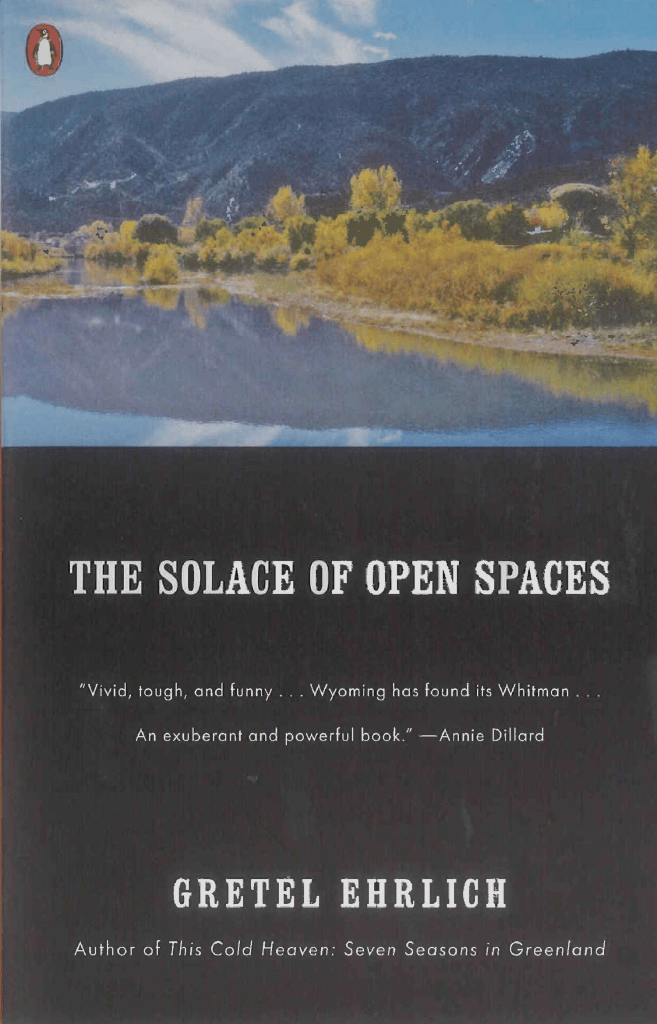
There’s No Memoir without Me

From our in-class discussions and supplemental readings, one concept that has interested me is the idea of intentional fallacy and the isolation of “the text itself” (Tyson 130). In Critical Theory Today, Lois Tyson provides the definition of intentional fallacy as the “mistaken belief that the author’s intention is the same as the text’s meaning” (130). New Criticism does not find value in authorial intention but looks at the text alone to determine and identify meaning. While there is value in isolating the text and looking at sentence structure, diction, etc., when determining a piece’s true meaning in the grand scheme, there is certainly some importance in knowing background about authorial intention or the author’s backstory. 

Thus, this sparked my interest to apply the concept of isolation and omission of author intention in New Criticism and see how an interpretation of Gretel Ehrlich’s The Solace of Open Spaces would differ depending on the lens it is seen through. Starting with the genre, the memoir has information about the author’s life included within the text, so New Criticism lends itself well for analysis as the outside information and authorial perspective is. However, The Solace of Open Spacesconflicts with New Criticism because of its lack of separation between the author and the author’s work. In a memoir, the two cannot be separated like poem and poet can be, as the reader is already aware that they are reading about some part of the author’s life. As readers, we are forced to engage with Gretel Ehrlich in relation to her work because the memoir is told directly from her perspective. Following the guidelines of New Criticism, we can look at The Solace of Open Spaceswith more of a focus on form, language, and the text itself, but the first person point of view introduces inherent authorial intention and rules out the isolation of author and text to some extent. 

Specifically with applying New Criticism’s focus on isolation of the text and the text alone, The Solace of Open Spacesexists within its own space and the author’s world, but fails to reach outside of that and have a broader meaning. The entire purpose of the memoir cannot be assessed under New Criticism because it deals with author intention. We cannot interpret what Gretel might mean or want to convey by only talking about certain moments in her life—or including chapter titles such as “To Live in Two Worlds” or “Other Lives”—for that would be intentional fallacy. She focuses on her time as a ranch hand and on the landscape of Wyoming, but we cannot assess why that is important to others reading her memoir. We can only take Ehrlich’s life story at surface level with New Criticism, because any further analysis would have to include why she is telling her story in global context and why the world is listening, which is then affective fallacy. 

Rhetorically, New Criticism allows the reader to see what devices Ehrlich puts into play, and the reader can appreciate her use of metaphor and simile as well as acknowledge her sentence structure and literary devices. Ehrlich’s use of metaphor paints a beautiful picture, where “dust rises like an evening gown behind his truck. It flies free for a moment, then returns, leisurely, to the habitual road—that bruised string which leads to and from my heart” (61), but the picture is all the reader can see with New Criticism, not the meaning behind it. I think applying New Criticism to a memoir is almost ironic: using a theory that does not look at the author or outside the text being used to analyze a piece that focuses specifically on authorial intentional and its implication with the outside world. Ultimately, I do not think using New Criticism to analyze a memoir is really fruitful because it dead-ends the reader into just looking at the text and not the surrounding environment, which is what truly gives purpose to the memoir as a genre. 

Ehrlich, Gretel. The Solace of Open Spaces. New York, Penguin, 1985.

Tyson, Lois. Critical Theory Today. 3rded., Routledge, 2015.