 Is there a text in this class? That’s a famous line (and title) from reader-response literary theory, coming later in the semester. For the first two weeks of our exploration of critical theory, the answer to that question is decidedly: “yes, there is only text in this class.” Beginning with the New Criticism, one of the oldest of the critical/literary theories we will study, and then continuing into structuralism and deconstruction, scholars and critical readers focus thoroughly and rigorously and entirely on texts. Although those texts are produced by authors who live in various historical contexts and bodies, and are read by readers who also live in various and different historical contexts and bodies, New Critics, structuralists, and deconstructionists will exclude those other contexts and focus on (a refrain) “the text itself.”
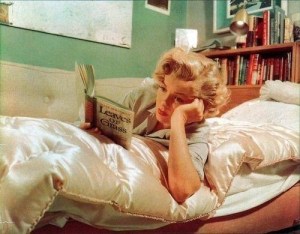
You and I, as English majors, are particularly familiar with this commitment to the text from New Criticism. Its primary strategy, still with us, is close reading. We have been trained to focus on what’s in front of us, the language and its complexities, recognizing that literary texts, and maybe any text at all, if they are worth our attention and interpretation, are highly connotative, not merely denotative. Such texts say what they mean, but they don’t necessarily mean what they say. That’s where the critic comes in.
As we make our way through the various critical theories and strategies, I will continually ask you to consider the uses and limits of each approach. Another phrasing I would use, borrowed from media and design studies: what are the affordances and constraints of the theory? What does it allow us to do and understand and see (theory comes from a Greek word related to vision)? What does it keep us from doing and seeing? This is where critical theory and rhetoric meet up. The rhetorician Kenneth Burke characterized rhetoric as the understanding that “every way of seeing is a way of not seeing.” I think Spivak has this in mind with her understanding of the “double bind.”
And so, with the New Criticism, close reading, close, careful, thoughtful attention to the text and the complexities that attend language and its symbolic uses (“language as symbolic action,” another phrase from Burke)–this legacy of close reading remains a rich and useful legacy of the tradition. We will continue it. Think, for a moment, about your encounters with close reading in the classroom, or in your scholarship. What have you done with this fundamental strategy of literary and textual interpretation? What did it enable you to do?
But also, think for a moment about being limited only to the text and its close reading. Have you had that experience as well? I am thinking of the student who brings into discussion of a text an idea not directly evident in the text, or maybe deliberately brought from outside the text. Something like: that image reminds me of X, where X might be something historical, or personal, or biographical. In the tradition of New Criticism, that student’s contribution would be knocked down by the teacher as “heretical” because it is external to the text. These are the terms used in the critical tradition: “The Intentional Fallacy,” “The Heresy of Paraphrase,” and “the extinction of personality” (Eliot).
Are these, in your view, legitimate and necessary constraints? Should we only focus on the text in our interpretation–and exclude, for example, what the text might mean to us (a kind of paraphrase), or what we think it meant to the author (intention), or where the text comes from (context)? These are matters for further interrogation and application this week as you begin your first “Further Reading.”
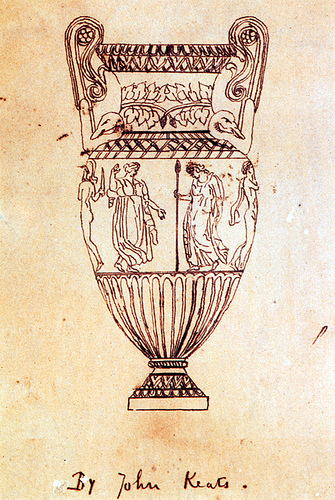
One insight to consider. New Criticism was particularly effective with poetry. This made it highly useful in the college classroom, where a poem could be approached within one class period and (perhaps) brought to resolution. This is a key to New Criticism: all the complexities and paradoxes and ironies and tensions so crucial to literary language–what makes it worth interpreting–must be resolved in the end if the work is to be literary art. We will be testing this out with a famous poem about art, Keats’s “Ode on a Grecian Urn.”
But does every poem necessarily resolve its contradictions and tensions? Does a poem need to be art in order to be a poem? And, what about reaching beyond poetry? You might begin to test out the limits of New Criticism by applying it to a novel. What about other kinds of texts and uses of language that Spivak and Emerson have in mind: speeches, film, the “philosophy of the street”? Should New Critical perspectives and interpretive strategies also be of use to us beyond the classroom?
 Creative Reading
You must be logged in to post a comment.