
In this week’s reading on new historicism, I found the keywords of discourse, interpretation, and self-positioning the most interesting in relation to the literary theory. In Lois Tyson’s Critical Theory Today, she explains that “new historicism views historical accounts as narratives, as stories, that are inevitably biased according to the point of view, conscious or unconscious, of those who write them” (271). If this statement is to be taken at full value, how can we, as humans, researchers, etc., legitimize retellings or accounts of anything that has happened in history? In thinking about this question further, the definition of a discourse as something created “by particular cultural conditions at a particular time and place” (270) that then illuminates some aspect of the human condition or experience partially legitimizes the understanding that new historicism regards history as a narrative instead of concrete facts, but I still wonder about the full impact a biased account can have on an audience.
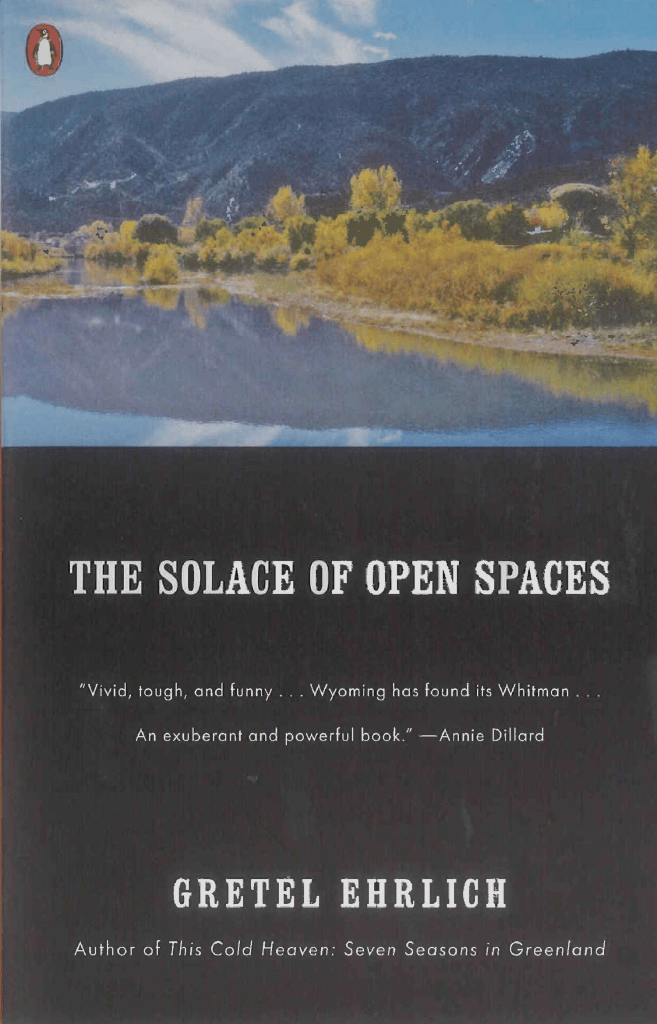
As interpretation plays a huge part in new historicism, my additional question of how this literary theory can be applied to a memoir seems fairly straight-forward. After all, the memoir as a genre is inherently biased as the author and audience seem to share an understanding that the text is written from a specific perspective and only tells about certain events from the author’s perspective. In this way, looking at memoirs from a new historicism lens seems entirely appropriate: the narrative is universally understood to be a snapshot of a particular moment in time. I would like to further pursue in my application how Ehrlich’s personal narrative can be useful—even if it is not objective—and how the memoir’s subjectivity in general can open realms of interpretation that allow readers to understand the context in which the text was written. In my application of new historicism to Gretel Ehrlich’s memoir The Solace of Open Spaces, I will explore how the genre of the memoir can be seen as a form of self-positioning and how looking at Ehrlich’s interpretation of events may not be totally accurate, but it still a useful lens through which readers can view certain moments in history.
Perhaps the most useful way to apply new historicism to Ehrlich’s memoir is to look at the chapter titled “To Live in Two Worlds: Crow Fair and a Sun Dance.” In this chapter, Ehrlich discusses several rituals, including a Native American religious ceremony called the Sun Dance. She starts her description with seemingly objective details: “Every man wore beaded moccasins, leaving legs and torsos bare. Their faces, chests, arms, and the palms of their hands were painted yellow” (108). In the next scene where the men start dancing, Ehrlich’s depiction is clearly more subjective, as she comments that “in the air so dry and with their juices squeezed out, [the men] looked weightless, their bodies thin and brittle as shells. It wasn’t the pain of the sacrifice they were making that counted but the emptiness to which they were surrendering themselves. It was an old ritual: separation, initiation, return” (112). With the genre of memoir as a whole, the text is acknowledged as being inherently biased, and yet accepted by the audience as such. In terms of self-positioning, I think it is unique that readers are aware that they are reading about experiences through the author’s lens, but that does not discredit the text itself. Much like new historicism argues, it is the reader’s interpretation of Ehrlich’s narrative that really matters. Because the reader knows the limitations out-right, there is room to balance Ehrlich’s objectivity when she talks about the body paint on the men with her interpretation of what the Sun Dance means in terms of Native American culture. We can still value Ehrlich’s outsider view of the Sun Dance because it gives us a glimpse into the historical culture of Wyoming in the 1980s, but reader’s must be aware that this is just one interpretation of the event from one person’s perspective. Therefore, one limitation of applying new historicism to the memoir is that the reader would have to do extra research to find out if Ehrlich’s narrative of Native American culture is accurate to this time period, because perhaps this biased content is not the best example of the culture of that time period. I think that this literary theory works when thinking about the memoir as a genre and the biases that are presented to the reader, but it lacks the concrete-ness needed to really construct an argument around the text. Perhaps attaching this theory to formalism, structuralism, and reader-response theory would help to construct an argument that looks at the subjective-ness of a text as being beneficial to convey authorial experiences while also imparting wisdom onto the reader.
Ehrlich, Gretel. The Solace of Open Spaces. New York, Penguin, 1985.
Tyson, Lois. Critical Theory Today. 3rd ed., Routledge, 2015.
 Creative Reading
You must be logged in to post a comment.