Until Proven Guilty: The Lack of Justice in And Then There Were None

I want to question the idea of justice in Agatha Christie’s And Then There Were None.  There are arguments aplenty on if U. N. Owen is justified or even interested in justice when they (singular) murder ten people, each of whom is accused of getting away with killing someone.  A closer look at how Owen accomplishes their idea of justice, and the people who are punished under it, reveals much more ambiguity. First, we must consider the “criminals” killed. One character, Emily Brent, is accused of causing a teenage girl’s suicide—even though Brent didn’t cause the suicide or tell the girl to kill herself.  Two other characters are never even confirmed guilty. They also happen to be, some say, the most minor: Thomas and Ethel Rogers, the butler and cook. But a New Critical lens reveals the Rogerses’ so-called underdevelopment makes them ripe for a range of interpretations, and their opaqueness is not classist ignorance on Christie’s part, but an unsolved mystery within a mystery.  Because we know so little about them and we never hear their thoughts, we never know if they’re guilty or innocent. In fact, there’s no conclusive evidence they committed murder. This ambiguity severely disrupts U. N. Owen’s master plan.  

Second, we must ask if Owen can enforce justice alone.  Under the English system, justice was jointly administered by the police, jury, judge, and executioner.  While Owen finds this unable to bring every killer to justice, Marti’s and Saks’s meta-analysis shows the importance of having many people involved in court proceedings.  When only one person is police, judge, jury, and executioner, it inherently contaminates the system’s integrity.  

Considering the potential innocence of the “guilty,” and the limitations of the one-person judgment, it becomes apparent that U. N. Owen’s plan for “justice” is poorly thought out at best.  At worst, it’s not justice at all.  

Potential Sources

Saks, Michael J., and Mollie Weighner Marti. “A Meta-Analysis of the Effects of Jury Size.” Law and Human Behavior, vol. 21, no. 5, 1997, pp. 451–467. JSTOR, www.jstor.org/stable/1394327.

Vurmay, M. Ayça.  “Detection or Endless Deferral/Absence in Detective Fiction: Agatha Christie’s And Then There Were None.”  DCTF Dergisi, 57.2, 2017, pp. 1127-1150.  

DID the Butler Do It? A New Critical Look at Two Underrated Servants

[There is a spoiler for And Then There Were None in this pitch.  No, I don’t reveal the killer’s identity.  If you haven’t read it, you should!]

A person doesn’t need an English degree to see the exploration of the universal themes of justice and punishment in Agatha Christie’s 1939 novel And Then There Were None.  Interestingly, few scholarly articles exist on the novel.  There are arguments aplenty on if U. N. Owen is justified or even interested in justice when s/he murders ten people, each of whom is accused of getting away with murder.  But nearly all these readers’ opinions are based on the assumption that all ten people are guilty of murder, which drains the book of some ambiguity. In fact, only eight characters are confirmed guilty through thoughts, flashbacks, or confessions.  The two that aren’t also happen to be, some say, the most minor, whose thoughts are never revealed: Thomas and Ethel Rogers, the butler and cook. Christie has been criticized for her underdeveloped domestic worker characters such as these two. But a New Critical lens reveals the paradox that the most “minor” characters are actually the most important.  The Rogerses’ so-called underdevelopment makes them ripe for a range of interpretations, and their opaqueness is not classist ignorance on Christie’s part, but an unsolved mystery within a (solved) mystery. Because we know so little about them and we never hear their thoughts, we never know if they’re guilty or innocent. In fact, unlike every other character, there’s no conclusive evidence they committed the murder they’re accused of.  This adds a dose of ambiguity that severely disrupts, if not completely overthrows, U. N. Owen’s master plan for “justice.”  

Potential Source: 

Vurmay, M. Ayça.  “Detection or Endless Deferral/Absence in Detective Fiction: Agatha Christie’s And Then There Were None.”  DCTF Dergisi, 57.2, 2017, pp. 1127-1150.  

The Death of the Author and the Birth of the Text

That ominous phrase and concept, “the death of the author,” has long been attached to deconstruction, or deconstructive criticism. Deconstruction is a leading critical theory of a larger grouping of literary and critical theory that emerges in the 1960s and 1970s in Europe, and thrives in American academic institutions (mostly) in the 1980s and 90s. That larger grouping is known as “poststructuralism,” a phrase which in some ways overlaps with the term “postmodernism,” but not entirely.

“Poststructuralism” (as an umbrella term for theories like deconstruction) is useful for our purposes this week since the phrase reminds us that deconstructive criticism follows and replaces structuralism, but does so by way of relation. Both focus on an understanding of language and writing as the foundation of any text–not the author, not the reader, not the historical era in which that text was composed or published.

To some extent, we are still talking about “text without contexts,” as we encountered in our readings of the New Criticism. But structuralism and then deconstruction take things a step further. In New Criticism, we had an author’s work (Brooks consistently refers to Keats and Eliot to “the individual talent”), but we understood that what mattered was interpretation of the poem/poetry, not the poet. Now, with structuralism and deconstruction, that individual author and work disappear into the writing of the text. Now, the text is all context–or as Derrida, leading proponent of deconstruction famously  put it: “there is no outside the text.” We move, as Roland Barthes phrases it, “From Work to Text.”  We will read that essay for Thursday, from a collection (Image/Music/Text) that includes his essay “The Death of the Author.” Barthes is a useful guide for us this week since his earlier work such as “The World of Wrestling” (from Mythologies) is a good example of a structuralist interpretation.

As a way to distinguish structuralism from what comes after it, poststructuralism, I think it is particularly helpful to focus on the linguistic “structure” that both emphasize in understanding the birth of the text and the death of the literary work grounded in the authority of the author. Structuralism would have us think in metaphors and analogies of surface and depth, the structures we can see and the deep structure we can’t. Here are some relevant surface/deep structure relations:

structural linguistics:

parole (individual speech) / langue (the underlying language, grammar, syntactic structures

cultural (also called structural) anthropology: culture (individual practices or rituals) or myths (individual stories, mythemes) / underlying kinship rules or archetypal mythology across groups, cultures [Levi-Strauss: “incest is bad grammar”]

psychoanalytic theory: conscious/unconscious

Marxism: superstructure/substructure or base

New Criticism: Denotation/Connotation or Tension/Opposition/Paradox in the poem/organic wholeness underlying the poetry


Poststructuralist theory, most especially deconstruction, learns from the structuralist insights on language (Saussure is a key figure for both) and what is called semiotics (the science of signs, the understanding the a sign is comprised of something signified but also its signifier). But rather than believing, as strucutralism does, that the acts of signification are contained or closed off by the signified, deconstruction argues that one signifier suggests another signifier. The process of signification continues without end. Instead of a surface/depth metaphor where the signifier is grounded by the signified, deconstruction shifts attention to the metonymy of signifying: one sign leads to the next sign that is near it or in part related, which leads to the next sign, and so on. From the deconstructive perspective, there is no underlying deep structure in language that somehow stands apart from language. The very idea of a deep structure, and the very act of interpreting or perceiving a deep structure in anything, exists only in the thinking we do with language and signs.

deconstruction: sign–>sign–>sign / signification (but: signification is itself more signs)

mise en abyme: a phrase from French used by Derrida and others: “placed into the abyss.” Think of a mirror held up to a mirror–where does it stop? Or a play within a play (which also has a play within it, and so on). This is where “undecidability” comes into play.

In other words, from the perspective of deconstructive theory, there is no end to the signifying process, since there is no one or no thing outside the process of signification. (The sign tells us there is another sign ahead; but when we get up to that sign, we are still looking at a sign.) There is no “transcendental signified” that can stand apart from the language we use to think. According to deconstruction, traditional names for some transcendental signifieds used to (falsely) suggest a stable ground apart from the process of signification: Author, God, Nature, Being.

Last week we suggested that Brooks’ new critical perspective on Keats’s “Ode” is on to something valuable. The poem is contradictory, paradoxical, maybe even noisy–and close reading of the symbols and language help us to hear the noise more clearly. That makes it interesting to both the new critic and the deconstructionist. But Brooks in the end has to sweep the mess (all the stuff he can’t account for) under the rug, saying the paradox is resolved by Paradox (his transcendental signified). It’s circular (just as the statement made by the Urn: this poem is art because true art is poetic). Deconstruction calls out that circularity as a lie, but says it’s a lie that all texts, all poets and critics, can’t escape, due to the nature of language. Instead of sweeping the mess under the rug, deconstruction suggests that the rug is indistinguishable from the mess.

But does that mean we should stop caring about cleaning up the room, stop sweeping the floor since the rug in the end isn’t separate from the floor or the mess? And are we, in fact, separate from that mess? Doesn’t contemporary physics suggest that we–the stuff that really makes us–can’t be decidable or certain in the ways we used to think of nature (Descartes, Newton) before Einstein and Heisenberg? I fear that the metaphor of my analogy is slipping away from me into quantum physics, sliding into the abyme of my thinking of thinking, my language about the nature of language.

For some further reading and thinking about structuralist principles in the real world, for example the idea of “archetypes”:  The 7 Story Archetypes, suggesting that any story  or narrative (including film) can be read at a deep structural level.

And for more on Derrida and deconstruction, you can’t go wrong with YouTube.

To hear Robert Frost reading “Mending Wall” (the poem used as an example in the Deconstruction chapter). Consider what a structuralist reading of this poem would do compare to what a deconstructive reading would do.

Limiting Genius with the New Criticism Method

The New Criticism model of literature evaluation forces us to compare a text against itself. It constrains us to what has been provided for us by the author. All arguments must stem from what is on the page, all evidence to support those arguments must come from that same page. We are asked not to consider the author’s background, their intent in writing the text, or the impact the artifact has had upon the reader.

The effect of this model of criticism is to limit the brilliance of some pieces of literature, by removing from their merit the huge emotional response a reader may have to the piece to avoid the “affective fallacy” (Tyson, 131). Removing the author’s background or purpose in writing to avoid the “intentional fallacy” (130) can also hobble appreciation of the piece; by not including their experiences or lack of experiences, we don’t fully appreciate what they’ve accomplished with the text.

The piece “Incarnations of Burned Children” by David Foster Wallace is a piece that suffers from the avoidance of the two fallacies Tyson describes. The text is a visceral stream of consciousness narrative from the internal dialogue of a father whose child has just been critically injured. The text itself does not follow many of the traditions that Eliot espouses authors building upon. Wallace’s concept is not a new one. The words he chooses, while well chosen, aren’t especially academic or inventive. What is new, or “temporal” (Eliot) about the piece is the effect the structure and words chosen have upon the reader.

If the reader is limited solely to the text, they will find little formal structure here. Even punctuation often goes by the wayside to accomplish the frantic, pell-mell feeling of the text. The piece is so appallingly real that many parents struggle to read the piece or listen to the work being read. When reading this piece, the reader fights to get through the piece quickly, desperately seeking resolution to the horrors unfolding before them, much as the father himself is trying to remedy his child’s distress. Wallace forces the reader to become the parent. The reader’s urgency is evidence of the brilliance of the piece. If we remove their response to the piece, we miss out entirely on the genius of the structure.

Where Wallace’s work might please Eliot is in his depersonalization. Eliot describes depersonalization as “a continual surrender of himself as he is at the moment to something which is more valuable” (Eliot). Wallace, who had no children of his own, steps into the shoes of a parent on the worst day of their lives. He surrenders himself to the experience that many parents have experienced to varying degrees. He fully explores the helplessness and rage and frustration a parent cast into those circumstances feels, with little personal experience to draw from.

To remove the reader’s response to “Incarnations of Burned Children” and to remove the incredibly real way Wallace explored a situation he had no experience in is to detract from the genius of the piece. Wallace’s ability to cast the reader into the same emotional crisis as the protagonist of his work using commonplace words arranged and paced in a deliberate way detracts from the piece’s value. His ability to conceptualize the emotional state of the man without having experienced it himself is remarkable.

For these reasons, the New Criticism model of evaluating literature cannot effectively assess the merits of some works. In works such as this, the New Criticism model becomes merely a starting point to look at the structure of the piece, its patterns, and overall tone. We as scholars must then step outside the model to truly evaluate the whole of the piece.

https://www.esquire.com/entertainment/books/a500/incarnations-burned-children-david-foster-wallace-0900/

Works Cited

Eliot, T. S. “Tradition and the Individual Talent by T. S. Eliot.” Poetry Foundation, Poetry Foundation, 13 Oct. 2009, https://www.poetryfoundation.org/articles/69400/tradition-and-the-individual-talent.

Tyson, Lois. Critical Theory Today: a User-Friendly Guide. Routledge, 2015.

Wallace, David Foster. “Incarnations of Burned Children.” Esquire, Hearst Magazine Media Inc., 11 Oct. 2017, https://www.esquire.com/entertainment/books/a500/incarnations-burned-children-david-foster-wallace-0900/.

Originality and the Historical Sense

Eliot describes a poet’s originality as the places where “the dead poets, his ancestors, assert their immortality most vigorously.”  In other words, everything in art has been done, no matter how original it seems, and this isn’t something to be ashamed of. (I get this a lot as a writer.)  He emphasizes the “historical sense,” an understanding of how the past is present today (clever pun). But a historical sense cannot be passively absorbed. It must be obtained by “great labor.”  

I agree with much of what Eliot said.  His argument on dead poets asserting their immortality in living poets’ work reminded me of a surprising discovery I made while revising a YA mystery.  I considered my protagonist Silas pretty original—he’s a seventeen-year-old butler—but I realized he has things in common with a much older protagonist: Jesus.  Silas is conceived out of wedlock to a low-class couple. He lives a life of service and obedience. He walks on (frozen) water and serves at the story’s last supper.  He puts the lives of others before his own to confront great evil (the killer), who drags him to a graveyard. There, he’s wounded in the hand and side but (miraculously?) walks out of the graveyard alive.  

Contrary to Eliot’s argument, I wasn’t aware of all this when I wrote the story.  Not all echoes of past literature are consciously inserted by the writer through great labor.  First, we’re born into cultures that carry assumptions, stories, and ideals, which influence our thinking.  Second, the story (or other art) always has connections, references, and ideas the writer isn’t immediately aware of.  However, I doubt it’s a coincidence that I, a Roman Catholic author who read various stories with Christ figures and Biblical allusions, wrote a story about a boy with Christ figure characteristics.  

At the same time, becoming aware of our culture’s assumptions, stories, and ideals that we absorb is important not just for writers but also for thinkers.  This is the “great labor” to acquire a “historical sense.” It helps us understand why we believe what we believe and gives us room to consider other cultures’ assumptions, stories, and ideals.  

The historical sense and the “immortality” of dead writers puts a wrinkle in new criticism, though.  New criticism cuts out any context a writer is born into and the influence of previous writers, but Eliot claims both of these must be considered by a writer with the historical sense.  A new critic could get around this by pointing out that historical sense is directed at writers, not readers, and new criticism is a way of reading, not writing. Arguably, a writer doesn’t have to think about new criticism and can consider all the context they want when writing.  A new critical reader just won’t factor any of that in. But ignoring the historical sense means ignoring influences that guide the work. Those influences may give a new way to see the work as a whole. For example, if I think of Silas as a Christ figure, that suggests the killer embodies Satan and human wickedness, or Silas’s friends represent disciples, which opens a new line of analysis into their roles in the story.  

Reference

Eliot, T. S. “Tradition and the Individual Talent.”  The Sacred Wood: Essays on Poetry and Criticism, 1920.  

Far From Close Reading

Megan Walsh

The critical concept that interested me most was one that I was not unfamiliar with. In high school, close reading was emphasized as part of a New Criticism-leaning curriculum. However, I have never questioned or considered the potential limitations or relevancy of close reading, nor its connection to New Criticism. Lois Tyson explains New Criticism as a movement characterized by a dedication to the text as a singular entity (130). It moves away from the earlier method of analysis, focus on authorial intent and historical context, and focuses singularly on the work itself (Tyson 130). New Critics emphasize a strict focus on the work in question with no outside knowledge or contextualization; they believe that the text speaks for itself and all other information is irrelevant.

New Criticism holds that in order to analyze and understand a work’s underlying meaning, one must only look for the answers in the text itself by reading closely. Close reading can also mean slow reading, or deliberately and carefully looking for deeper meaning and connections in a text. Even individual words can be analyzed within a text and change the meaning of the overall piece through connotation. Close reading recognizes this and, as a strategy, aims to reach a broader understanding of a text and its relevancy to humanity and overarching themes by analyzing details within the text. The strategy of close reading aims to examine “all the evidence provided by the language of the text itself: its images, symbols, metaphors, rhyme, meter, point of view, setting, characterization, plot, and so forth, which, because they form, or shape, the literary work are called its formal elements” (Tyson 131). I found that although new criticism has waned in popularity, close reading is still a key part of current literary practice.

However, form does dictate close reading’s relevancy to a certain extent. There may be limitations to close reading that I had not previously thought possible. I realized this while reading Cleanth Brooks’ “An Account of Keats’ Urn”, a close reading analysis of “Ode on a Grecian Urn”. Brooks draws evidence stanza by stanza to support his claim of a larger connection that justifies the final paradox of the poem as “in character”: “But to return to the larger pattern of the poem: Keats does something in this fourth stanza which is highly interesting in itself and thoroughly relevant to the sense in which the urn is a historian” (Brooks 9). I agree with Brooks in that I believe formally close reading may be necessary to ascertain the overlying meaning of this poem or justify the last few lines. Poetry lends itself to close reading on a formal level. However, Brooks’ writing points out a glaring flaw of the strategy; the double bind of close reading is revealed.

Brooks close reads in order to pick out evidence for his argument, glossing over lines that do not support his claim. It is nearly impossible to close read everything in the poem, but entirely necessary to do so in order to create the unity and wholeness desired by those who uphold close reading. In order to look at the whole text and nothing but the text, and to achieve a singular effect, close reading must be applied to every stanza in order to not miss any chance for analysis that might change the poem’s meaning. After all, if every word counts, doesn’t glossing over lines leave potential analysis out? This is the paradox that created the biggest limitation of close reading for me. I decided to apply this to another work that differed in form, The Great Gatsby, in order to look at Tyson’s example in a different light. To look at The Great Gatsby from a New Criticism lens is to risk close reading for the wrong reasons. To decontextualize Gatsby from the American Dream and the time period is to miss greater themes that characterize the novel. Also, depending on which parts of the novel one close reads, very different types of criticism become necessary. For instance, one could hypothetically perform a close reading of The Great Gatsby which focuses only on Nick’s interactions with Gatsby, thus leading to an analysis centered around themes of hero worship and even homosocial bonding, missing the larger themes Daisy represents in the text and Gatsby’s real motivations.

To go further with this idea, I wondered if it were possible to close read a text in a way that goes completely against its purpose as a work, and I believe that by picking and choosing which passages one reads from, this is a legitimate problem. How much of a given text are we missing by close reading? Is it possible to apply close reading wholly to longer texts, such as Moby Dick, without skipping over parts of the novel? I wondered if close reading could get too close and miss the point of a text. I think that sometimes it may be necessary to get further away from close reading, to contextualize a text and look for broader themes in the novel by looking at a text without a (potentially too narrow) New Criticism lens.

Works Cited:

Brooks, Cleanth. “History without Footnotes: An Account of Keats’ Urn.” The Sewanee Review, vol. 52, no. 1, 1944, pp. 89–101.

 Fitzgerald, F. Scott. The Great Gatsby. New York: Scribner, 2004.


Tyson, Lois. Critical Theory Today. 3rded., Routledge, 2015. 

Poetryfoundation.org. (2019). Ode on a Grecian Urn by John Keats: The Poetry Foundation. [online] Available at: http://www.poetryfoundation.org/poem/173742

The Cost of Cutting the Context

I find many aspects of New Criticism contradictory and un-objective, but what created the most conflict for me is the New Critic perspective on psychological, sociological, and philosophical parts of works. In Critical Theory Today, Lois Tyson describes this perspective: “…New Critics addressed these elements, but they did so for the purpose of examining how such elements operate to establish the texts’ theme… they aestheticized them” (142). To look at psychological, sociological, and philosophical parts of a work and disregard them or only look at them aesthetically seems disingenuous. True distance from those three areas is impossible for a human, who is made of subjectivity and bias, and more so for the specific group of humans – rich, white, educated, abled, cisgender, heterosexual men – who dominated this theory in its heyday.

T.S Eliot writes in “Tradition and the Individual Talent” that “the emotion of art is impersonal.” This ties into his commentary on the separation of the of the “personality” of the author, as he describes it, and the medium. This implies a vast distance between a poet and their writing. I understand him to mean that emotional distance is required to produce effective poetry, and I agree that some is useful. However, his description of the distance is too extreme. It is as if the poet is merely a robot that has no experiences, feelings, or thoughts that can – intentionally or unintentionally – influence the resulting poem. Or, those influences are irrelevant to the quality of the poem.

The New Critics reduce writing to the formal qualities, and Eliot furthers this notion of intratextual examination when he distances the author. Neither, however, are the problem inherit with this theory. Its claims of ‘single best interpretation’ and ‘objectivity’ create the issue. As I have touched above, there are alternatives to the rigidness of New Criticism, which can hold more weight based on the work.

Consider “On Being Brought from Africa to America” by Phillis Wheatley:

‘Twas mercy brought me from my Pagan land,

Taught my benighted soul to understand

That there’s a God, that there’s a Saviour too:

Once I redemption neither sought nor knew.

Some view our sable race with scornful eye,

“Their colour is a diabolic die.”

Remember, Christians, Negros, black as Cain,

May be refin’d, and join th’ angelic train.

A New Critic would talk about the organic unity in certain aspects in this poem (“Pagan” balancing “Saviour,” the contrast of a physical land and a soul). But they would be missing what I find of the utmost relevance, because context is required. It was written by an enslaved African woman in the United States at the beginning of the 19th century. Phillis Wheatley was published by white people for white people, and her master encouraged her to write. She could neither cut herself off completely, because she had things she needed to say, nor directly convey what she needed to tell them. New Critics may say, “Well, we can aestheticize some of that from within the poem.” And to that, I say, if we do, we miss the integral part of this poem. This poem does not exist simply to be art. It is a message. In an elegant and poetic form, but the purpose is to convey a specific message in a non-threatening yet impactful way that comes directly from her personal circumstances. It is openly as Phillis Wheatley can say to that her enslavement is wrong: “Remember, Christians, Negros, black as Cain / May be refin’d, and join th’ angelic train.”

This portrait comes from one of Phillis Wheatley’s poetry books.

Works Cited

Eliot, T. S. “Tradition and the Individual Talent.” Poetry Foundation. 13 Oct. 2009. www.poetryfoundation.org/articles/69400/tradition-and-the-individual-talent. Accessed 6 Sept. 2019.

Moorhead, Scipio, Engraver. Phillis Wheatley, Negro servant to Mr. John Wheatley, of Boston. Retrieved from the Library of Congress. http://www.loc.gov/item/2002712199/. Accessed 6 Sept. 2019.

Tyson, Lois. Critical Theory Today. 3rded., Routledge, 2015.

Wheatley, Phillis. “On Being Brought from Africa to America.” Poetry Foundation. www.poetryfoundation.org/poems/45465/on-being-brought-from-africa-to-america. Accessed 6 Sept. 2019.

Loss of Satire

When going through the concept of New Criticism and its replacement of Biographical-historical criticism, it mainly sets the common rule of interpreting only the text itself. This rule is put in place to view literature through a purer lens, looking only at the literature, thus cutting off connected subjects such as history. This intends for scholars to deeply think about the words on the paper without being distracted by all manner of related content. This unfortunately does not allow for all works of literature to be analyzed in a proper manner as some simply do not fit well into this form of literary theory, as shown in Brooks’ History without Footnotes, where even the title implies a lack of context. In the essay he quickly addresses the problem of some of the poem’s last few lines, “Beauty is truth, truth beauty”. The line creates a paradox that doesn’t fit well into New Criticism not only for the fact that it is a self defining definition with no end but also that it leaves the poem in a state of ambiguity despite leading up to such an end.

This type of breaking of the system brought to mind other works of literature that would achieve something similar, one such work being A Modest Proposal by Jonathan Swift. Since New Criticism strictly deals with the text and chooses to cut out all accompanying context, the main focus of this essay is lost in translation. Swift writes about the problem of “beggars of the female sex, followed by three, four, or six children, all in rags, and importuning every passenger for an alms” (Swift). Swift states how poverty is the overall problem which is leading to many mouths to feed but no food to do it with. Swift follows that up with a proposed solution to such a problem saying “[Children], instead of being a charge upon their parents, or the parish, or wanting food and raiment for the rest of their lives, they shall, on the contrary, contribute to the feeding, and partly to the cloathing of many thousands” (Swift). Swift’s proposal ends up being exactly as he describes, eat the children and make clothes from them and while this is sickening it is easily explained through biographical-historical context. Swift was known for his satirical essays and therefore was not serious at all about his proposed solution. The entire essay is meant to be a longwinded effort to poke fun at the standing government’s treatment yet responses to the growing problem of Irish poverty in the early eighteenth century. Without the context of what Swift is known for writing and the history behind the situation he writes about the essay loses much of its meaning.

Looking through the essay using New Criticism will still allow a scholar to study the literary techniques used and the many complexities of the work, sure, but lacks its main points. Satire becomes far more difficult to detect using New Criticism as nothing plainly states its use in the essay and leaves the reader to a more surface view of the work. Works may be taken literally that were not intended to be and to bring in the intentions of the author to find such a singular meaning would break a core rule of New Criticism.

Brooks, Cleanth. “History without Footnotes: An Account of Keats’ Urn.” The Sewanee Review, vol. 52, no. 1, 1944, pp. 89–101.

Bruggink, Eric. “A Modest Proposal.” Public Contract Law Journal, vol. 28, no. 4, 1999, pp. 529–543.

John Keats, “Ode on a Grecian Urn,” Bartleby.com, http://www.bartleby.com/101/625.html , Accessed 5 November 2009.

There’s No Memoir without Me

From our in-class discussions and supplemental readings, one concept that has interested me is the idea of intentional fallacy and the isolation of “the text itself” (Tyson 130). In Critical Theory Today, Lois Tyson provides the definition of intentional fallacy as the “mistaken belief that the author’s intention is the same as the text’s meaning” (130). New Criticism does not find value in authorial intention but looks at the text alone to determine and identify meaning. While there is value in isolating the text and looking at sentence structure, diction, etc., when determining a piece’s true meaning in the grand scheme, there is certainly some importance in knowing background about authorial intention or the author’s backstory. 

Thus, this sparked my interest to apply the concept of isolation and omission of author intention in New Criticism and see how an interpretation of Gretel Ehrlich’s The Solace of Open Spaces would differ depending on the lens it is seen through. Starting with the genre, the memoir has information about the author’s life included within the text, so New Criticism lends itself well for analysis as the outside information and authorial perspective is. However, The Solace of Open Spacesconflicts with New Criticism because of its lack of separation between the author and the author’s work. In a memoir, the two cannot be separated like poem and poet can be, as the reader is already aware that they are reading about some part of the author’s life. As readers, we are forced to engage with Gretel Ehrlich in relation to her work because the memoir is told directly from her perspective. Following the guidelines of New Criticism, we can look at The Solace of Open Spaceswith more of a focus on form, language, and the text itself, but the first person point of view introduces inherent authorial intention and rules out the isolation of author and text to some extent. 

Specifically with applying New Criticism’s focus on isolation of the text and the text alone, The Solace of Open Spacesexists within its own space and the author’s world, but fails to reach outside of that and have a broader meaning. The entire purpose of the memoir cannot be assessed under New Criticism because it deals with author intention. We cannot interpret what Gretel might mean or want to convey by only talking about certain moments in her life—or including chapter titles such as “To Live in Two Worlds” or “Other Lives”—for that would be intentional fallacy. She focuses on her time as a ranch hand and on the landscape of Wyoming, but we cannot assess why that is important to others reading her memoir. We can only take Ehrlich’s life story at surface level with New Criticism, because any further analysis would have to include why she is telling her story in global context and why the world is listening, which is then affective fallacy. 

Rhetorically, New Criticism allows the reader to see what devices Ehrlich puts into play, and the reader can appreciate her use of metaphor and simile as well as acknowledge her sentence structure and literary devices. Ehrlich’s use of metaphor paints a beautiful picture, where “dust rises like an evening gown behind his truck. It flies free for a moment, then returns, leisurely, to the habitual road—that bruised string which leads to and from my heart” (61), but the picture is all the reader can see with New Criticism, not the meaning behind it. I think applying New Criticism to a memoir is almost ironic: using a theory that does not look at the author or outside the text being used to analyze a piece that focuses specifically on authorial intentional and its implication with the outside world. Ultimately, I do not think using New Criticism to analyze a memoir is really fruitful because it dead-ends the reader into just looking at the text and not the surrounding environment, which is what truly gives purpose to the memoir as a genre. 

Ehrlich, Gretel. The Solace of Open Spaces. New York, Penguin, 1985.

Tyson, Lois. Critical Theory Today. 3rded., Routledge, 2015. 

Further Reading – T. S. Eliot

In his essay, T. S. Eliot takes a very New Critical stance by insisting that one must focus on the technical prowess of the text alone to find value in a work of literature.  He made the case that the value of poetry can only be found in the text and not anything around it.  This excludes a lot of context, history, and biographical information that could help lead a reader to a better understanding of the text and to gain a better appreciation for the work.  New Criticism limits the ways one can look at a text and excludes many different lenses that can help contribute to an analysis of why a text is written the way it is.  I don’t agree with Eliot’s insistence that background and history don’t matter.  I think that they provide valuable insight or context to an author’s decisions in their writing.  Authors are a product of their time, just like anyone else.  Many things that they include in their writing are influenced by the time period they live in, the societal expectations, and the events happening around them.  It is impossible to separate a work from its time because you loose so much valuable context.

The Odyssey is one such text that does benefit from having contextual information.  Throughout the epic poem, many lines, phrases, or images are repeated.  From a purely textual basis, this would make these repetitions seem unnecessary, drawing attention to things that don’t have much of an impact on the story at large.  Most of these repetitions refer to the changing of time or already established details about the characters.  Homer’s famous epithets do the famous faux pas of telling instead of showing.  Yet the Odyssey is still treated as a prevailing classic across centuries despite these textual flaws.  The important context here is that the Odyssey used to be memorized and performed aloud more than the actual text was sat down with and read or studied.  The repeating lines, phrases, and images made the poem easier to memorize and to be listened to.  The Odyssey was not even conceived by Homer himself.  The Odyssey began as an oral tradition that Homer recorded, and that record was used as the basis for the oral retellings from there on out.  The Odyssey also takes place just after the Trojan War, which holds valuable context for why Odysseus is in the predicament he is in.  Without studying the background of the Trojan War or the events of the Iliad, which is almost like a prequel for the Odyssey, a lot of the background for the text would be lost and the events of the narrative, both past and present, would be confusing.  In the case of the Odyssey, it is beneficial to study the history and background of the text as well as analyzing it.  Many of the important details of this text would be lost without studying them.
-Lauren Souder

Texts Without Contexts

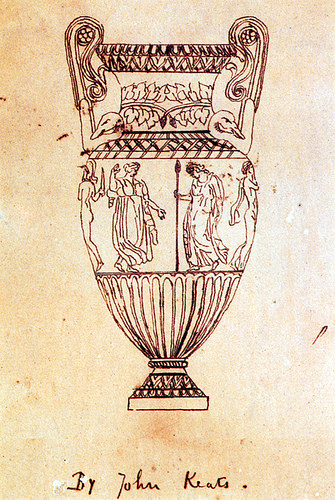
Keats_urnIs there a text in this class? That’s a famous line (and title) from reader-response literary theory, coming later in the semester. For the first two weeks of our exploration of critical theory, the answer to that question is decidedly: “yes, there is only text in this class.” Beginning with the New Criticism, one of the oldest of the critical/literary theories we will study, and then continuing into structuralism and deconstruction, scholars and critical readers focus thoroughly and rigorously and entirely on texts. Although those texts are produced by authors who live in various historical contexts and bodies, and are read by readers who also live in various and different historical contexts and bodies, New Critics, structuralists, and deconstructionists will exclude those other contexts and focus on (a refrain) “the text itself.”

You and I, as English majors, are particularly familiar with this commitment to the text from New Criticism. Its primary strategy, still with us, is close reading. We have been trained to focus on what’s in front of us, the language and its complexities, recognizing that literary texts, and maybe any text at all, if they are worth our attention and interpretation, are highly connotative, not merely denotative. Such texts say what they mean, but they don’t necessarily mean what they say. That’s where the critic comes in.

As we make our way through the various critical theories and strategies, I will continually ask you to consider the uses and limits of each approach. Another phrasing I would use, borrowed from media and design studies: what are the affordances and constraints of the theory? What does it allow us to do and understand and see (theory comes from a Greek word related to vision)? What does it keep us from doing and seeing? This is where critical theory and rhetoric meet up. The rhetorician Kenneth Burke characterized rhetoric as the understanding that “every way of seeing is a way of not seeing.” I think Spivak has this in mind with her understanding of the “double bind.”

And so, with the New Criticism, close reading, close, careful, thoughtful attention to the text and the complexities that attend language and its symbolic uses (“language as symbolic action,” another phrase from Burke)–this legacy of close reading remains a rich and useful legacy of the tradition. We will continue it. Think, for a moment, about your encounters with close reading in the classroom, or in your scholarship. What have you done with this fundamental strategy of literary and textual interpretation? What did it enable you to do?

But also, think for a moment about being limited only to the text and its close reading. Have you had that experience as well? I am thinking of the student who brings into discussion of a text an idea not directly evident in the text, or maybe deliberately brought from outside the text. Something like: that image reminds me of X, where X might be something historical, or personal, or biographical. In the tradition of New Criticism, that student’s contribution would be knocked down by the teacher as “heretical” because it is external to the text. These are the terms used in the critical tradition: “The Intentional Fallacy,” “The Heresy of Paraphrase,” and “the extinction of personality” (Eliot).

Are these, in your view, legitimate and necessary constraints? Should we only focus on the text in our interpretation–and exclude, for example, what the text might mean to us (a kind of paraphrase), or what we think it meant to the author (intention), or where the text comes from (context)? These are matters for further interrogation and application this week as you begin your first “Further Reading.”

One insight to consider. New Criticism was particularly effective with poetry. This made it highly useful in the college classroom, where a poem could be approached within one class period and (perhaps) brought to resolution. This is a key to New Criticism: all the complexities and paradoxes and ironies and tensions so crucial to literary language–what makes it worth interpreting–must be resolved in the end if the work is to be literary art. We will be testing this out with a famous poem about art, Keats’s “Ode on a Grecian Urn.”

But does every poem necessarily resolve its contradictions and tensions? Does a poem need to be art in order to be a poem? And, what about reaching beyond poetry? You might begin to test out the limits of New Criticism by applying it to a novel. What about other kinds of texts and uses of language that Spivak and Emerson have in mind: speeches, film, the “philosophy of the street”? Should New Critical perspectives and interpretive strategies also be of use to us beyond the classroom?