Writing groups have existed throughout written history. From
Plato’s Symposium to the Brontë sisters to Benjamin Franklin’s Junto, it’s a
familiar model. A group of people with aspirations to write get together, share
their writing (and often wine), critique one another’s work, and help each
other hone their craft.
Some writing groups through history have enjoyed a great
deal of success compared to others. There were other groups of writers working
together in the same period as many of the writing groups we’re most familiar
with. Why did they not experience the same lasting success? What made the Brontë
sisters so successful? What did their triad possess that other writing groups
in their time did not? What was it that has scholars and the general public
still consuming their literature?
Perhaps it is a spark of genius that elevates some writing
groups while others receive no wide acclaim, and that genius is to elicit a
response from the reader that is potent enough for their work to survive long
after the works of their peers. Aspiring
writers who do not possess the gift of working with themes and characters that
resonate with their readers may become serviceable writers, but their writing
does not capture the imagination and hearts of the readers. Texts that strike a
chord with the reading public are lasting and celebrated because of the way
readers connect with them.
The book, “Writing Groups: History, Theory, and Implications”
by Anne Ruggles Gere looks at writing groups throughout history and their
evolution into social groups that democratized scholarship in all sorts of
communities. It is a very interesting starting point to look at the mechanics
of writing groups and the theories behind their function.
Works Cited
Gere, Anne Ruggles. Writing Groups: History, Theory, and Implications. Published for the Conference on College Composition and Communication Southern Illinois University Press, 1987.
A key facet of the Reader Response
Critical Theory is the understanding that through the combination of the reader
and the text, meaning is created. Lois Tyson explains it as, “a written text is
not an object, despite its physical existence, but an event that occurs within
the reader, whose response is of primary importance in creating the text”
(164).
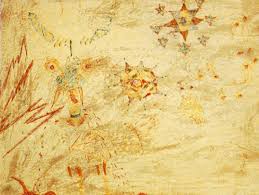
Julian Lennon arrived home from preschool with a painting he had made of his schoolmate and friend Lucy O’Donnell. When his father John asked him about his work of art, Julian simply said, “it’s Lucy in the sky with diamonds” (Runtaugh, 2018).
Julian Lennon’s Painting of his friend, Lucy O’Donnell
John, a fan of Lewis Carroll, connected the abstract nature of his son’s art with the “Which Dreamed It?” chapter of “Through the Looking Glass“. He sat down to write a song about the type of fantastical world that a three-year-old child might imagine, written in the style of Lewis Carroll’s descriptions of imagery.
When the song was released, more observant listeners connected the title “Lucy in the Sky with Diamonds” with the drug lysergic acid diethylamide (LSD), a hallucinogenic drug. John Lennon was known to experiment with the drug, and the surrealist world described in the song seemed to reflect the experience of an LSD trip. The belief was so pervasive that the song was banned from the radio.
John claimed that he was inspired to
write the song because of Julian’s painting and his reading of Lewis Carroll.
“This is the
truth: My son came home with a drawing and showed me this strange-looking woman
flying around,” he explained during an appearance on The Dick
Cavett Show in 1971. “I said, ‘What is it?’ and he said, ‘It’s Lucy
in the sky with diamonds,’ and I thought, ‘That’s beautiful.’ I immediately
wrote a song about it. After the album had come out and the album had been
published, someone noticed that the letters spelt out LSD and I had no idea
about it. … But nobody believes me” (Runtaugh2018).
His bandmate Ringo Starr, Julian’s
mother Cynthia Lennon, and friend Pete Shotton confirmed John’s story
(Runtaugh, 2018).
Readers believed he was making a thinly
veiled reference to drug use. They combined the letters in the title of the
song with the surreal imagery and applied what they knew of John’s use of
hallucinogens and came up with their own meaning. Reader Response Critical
Theory teaches us that the meaning created by the reader’s experiences and
beliefs while digesting the text is valid.
Ultimately, it doesn’t really matter what John Lennon intended, consciously or subconsciously. When the consumer of his art can make a sound argument for their perception, and back it with evidence, their argument becomes a valid critical response. When a large group of consumers, or an “interpretive community” (Tyson, 176), agree upon that meaning through the Social Reader Response Theory, that agreement demonstrates that societal influences inform the constructs readers apply to texts. “Lucy in the Sky with Diamonds” may always be associated with hallucinogens, and no protestations will convince many readers of the lyrics otherwise.
Julian Lennon’s painting currently hangs
in the home of musician David Gilmour (Raul, 2016). The song is played
regularly on the radio and there are dozens of videos to accompany the song on the
internet. Future listeners who don’t necessarily understand the drug culture of
1967 may indeed believe that the song is about the lovely painting by a three-year-old
boy as the experiences of the interpretive community change. John Lennon’s
author intent may someday align with the reader’s response, after all.
 Creative Reading
You must be logged in to post a comment.