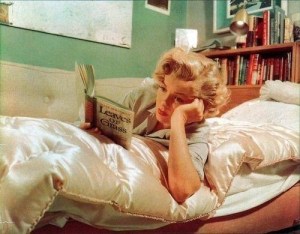
 Psychoanalytic literary theory and criticism is by no means limited to the insights and theories developed by Sigmund Freud, the father of psychoanalysis. As Lois Tyson demonstrates, a great deal comes after Freud and the classical psychoanalysis that he establishes in the early 20th century, and much of that challenges while also building upon Freud’s “discovery” of the unconscious: Jung, Lacan, French feminists such as Kristeva and others who build upon Lacan and psychoanalytic theory. It’s complex stuff, and even though I took an entire course in graduate school on psychoanalytic theory, much of it is beyond my limited powers of understanding.
But there is something fundamental to Freud and–I’m generalizing here–insightful about psychological approaches to literary interpretation that we might trace back to Freud. It is the notion, the recognition, that human consciousness, all we think and do and feel and speak, is fundamentally ironic. We can never exactly mean what we say, or say what we mean, because of the split between the conscious and the unconscious. As a result, life becomes something like a dream, and dreams become something like an alternative text of life. Such is the insight of Freud’s dream interpretation, established by his book The Interpretation of Dreams (1900). He takes this psychological concept of dream interpretation and extends it directly to literature in a 1908 essay titled “The Relation of the Poet to Day-Dreaming” (also known as “Creative Writers and Day-Dreaming”). Dreams are phantasies, with symbolic meaning that relates to the real world, but in need of critical interpretation since the symbols (and images) are phantasmal–they mean differently than what they say or suggest. And by extension, Freud suggests, writers create phantasies in writing that work something like their dreams.
Here we see the great use of psychoanalytic theory for interpretation, or at least Freud’s version of it: every literary text is dream-like, phantasy, even those that are seemingly real. They are and they aren’t. That gives us something to interpret and critique. We can always page Dr. Freud for help. Sometimes it’s obvious (Victor’s freaky nightmare after he creates the “monster”); other times it’s more subtle and arguable (sometimes a cigar is just a cigar).
But this also suggests a limitation or constraint: every writer, and this would include us as creative writers and critics, is always subject to mis-interpretation. Every thing we write is somehow about us, familiar to issues in our lives; but at the very same time, the real source of our writing must remain unfamiliar. We can’t simply say what we mean.
This last point about the familiar being unsettled by the unfamiliar is an insight from another essay Freud writes where he further relates his theories to literary interpretation and language: “The Uncanny” (1919). For some notes and a summary of this concept, read here. Freud discovers through a study of language that the uncanny means something different than being surprised or frightened by the unfamiliar, but in fact is when the unfamiliar is revealed to be related to the familiar. The word in German for “uncanny” Freud shows means two exactly opposite things: heimlich (familiar, homely) and unhemilich.
Pretty ironic, isn’t it? As we have seen, since we began with New Criticism and worked through deconstruction, irony factors significantly into literature and many theories for understanding and interpreting literature. Given that, what do psychoanalytic theories of literature and interpretation enable us to do with the ironies of literature? Are irony and misinterpretation inescapable for literature and reading? Can we read and write without psychological motivations and unconscious drives, without needing to page Dr. Freud?
 Creative Reading